

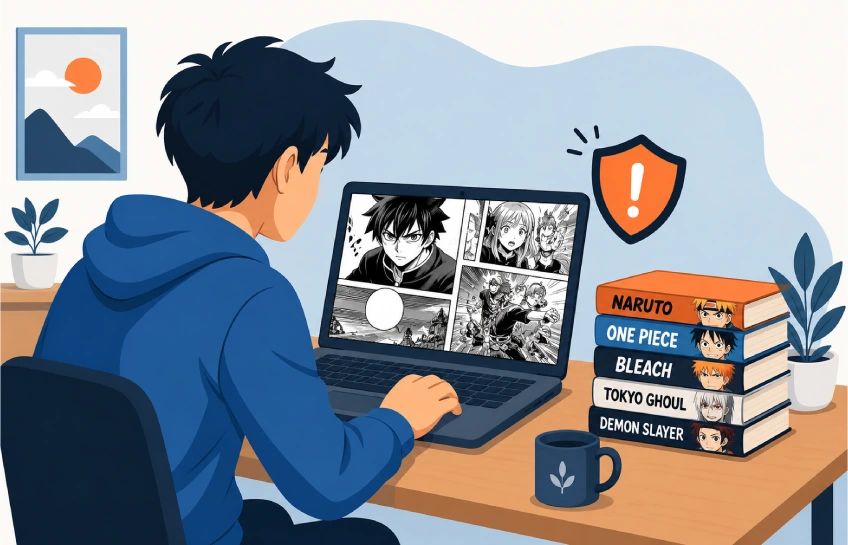
Mangago is not safe or legal to use. It hosts copyrighted manga without permission from publishers, and it relies on the same kind of ad networks that have gotten other manga piracy sites shut down and investigated by police this year. If you want to read manga without the legal and security risks, official platforms like VIZ Media and MANGA Plus give you a safer, faster, and honestly better experience.
Here is everything you need to know before you open that next chapter.
What Is Mangago?
Mangago is a free manga aggregator website. It does not create its own content. Instead, it collects scanlations — manga scanned and translated by fans — and hosts them for anyone to read without a subscription or login.
That is exactly why it feels so convenient. You search a title, click a chapter, and start reading in seconds. No paywall. No app download. No waiting for an official English release.
But that convenience comes from skipping a step almost every legal manga platform pays for: licensing.
Is Mangago Legal?
No, Mangago is not legal. It distributes copyrighted manga without authorization from the publishers or creators who own the rights, which is copyright infringement under most countries’ laws.
Why Scanlation Sites Break Copyright Law
Scanlations start with someone scanning physical manga pages or ripping digital ones, translating the text, and uploading the result online. Even though the translation work took real effort, the underlying artwork and story still belong to the original publisher.
Changing the language does not transfer ownership. It just creates what courts usually call a derivative work, and making derivative works without permission is still infringement.
Who Owns the Rights to Manga?
Most popular manga titles are owned by major Japanese publishers, including:
- Shueisha (One Piece, Jujutsu Kaisen, My Hero Academia)
- Kodansha (Attack on Titan, Fairy Tail)
- Square Enix (Tokyo Ghoul, Fullmetal Alchemist)
These publishers license their titles to official platforms for a fee. Sites like Mangago skip that fee entirely, which is a big part of why they can offer everything for free.
Is Mangago Safe to Use?
Mangago is not considered safe. Like most unlicensed manga sites, it depends on aggressive ad networks that are known for pop-ups, redirects, and malicious ads, and it does not follow the security standards that official apps and platforms are required to meet.
Ad and Malware Risks
Legal platforms make money through subscriptions or vetted advertising deals. Piracy sites usually cannot get those deals, so they turn to lower-quality ad networks instead. Some common issues readers report on sites like Mangago include:
- Pop-up ads that redirect to unrelated or suspicious pages
- Fake “download” or “update” buttons disguised as part of the site
- Browser notification spam that keeps showing up after you leave
- Ads linking to scam or adult sites
Not every visit ends badly, but the risk is real and it is higher than what you would face on an official app.
What Happened to Other Manga Piracy Sites in 2026
This is the part most older articles about Mangago miss. Two of the biggest manga piracy sites in the world were shut down in 2026, and both cases show that this kind of site is not as untouchable as it feels.
| Site | What Happened | When |
|---|---|---|
| Bato.to (Bato) | Once the world’s largest manga piracy site, with an estimated 350 million visits in a single month; shut down, with its operator under criminal investigation | Late January 2026 |
| TuMangaOnline | Major Spanish-language manga piracy platform; dismantled by Spanish police after a rights holder complaint, with over four million euros in revenue tied to the case | April 2026 |
Both cases started with a complaint from a rights holder or industry group, followed by an investigation, and ended with the site going offline. Mangago operates on the same basic model, which means it carries the same underlying legal exposure.
Could You Get in Trouble for Using Mangago?
Realistically, individual readers are rarely targeted directly. Most enforcement action goes after the people who run and profit from the site, not the people reading on it. Still, there are risks worth knowing:
- Site operators face the highest risk — criminal investigation, site seizure, and civil lawsuits from publishers, as seen with Bato.to and TuMangaOnline.
- Readers face lower but nonzero risk — copyright holders generally do not sue individual readers, but you have no protection if a site is compromised or your data is exposed.
- Everyone faces security risk — malicious ads and unsafe redirects do not care whether you are the site owner or just a visitor.
- Access can disappear without warning — as both 2026 shutdowns showed, a piracy site can vanish overnight, taking your reading history and bookmarks with it.
Legal Alternatives to Mangago
Switching to a licensed platform means official translations, no shady ads, and creators actually getting paid for their work.
| Platform | Price | Catalog | Best For |
|---|---|---|---|
| VIZ Media | Free (ads) or $1.99–$2.99/month | Shonen Jump titles, One Piece, Naruto | US readers wanting official Shonen Jump manga |
| MANGA Plus | Free | Simulpub chapters from Shueisha | Reading new chapters close to the Japan release date |
| Crunchyroll Manga | Included with Crunchyroll subscription | Wide manga and light novel library | Anime fans who already subscribe to Crunchyroll |
| ComiXology (Amazon) | Pay-per-volume or Kindle Unlimited | Huge back-catalog of completed series | Binge-reading full series at once |
| Webtoon | Free (ads) or coins for early access | Webtoons and manhwa | Vertical-scroll comics and Korean webtoons |
How to Switch to Legal Manga Reading
- Pick one or two official platforms that carry your favorite series.
- Check if your current series is available through Shonen Jump, MANGA Plus, or Crunchyroll before assuming it is not.
- Use free tiers first — several platforms let you read the latest chapters at no cost.
- Set up a reading list or favorites on the official app so you do not lose track of ongoing series.
- For completed series, check ComiXology or Kindle for full-volume purchases.
FAQs
Is Mangago down or shut down?
Mangago has faced downtime and mirror-site issues in the past, similar to other scanlation aggregators, but it has not been permanently shut down the way Bato.to and TuMangaOnline were in 2026.
Is it illegal to read manga on Mangago?
Reading on Mangago means accessing copyrighted content without the publisher’s permission, which falls under copyright infringement. Legal action against individual readers is uncommon, but the underlying activity is still against copyright law.
What is the safest way to read manga for free?
MANGA Plus and the free ad-supported tiers of VIZ Media and Webtoon are the safest free options, since they are officially licensed and do not rely on the risky ad networks found on piracy sites.
Why do sites like Mangago keep coming back after shutdowns?
Piracy aggregators often reappear under new domains or mirror sites after a shutdown, since the original operators can relaunch elsewhere. This is part of why publishers keep pursuing new legal action instead of expecting one shutdown to solve the problem.
Are scanlations ever legal?
Scanlations can be legal if the scanlator has direct permission from the rights holder, but this is rare. Most scanlations, including the ones hosted on aggregator sites, are unauthorized.
Conclusion
Mangago offers a huge, free manga library, but that convenience comes from skipping licensing fees and copyright law entirely. With Bato.to and TuMangaOnline both shut down in 2026, the risk tied to sites like Mangago is no longer just theoretical. Official platforms like MANGA Plus, VIZ Media, and Crunchyroll Manga now offer enough free content that switching does not have to cost you anything — except the ads and risk that come with piracy sites.

Other Articles

Herpesyl Reviews: Does This Herpes Supplement Really Work?
Mangago Not Working in 2026? 9 Fast Fixes That Work

No Comment! Be the first one.