

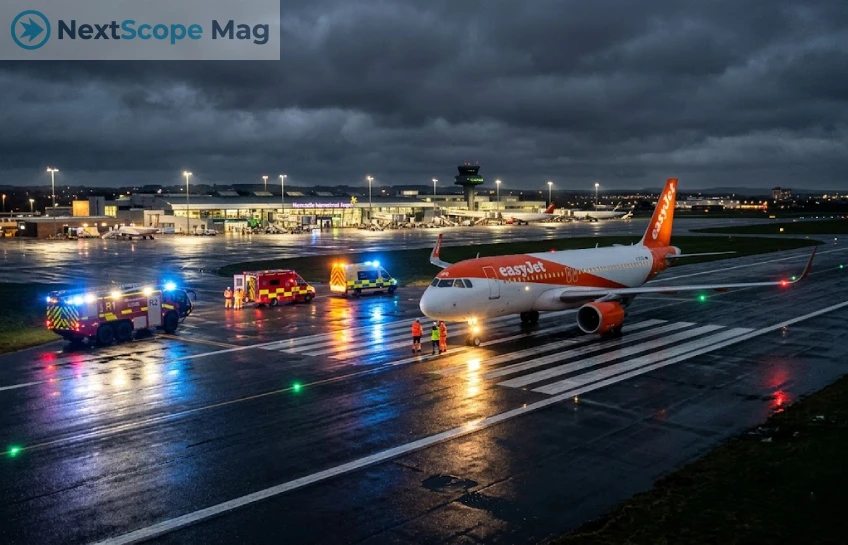
Overview of the EasyJet U2238 Emergency Landing
On the night of October 27, 2025, the easyjet flight u2238 emergency landing newcastle made headlines after a passenger fell critically ill over the North Sea. The Copenhagen-to-Manchester service diverted to Newcastle International Airport, where paramedics were waiting before the plane even touched down.
It wasn’t a crash. It wasn’t a technical failure. It was actually a textbook example of aviation doing exactly what it’s supposed to do — getting a sick person to hospital care as fast as possible while keeping everyone else safe.
The incident spread quickly online because the flight had broadcast Squawk 7700, the international emergency transponder code that aviation watchers track in real time. That code always triggers curiosity, and this time it brought tens of thousands of people to flight-tracking apps and news sites.
A quick note on flight codes: the diversion involved EZY2238 (also shown as U22238) — the Copenhagen-Manchester service. EasyJet runs a separate Newcastle-to-Bristol service under the shorter code U2238, which caused genuine confusion in several early published reports.
Flight Path and Timeline: From Copenhagen to Newcastle
The aircraft — an Airbus A320-214 registered G-EZPB — pushed back from Copenhagen Airport at 22:13 local time, already 28 minutes behind its scheduled 21:45 departure. It carried 178 passengers and six crew, filling 178 of the plane’s 180 seats.
Here’s how the evening unfolded:
| Time (CET / GMT) | Event |
|---|---|
| 22:13 CET | EZY2238 departs Copenhagen, 28 mins late |
| ~22:28 CET | Passenger falls ill ~15 mins after departure |
| ~22:33 GMT | Cabin crew alert flight deck; Squawk 7700 activated |
| 22:33 GMT | North East Ambulance Service dispatched to Newcastle Airport |
| 22:52 GMT | Aircraft lands on runway 25 at Newcastle |
| ~23:00 GMT | Paramedics board; passenger transferred to Royal Victoria Infirmary |
| ~00:10 GMT | EZY2238 departs Newcastle for Manchester |
| ~00:37 GMT | Aircraft lands in Manchester — 1 hour 43 minutes late |
The entire emergency response — from Squawk activation to wheels on the ground — took roughly 20 minutes. That’s a fast, coordinated chain of decisions across the flight deck, air traffic control, and Newcastle ground services.
Cause of the Diversion: A Medical Emergency On Board
The diversion happened because a passenger became seriously ill in flight. EasyJet classified the disruption as a “passenger welfare matter,” and confirmed in a formal statement that the flight diverted due to a customer requiring urgent medical attention.
Fifteen minutes after takeoff, while the aircraft was still climbing to cruising altitude, the passenger’s condition became serious. Cabin crew immediately brought out the onboard medical kit and provided oxygen support. Commercial aircraft carry structured emergency equipment for exactly this kind of situation — it’s not hospital-level care, but it’s designed to stabilise a patient until help arrives on the ground.
Once the cabin crew informed the pilots, the captain didn’t hesitate. The decision to divert was made quickly, and Newcastle was the logical choice:
- Manchester was still 30 minutes away
- Newcastle was the nearest airport with full emergency capabilities
- Ground services could be positioned before the plane landed
The passenger was taken to Newcastle’s Royal Victoria Infirmary for emergency treatment after landing.
What Happens When a Flight Declares a General Emergency?
When a pilot activates Squawk 7700, it sends an immediate signal to air traffic control that the aircraft needs priority handling. It’s an internationally recognised code — no spoken explanation required.
Here’s what typically follows once that code goes out:
- ATC clears the airspace. Other aircraft in the area are redirected or placed in holding patterns to make way.
- Emergency services are notified. The relevant airport activates its emergency plan while the aircraft is still in the air.
- Priority landing clearance is issued. The aircraft doesn’t queue — it goes straight in.
- Ground teams position themselves. Ambulances, fire engines, and police head to the runway.
In this case, Air France flight AFR1558 was placed in a holding pattern to clear the airspace for U2238’s approach. That’s standard procedure when a Squawk 7700 aircraft is given priority handling — other flights make way without question.
From the moment the emergency code was broadcast to touchdown at Newcastle, the response took roughly 20 minutes. That’s how coordinated the system is when it’s working properly.
Passenger Experience During the Emergency Landing
Most of the 177 passengers on board probably had little warning before the aircraft changed course. The cabin crew stayed calm, the captain made an announcement explaining the diversion, and the plane descended toward Newcastle without any reported panic.
The plane sat on the ground at Newcastle for approximately 70 minutes. Passengers stayed on board during that time while the crew managed the medical handover and the aircraft was refuelled. EasyJet sent a formal notification to passengers mid-diversion:
“We’re very sorry that your flight has now been diverted. This is due to a passenger welfare issue.”
After the 70-minute stop, the flight continued the 50-mile leg to Manchester. That 27-minute flight brought everyone to their intended destination in the early hours of October 28. No passengers were stranded overnight. The aircraft was cleared by engineers and back in service the same night.
EasyJet’s Response and Safety Record in Context
EasyJet confirmed the diversion publicly and framed it correctly — a medical emergency requiring immediate action, not a technical fault with the aircraft. The airline classified it as an extraordinary circumstance beyond their operational control, which carries specific legal weight under UK passenger rights rules.
The G-EZPB aircraft had no reported technical issues. It was nine years old at the time, having been delivered to easyJet on 18 February 2016, and had been in continuous service. The diversion had nothing to do with the plane’s condition.
It’s worth mentioning that Newcastle has appeared in easyJet emergency news before. In 2017, an easyJet flight diverted to Newcastle due to smoke in the cockpit traced to an overheated voltage converter. That incident is still referenced online whenever a new easyJet emergency near Newcastle surfaces, which sometimes blurs search results between technical faults and medical diversions. The 2025 U2238 diversion was strictly a medical emergency.
Role of Newcastle Airport and Emergency Services
Newcastle International Airport handled this exactly as it’s supposed to. The moment Squawk 7700 was broadcast and the diversion was confirmed, the airport activated its emergency plan.
North East Ambulance Service paramedics were dispatched at 22:33 GMT — about 19 minutes before the aircraft landed. By the time G-EZPB taxied in, medical teams were already at the gate. Paramedics boarded immediately and transferred the passenger to the Royal Victoria Infirmary.
This kind of readiness comes from regular emergency drills. Airports with commercial traffic run these exercises routinely, so when a real emergency arrives, every team knows their exact position and role. There’s no figuring it out on the night.
Fire services and police were also on standby, as is standard procedure for any Squawk 7700 arrival.
Passenger Rights After an Emergency Diversion
This is where a lot of people get confused, so it’s worth being clear.
Can you claim compensation for the U2238 diversion?
Probably not in cash. Under UK261 — the UK’s air passenger rights regulation, aligned with EU Regulation 261/2004 — airlines don’t owe financial compensation when a delay is caused by an extraordinary circumstance. A passenger medical emergency qualifies as exactly that.
There’s a second reason the compensation threshold wasn’t met here: EZY2238 arrived in Manchester approximately one hour and 43 minutes late, which is below the three-hour minimum required to trigger a financial claim independently.
What passengers are still entitled to:
- Meals and refreshments proportionate to the waiting time
- Communication access (calls, emails) during the delay
- Hotel accommodation if an overnight stay was necessary
- Transport to the hotel or to the final destination
Anyone who bought food or made calls at Newcastle out of pocket has the right to submit a reimbursement claim to easyJet with receipts. That “Right to Care” entitlement remains active even when cash compensation doesn’t apply.
If you were on this flight, here’s what to do:
- Keep receipts for any costs incurred at Newcastle Airport
- Submit a claim via easyJet’s customer service within the standard timeframe
- If easyJet doesn’t respond, escalate to the Civil Aviation Authority (CAA)
- Check your travel insurance policy — some policies cover disruption regardless of airline liability
Don’t expect a cash payout for the diversion itself, but do pursue reimbursement for genuine out-of-pocket expenses.
Key Takeaways for Passengers and Future Travellers
The easyjet flight u2238 emergency landing newcastle is, at its core, a story about things going right. A passenger became seriously ill over the North Sea. Within 15 minutes, the crew had responded correctly. Within 20 minutes, the plane was on the ground at Newcastle. Within an hour, the passenger was in a Level 1 trauma centre.
That’s the system working.
A few things worth taking away if you fly regularly:
- Medical diversions are uncommon but not rare. Hundreds happen across Europe every year. Airlines prepare for them constantly.
- Squawk 7700 doesn’t mean catastrophe. It’s an emergency code, but “emergency” in aviation covers a wide range of situations. The crew’s job is to escalate early and often.
- You don’t lose all your rights in a diversion. No cash compensation for extraordinary circumstances, but the Right to Care still applies. Keep receipts.
- Newcastle Airport is well-equipped. Its proximity to a major hospital and its trained emergency response made it the right call on the night.
If your flight is ever diverted for a medical reason, stay calm, listen to the crew, and know that the system around you has been preparing for exactly that moment. Everyone on U2238 got home safely — and that’s the point.
Thinking about flying with easyJet soon? Check their official flight status tool before you travel, and make sure your travel insurance covers unexpected diversions. It’s a small step that makes a big difference if the unexpected ever happens to you.

Other Articles
Do You Have Irish Curls? Here’s What You Need To Know

No Comment! Be the first one.