

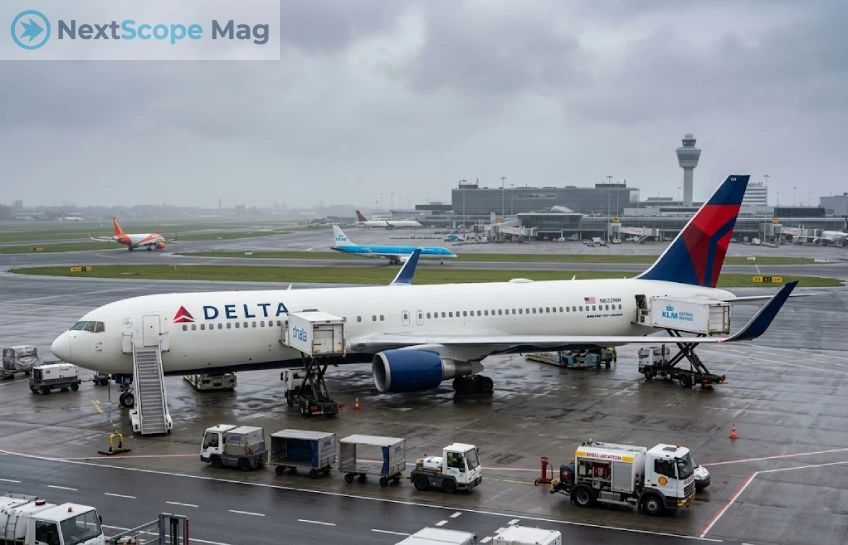
On June 30, 2025, Delta flight DL139 departed Venice on a routine transatlantic run to Atlanta. Less than two hours later, it landed in Amsterdam instead. If you were on that flight — or just trying to make sense of the delta dl139 venice atlanta diversion amsterdam story — here’s everything that actually happened, and what comes next for affected travelers.
Overview of Delta Flight DL139
Delta flight DL139 is a daily long-haul service between Venice Marco Polo Airport (VCE) and Hartsfield-Jackson Atlanta International Airport (ATL). It’s one of Delta’s key routes connecting southern Europe to the American Southeast during peak summer travel season.
The aircraft assigned to this route is typically a Boeing 767-400ER — a wide-body, twin-engine jet built for long transoceanic crossings. On June 30, 2025, registration N830MH operated the flight. That specific airframe is around 24.8 years old, putting it among the older active jets in Delta’s transatlantic fleet.
What route DL139 usually flies
The route covers roughly 4,900 miles from northeastern Italy to Georgia. Under normal conditions, it takes about 10 hours in the air. Passengers on this flight are mainly tourists wrapping up European vacations, business travelers, and connecting passengers from other Italian cities.
Aircraft type and typical schedule
The Boeing 767-400ER has a range of over 6,000 miles, so a Venice–Atlanta crossing is comfortably within its limits. Delta uses this type heavily on its European routes, and it’s generally considered reliable for transatlantic service. Flight DL139 departs Venice in the morning and arrives in Atlanta in the early afternoon local time.
Timeline: What Happened on June 30, 2025
The DL139 diversion to Amsterdam unfolded quickly. The crew didn’t have hours to deliberate — they noticed something, assessed it, and acted within a tight window.
Here’s how the sequence played out:
- 9:43 UTC — DL139 lifts off from Venice Marco Polo Airport (VCE), bound for Atlanta
- ~10:45–11:00 UTC — Around one hour into the flight, the crew responds to a technical alert at cruising altitude over Europe
- 11:14 UTC — The Boeing 767-400ER lands on Runway 06 at Amsterdam Airport Schiphol (AMS)
- Post-landing — The aircraft is directed to a remote stand, away from the main terminal
- Later that day — Delta confirms the flight to Atlanta is canceled; passengers need rebooking
The whole diversion from alert to touchdown took roughly 1 hour and 35 minutes from departure. That’s a fast turnaround for a major route change on a transatlantic flight.
Departure from Venice Marco Polo Airport
The flight left on schedule from VCE that Monday morning. There were no reported issues at departure. Passengers boarded expecting a standard 10-hour crossing to Atlanta.
When and where the flight changed course
Roughly an hour after takeoff, the crew detected what’s described as a possible technical issue or minor alert. At that point, the aircraft was still over or near European airspace — well before the mid-Atlantic point of no return. The crew decided not to continue and turned toward Amsterdam.
Landing at Amsterdam Schiphol and remote stand parking
The aircraft came down on Runway 06 at Schiphol and was parked at a remote stand rather than a jetway gate. A remote stand means passengers typically exit via airstairs onto the tarmac and board a bus to the terminal. It’s a standard procedure for unplanned arrivals and doesn’t indicate any ongoing emergency.
Why the Flight Diverted to Amsterdam
Diversions happen when the crew determines it’s safer to land than to continue. In this case, the decision was precautionary — not a declared emergency.
The crew of DL139 received a technical alert shortly after entering cruise. Delta hasn’t publicly specified the exact nature of the fault, which is normal. Airlines rarely detail maintenance specifics before a full technical review. What’s confirmed is that the issue was described as minor or possible, and the diversion was a precautionary choice.
How pilots decide to divert a long-haul flight
When something flags in the cockpit, pilots follow strict checklists. They weigh the severity of the alert, the aircraft’s current position, weather at nearby airports, fuel load, and the safest place to land. On this flight, the crew was still over Europe with plenty of airport options — continuing across the Atlantic with an unresolved alert wasn’t the call they made.
Why Amsterdam Schiphol was the logical choice
Schiphol is one of the largest and best-equipped airports in Europe. It has 24-hour maintenance facilities, wide runways, and direct access to Delta’s network for passenger rebooking. For a flight that departed northeastern Italy and was heading northwest over Europe, Amsterdam sits right along the natural flight path — it wasn’t far out of the way, and it offered everything the crew needed.
Reported technical alert — what we know
Delta hasn’t confirmed the specific fault. Some reports mention a possible cockpit warning light related to aircraft systems, but none of these details have been officially verified. The Boeing 767-400ER stayed on the ground in Amsterdam for around 23 hours while technical crews assessed it. That length of ground time suggests a thorough inspection rather than a quick fix.
What Happened to Passengers on DL139
Once the aircraft landed, passengers on DL139 faced a significant disruption. The flight to Atlanta didn’t resume that day.
Delta confirmed the cancellation of the remaining leg to ATL. That left over 200 passengers stranded at Schiphol needing new arrangements. Here’s what the situation looked like:
- Passengers deplaned via the remote stand and were bused to the terminal
- The flight was formally canceled — not delayed — for the remainder of June 30
- Travelers needed to be rebooked onto later Delta services or partner flights
- Those with onward connections from Atlanta faced a cascade of missed flights
Onboard communication and immediate steps at the airport
The first thing to do at the airport during an unplanned diversion is to speak with airline staff or use the airline’s app to start the rebooking process. Long lines form quickly after a mass diversion. Passengers who acted fast — either at the gate or through Delta’s app — typically got better options than those who waited.
Rebooking and onward travel
Delta’s standard procedure after a cancellation is to rebook passengers on the next available flight to their final destination at no additional cost. From Amsterdam, options include:
- Later Delta flights from AMS or nearby hubs
- Partner airline flights via SkyTeam
- Alternate routing through other European hubs like Paris CDG or London LHR
Passengers could also request a full refund if they chose not to travel.
Safety, Diversions, and Boeing 767 Operations
A diversion like this one isn’t a sign that something went catastrophically wrong. In aviation, it’s actually the opposite — it’s the safety system working exactly as designed.
Pilots are trained to treat any unverified cockpit alert as real until proven otherwise. The threshold for a precautionary diversion is deliberately low. It’s far better to land and inspect than to spend 8+ hours over the Atlantic with an unresolved warning.
How diversions protect passengers and crew
The goal is always to land at the nearest suitable airport when there’s any uncertainty. Modern aircraft systems generate alerts at the first sign of deviation from normal parameters. That early warning gives crews time to act calmly, rather than reactively.
Boeing 767-400ER capabilities and safety procedures
| Spec | Detail |
|---|---|
| Aircraft type | Boeing 767-400ER |
| Registration | N830MH |
| Age (at time of incident) | ~24.8 years |
| Range | 6,385 miles / 10,270 km |
| Engines | 2 × Pratt & Whitney PW4062 |
| Typical capacity | ~240–304 passengers |
| Common Delta routes | Transatlantic Europe–USA |
The 767-400ER has a strong safety record. Age alone doesn’t make an aircraft less safe — Delta’s maintenance schedule for this fleet is FAA-regulated and extensive.
Maintenance checks after a precautionary landing
After any diversion triggered by a technical alert, the aircraft undergoes a full inspection before returning to service. Engineers review the flight data, check the flagged system, and sign off on airworthiness before the plane flies again. The 23 hours N830MH spent on the ground at Schiphol fits that pattern.
Passenger Rights and Compensation (EU261 and Delta Policies)
This is where things get practical. Because DL139 departed from Venice — an EU airport — EU Regulation 261/2004 applies. That’s true even though Delta is a US carrier.
When EU261 applies to US carriers departing the EU
EU261 covers any flight departing from an EU airport, regardless of which airline operates it. Since DL139 left from Italy, Delta passengers on this flight are entitled to EU261 protections. Here’s a quick breakdown:
- Right to care: Delta must provide meals, refreshments, and hotel accommodation if passengers are stuck overnight
- Right to rebooking or refund: Passengers can choose a replacement flight or a full ticket refund
- Right to compensation: For cancellations within the airline’s control, passengers may claim between €250 and €600 per person depending on flight distance
A Venice–Atlanta flight exceeds 3,500 km, which puts potential compensation at €600 per passenger — assuming the cancellation wasn’t caused by “extraordinary circumstances” beyond Delta’s control.
Does a technical issue count as extraordinary circumstances?
This is where it gets nuanced. EU courts have generally ruled that technical issues that arise from normal aircraft operation — not freak accidents or manufacturer defects — don’t qualify as extraordinary circumstances. That means passengers likely have a strong basis for a compensation claim in this case.
Hotel, meals, and duty of care after a diversion
Under EU261, Delta was obligated to provide:
- Meals and refreshments during the wait
- Hotel accommodation for passengers stuck overnight
- Transport between the airport and the hotel
- Two free communications (calls, emails)
If Delta didn’t provide these automatically, passengers can claim reimbursement for reasonable out-of-pocket costs by submitting receipts.
Refunds, rebooking, and travel insurance claims
Passengers who didn’t fly to Atlanta can request a full refund through Delta’s website. Those who had travel insurance should file a claim for trip interruption, covering costs like last-minute hotel stays, meals, and any non-refundable bookings affected by the delay.
How to Check Flight Status and Verify Flight Incidents
If you’re trying to confirm what happened with DL139, or track a current flight in real time, a few tools make this easy.
Using flight trackers for DL139
- FlightAware (flightaware.com) — shows live and historical flight paths, departure/arrival times, and diversion data
- FlightRadar24 (flightradar24.com) — real-time ADS-B tracking; you can replay the exact path DL139 took on June 30
- AirPaz — useful for checking scheduled vs. actual flight data by route or flight number
On FlightRadar24, the June 30 flight shows DL139 departing Venice at 9:43 UTC and landing at Schiphol at 11:14 UTC — a clear detour before ever reaching the Atlantic.
Cross-checking news and official sources
For incident verification, check:
- AirLive (airlive.net) — one of the first outlets to report the DL139 diversion
- Delta’s official newsroom — for any formal statements on the incident
- Aviation A2Z and Simple Flying — solid secondary sources for technical context
What “diverted,” “canceled,” and “returned to gate” actually mean
These terms get mixed up often:
- Diverted = the aircraft landed at an airport other than the planned destination
- Canceled = the flight will not continue to the original destination that day
- Returned to gate = the aircraft went back to the departure airport before the flight ended
DL139 was diverted (to AMS) and then canceled. It didn’t return to Venice.
Practical Tips If Your Long-Haul Flight Gets Diverted
If you’re ever in a situation like the passengers on DL139, here’s what to do right away.
Immediate steps at the airport
- Open the airline’s app immediately — rebooking options often appear there before staff can help you at the counter
- Call the airline’s customer service line — hold times are long, but it’s worth queuing while you also wait in person
- Document everything — take photos of departure boards, keep all receipts for food, transport, and hotel
- Ask specifically for a written statement from staff confirming the cancellation and the reason
How to talk to the airline about options
Be clear about your final destination and your flexibility. Ask about:
- The next available direct or connecting flight
- Whether there are SkyTeam partner options (Air France, KLM, Alitalia, etc.)
- Whether Delta will cover overnight accommodation costs
If Delta’s staff can’t help on the spot, follow up in writing via their customer service portal with all your documentation.
Keeping records for future claims
Save everything: boarding passes, receipts, screenshots of app notifications, and any written communication from Delta. EU261 claims can be filed up to 6 years after the incident in some EU countries. It’s worth starting the process as soon as you’re home.
The delta dl139 venice atlanta diversion amsterdam incident is a solid reminder that precautionary diversions are the safest outcome when something flags in the cockpit. No one was hurt, the aircraft landed without incident, and the systems worked as they should. For passengers, the disruption was real — missed connections, a canceled transatlantic flight, a night in Amsterdam they didn’t plan for. But the rights framework is there: EU261 gives DL139 passengers a strong basis for compensation and full reimbursement of out-of-pocket costs.
If you were on this flight, start your claim now. And if you just want to stay informed on future disruptions, set up a flight alert through FlightAware before your next long-haul trip.


No Comment! Be the first one.