

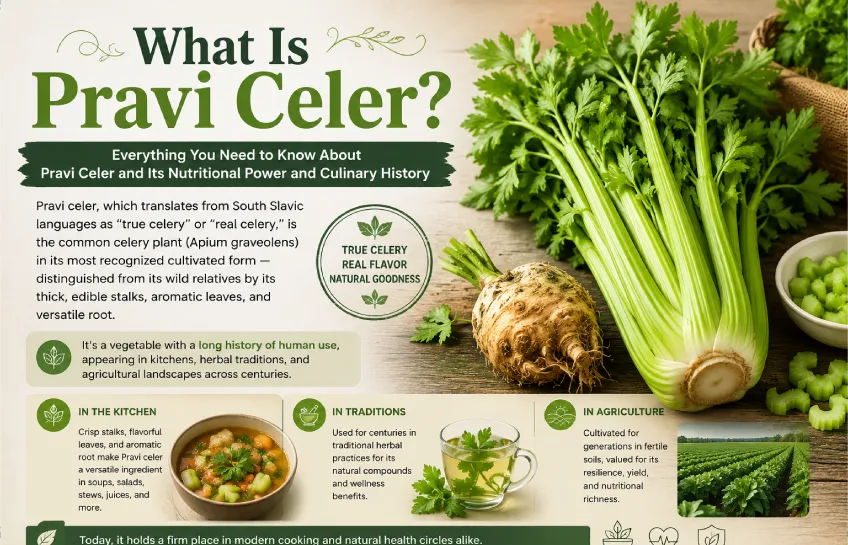
Pravi celer, which translates from South Slavic languages as “true celery” or “real celery,” is the common celery plant (Apium graveolens) in its most recognized cultivated form — distinguished from its wild relatives by its thick, edible stalks, aromatic leaves, and versatile root. It’s a vegetable with a long history of human use, appearing in kitchens, herbal traditions, and agricultural landscapes across centuries. Today, it holds a firm place in modern cooking and natural health circles alike.
Origin and Historical Background of Pravi Celer
Celery’s roots go back to the ancient Mediterranean world. Wild forms of the plant grew across southern Europe and parts of Asia, and early records from ancient Egypt, Greece, and Rome show it was valued more for its medicinal qualities than as food. The Greeks called it selinon and used it in funeral rites; Roman soldiers reportedly wore garlands of it. The cultivated version — what we now call pravi celer — developed gradually through selective growing over many generations.
By the 17th century, Italian farmers had refined the plant into the crunchy, pale-stalked vegetable familiar today. It spread through Europe and later to the Americas, where it became a kitchen staple. Its journey from wild herb to domesticated crop is one of the longer ones in vegetable history.
What “Pravi Celer” Actually Means
The phrase comes from South Slavic linguistic traditions — particularly Serbian, Croatian, and Bosnian — where celer refers to celery and pravi means “real” or “true.” The distinction matters because there are several celery-related plants, including celer koren (celeriac, or root celery) and lisnatsi celer (leaf celery). Pravi celer specifically refers to the stalk-dominant variety, the one sold in bunches at markets with long green ribs and leafy tops.
This naming reflects a broader European habit of distinguishing plant varieties by their most prominent edible part. It helps home cooks and growers know exactly what they’re dealing with at a glance.
Main Characteristics of the Pravi Celer Plant
Pravi celer is a biennial plant, though it’s almost always grown as an annual for harvest. It produces a dense cluster of upright stalks rising from a compact base, with each stalk ribbed and slightly curved. The color ranges from deep green to pale yellow depending on whether it’s been blanched during growth. The leaves are serrated and strongly aromatic.
The plant reaches about 30 to 60 centimeters in height when mature. Its smell — sharp, green, slightly bitter — comes from a compound called phthalide, which is responsible for much of its flavor too. That distinctive scent is one of the clearest ways to identify fresh, quality pravi celer over older or wilted specimens.
Varieties and Types of Celery
There are three broad categories of cultivated celery worth knowing. Stalk celery, or pravi celer, is the type most people picture — the long, crunchy ribs used raw in salads or cooked in soups. Celeriac (celer koren) is grown primarily for its large, knobby root and has a more concentrated flavor. Leaf celery (lisnatsi celer) produces thinner stalks but abundant foliage, and it’s favored in Asian cooking.
Within pravi celer itself, there are dozens of cultivars. Some are bred for early harvest, others for disease resistance or tolerance to cold. Popular varieties include Utah, Tall Utah, and Golden Self-Blanching, each with slightly different growth habits and flavor profiles.
Nutritional Value of Pravi Celer
Pravi celer is low in calories — a medium stalk contains around 6 to 10 calories — but it delivers a reasonable amount of vitamins and minerals relative to its size. It’s a solid source of vitamin K, which supports bone health and proper blood clotting. It also contains folate, potassium, vitamin C, and small amounts of calcium and magnesium.
The plant’s high water content (roughly 95%) makes it naturally hydrating. It also provides dietary fiber, particularly in the stalks, which aids digestion. For people tracking their food intake carefully, it’s one of the most nutrient-dense foods by calorie count available.
Health Benefits Linked to Pravi Celer
Research into celery’s health effects has grown considerably in recent years. One of the more studied compounds is apigenin, a plant flavonoid found in celery leaves and seeds that has shown anti-inflammatory properties in lab studies. Phthalides, mentioned earlier, have also been investigated for their potential to support healthy blood pressure by relaxing arterial walls.
Celery seed extract has been used in traditional medicine across Eastern Europe and South Asia for conditions ranging from joint pain to urinary tract issues. While clinical evidence is still building, the existing research is enough to explain why pravi celer keeps appearing in health-focused diets. It’s not a cure-all, but it’s far from an empty vegetable either.
Cultural Significance Across Regions
In the Balkans and broader Southeast Europe, celer has a deep presence in home cooking. It’s almost always part of a sofrito base — the mixture of onion, carrot, and celery used to start soups, stews, and sauces. This combination, known in Italian as soffritto and in French cuisine as mirepoix, is so fundamental that home cooks often keep celery stocked year-round.
Pravi celer also appears in traditional folk medicine across Serbia, Croatia, and neighboring countries, often prepared as a tea from the leaves or seeds. Older generations have long used it for its supposed diuretic and cleansing properties, practices that predate modern nutritional science by several centuries.
Role of Pravi Celer in Cooking
Few vegetables are as useful across such a range of cooking methods. Raw pravi celer adds crunch and a clean, slightly bitter note to salads and crudité platters. Cooked, it softens considerably and releases a sweeter, more mellow flavor that forms the background of countless soups and braises. It’s one of the three vegetables in the classic mirepoix base, a foundation of French and broader European cooking.
Celery leaves, often discarded, are actually full of flavor and work well as an herb — chopped and scattered over finished dishes the way you’d use parsley. Celery seeds, ground or whole, are a common spice in pickling brines, dressings, and seasoning blends. None of the plant needs to go to waste.
Growing Pravi Celer at Home or in the Garden
Celery is not the easiest vegetable to grow, but it’s manageable with the right conditions. It needs consistently moist soil, cool temperatures during most of its growth, and a long growing season — typically 100 to 140 days from transplant to harvest. Starting seeds indoors 10 to 12 weeks before the last frost gives the plant enough of a head start.
Soil should be rich in organic matter and drain well without drying out. Blanching — the practice of blocking sunlight from the stalks by wrapping or hilling — produces paler, less bitter celery, which is what most supermarkets sell. Unblanched celery is greener and stronger in flavor, preferred by many home growers who want more intensity in their cooking.
Modern Trends and Growing Popularity
Celery has had an unusual resurgence in popular culture over the past decade. The so-called celery juice trend — drinking a glass of straight celery juice on an empty stomach — went viral in health communities around 2017 and 2018, driven largely by social media. Proponents claimed benefits ranging from improved digestion to clearer skin, though most of these claims lack rigorous scientific support.
Still, the trend pushed celery consumption up noticeably in several countries and introduced a new generation of consumers to the vegetable. It also sparked more research into celery’s bioactive compounds. Whether the juice trend continues or fades, it brought genuine attention to a plant that had quietly been one of the world’s most commonly used vegetables for decades.
How to Select and Store Pravi Celer
When buying pravi celer, look for stalks that are firm, not limp or rubbery, with leaves that are bright and green rather than yellowed. Stalks should snap cleanly when bent — that’s a sign of freshness. Avoid bunches where the base looks cracked or the outer stalks are heavily bruised.
At home, wrap celery loosely in foil or store it in a container with a little water, like cut flowers. Properly stored in the fridge, it keeps for one to two weeks. Chopped celery can be frozen after a quick blanch, though it will lose its crunch and is only suitable for cooked applications after that.
Safety and Precautions When Using Pravi Celer
For most people, celery is completely safe eaten in normal food quantities. However, celery is listed among the top allergens in the European Union, and reactions can range from mild oral tingling to serious anaphylaxis in sensitive individuals. People with known allergies to related plants — like parsley, parsnip, or fennel — should approach celery with some caution.
Celery also contains compounds called furanocoumarins, which can cause skin sensitivity to sunlight if the fresh plant juice contacts skin. This is more of a concern for people who harvest or handle large quantities regularly. For the average home cook, it’s not something that requires any special precautions.
Environmental Importance and Sustainability
Celery is a relatively resource-intensive crop to grow commercially. It needs consistent irrigation, and large-scale production can put pressure on water supplies in drier regions. That said, it’s also a crop that can be grown in smaller-scale, water-efficient systems when managed carefully.
From a sustainability angle, pravi celer is one of the better vegetables to buy locally and seasonally. Regional growers in cooler climates often produce excellent quality celery without the environmental cost of long-distance shipping. Growing it at home is also very achievable, reducing packaging and transport impact entirely.
Common Mistakes People Make With Pravi Celer
One of the most common errors is throwing away the leaves. The leafy tops of pravi celer are edible, flavorful, and nutritious — discarding them wastes a significant portion of the plant. They can be used wherever you’d use an herb, or tossed into soups and stews.
Another mistake is overcooking it. Celery cooked for too long turns mushy and loses whatever texture it had, which makes it unpleasant in dishes where it should add some body. In a soup or stew, add it earlier for background flavor, but if you want noticeable pieces in the finished dish, it should go in during the last 15 to 20 minutes of cooking.
Future Outlook for Pravi Celer
Interest in plant-based eating continues to grow, and pravi celer fits naturally into that direction. It’s versatile, low-calorie, inexpensive, and available year-round in most markets. Researchers are continuing to study its bioactive compounds, and there’s real potential for more targeted findings on its anti-inflammatory and cardiovascular effects in the coming years.
On the culinary side, chefs and food writers are paying more attention to using whole vegetables — stalks, leaves, seeds, and all — which aligns perfectly with how pravi celer can be used. It’s unlikely to disappear from kitchens anytime soon.
Final Thoughts on Pravi Celer
Pravi celer has earned its place as a kitchen essential through centuries of practical use. It’s not glamorous, it’s not expensive, and it doesn’t require much fuss — but it consistently delivers in flavor, nutrition, and versatility. Whether you’re building a base for a slow-cooked stew, eating it raw with a dip, or experimenting with celery juice, this is a vegetable that rewards attention.
The more you understand about what pravi celer is, how it grows, and what it contains, the easier it is to use it well. That knowledge makes the difference between treating it as an afterthought and actually getting the most out of every bunch you bring home.
Frequently Asked Questions About Pravi Celer
What exactly is pravi celer?
Pravi celer is the South Slavic term for common stalk celery (Apium graveolens), distinguishing it from celeriac (root celery) and leaf celery. It refers specifically to the variety grown for its long, edible stalks. The word pravi means “real” or “true,” used to identify this as the main cultivated form.
Is pravi celer good for your health?
Yes, it offers genuine nutritional benefits — it’s low in calories, high in water content, and contains vitamins K, C, and folate, plus anti-inflammatory plant compounds. Research into its bioactive components like apigenin and phthalides is ongoing. It’s a healthy addition to a balanced diet, though it shouldn’t be treated as a medicine on its own.
How do you store pravi celer to keep it fresh?
Keep it in the refrigerator, either wrapped loosely in foil or standing upright in a container with a small amount of water. Stored properly, it stays fresh for one to two weeks. Don’t wash it until you’re ready to use it, as moisture speeds up deterioration.
Can you eat all parts of pravi celer?
Yes — the stalks, leaves, and seeds are all edible and useful. The leaves are particularly underused; they work well as an herb, added to soups, salads, or as a garnish. Celery seeds, available as a spice, are used in pickling brines, dressings, and seasoning blends.
What’s the difference between pravi celer and celeriac?
Pravi celer is grown for its stalks, while celeriac (celer koren) is cultivated primarily for its large, dense root. They come from the same species but are different cultivars with distinct uses. Celeriac has a more concentrated, earthy flavor and is often roasted, mashed, or used raw in slaws, whereas pravi celer is more commonly eaten raw in salads or cooked in soups and stews.



No Comment! Be the first one.