

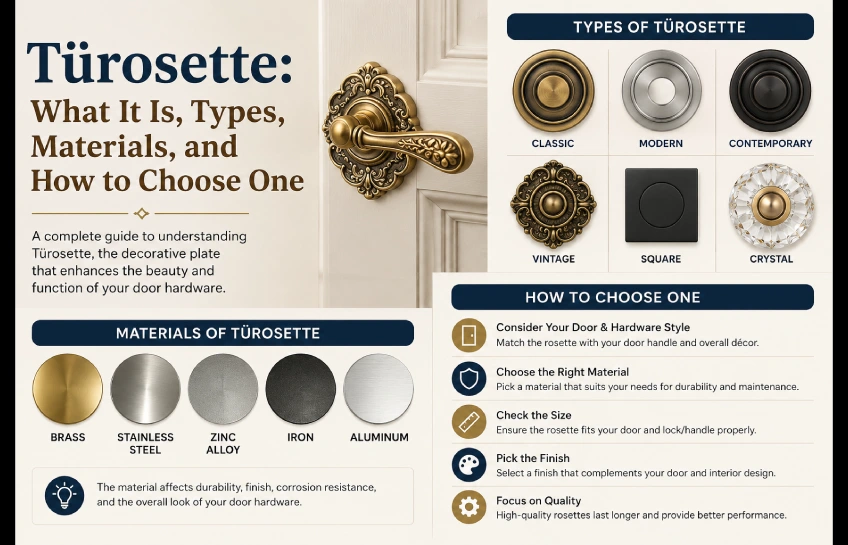
Most people renovating a room spend hours picking the right door handle and forget entirely about the türosette sitting beneath it. That’s a mistake. A türosette — the small plate fitted around a door handle spindle or keyhole — affects how your door looks, how long the surface around the handle lasts, and in some cases, how secure the lock is.
This guide covers everything: what a türosette actually does, which types exist, what materials hold up over time, how installation works, and how to match one to your door style without getting it wrong.
What Exactly Is a Türosette?
A türosette is a cover plate — typically circular, though square and oval versions exist — fitted around the base of a door handle or around a keyhole. It sits flush against the door surface and conceals the hole through which the spindle or lock mechanism passes.
The word comes from German. Tür means door, and Rosette refers to a round decorative plate. In English, the closest equivalent terms are “door rosette” or “door furniture” — a broad category that includes handles, knockers, letter plates, and rosettes.
Unlike a long door backplate, which covers both the handle and the keyhole in one piece, a türosette works as a standalone component. The handle rosette and keyhole rosette are separate, which is why this style looks cleaner on modern doors.
Why a Türosette Matters More Than You’d Think
It’s tempting to treat a türosette as an afterthought. Don’t. Here’s what it actually does:
- Protects the door surface — Door handles get used dozens of times daily. Without a rosette, the area around the spindle hole scratches, chips, and wears out noticeably faster.
- Hides mounting hardware — Screws, fixing brackets, and the spindle hole itself all disappear under the rosette cover, giving the door a much cleaner look.
- Adds a security layer — Cylinder rosettes, specifically, wrap around the lock core and resist drilling and pull attacks. On an exterior door, this matters.
- Simplifies upgrades — You can swap a damaged or outdated türosette without replacing the whole handle set. That alone saves time and money.
The 4 Main Types of Türosette
Handle Rosette (Drückerrosette)
This is the most common type. A Drückerrosette surrounds the door handle spindle and comes in pairs — one for each side of the door. It’s what you’ll find on almost every interior door in a modern home or office.
Keyhole Rosette
A keyhole türosette frames a traditional lock opening, most often seen on older doors or period-style hardware. It’s purely protective and decorative — it doesn’t interact with the lock mechanism directly.
Cylinder Rosette
Cylinder rosettes are designed for doors fitted with a profile cylinder lock. They wrap tightly around the cylinder and often include anti-tamper features. These are standard on apartment entrance doors and most external residential doors.
Security Rosette (Sicherheitsrosette)
A security rosette takes the cylinder rosette concept further. It’s made from hardened steel, resists drilling, and has a rotating outer ring that prevents the rosette itself from being gripped with pliers. If you’re replacing hardware on a front door, this is worth the extra cost.
Materials: Which One Should You Actually Buy?
The material determines durability, appearance, and price. Here’s how the common options compare:
Stainless steel is the strongest all-round choice. It doesn’t rust, it holds its finish well, and it suits contemporary interiors without looking out of place in classic ones. Brushed stainless is particularly forgiving — it doesn’t show fingerprints the way polished surfaces do.
Brass works well in traditional interiors. Polished brass looks formal and warm. Antique or aged brass suits heritage properties. The downside is that some lower-grade brass türosette products tarnish faster than advertised, so check whether the finish is lacquered or unlacquered before buying.
Zinc alloy sits in the middle — cheaper than stainless or brass, but capable of more complex shapes. It’s widely used in designer-style door hardware.
Aluminum is lightweight and budget-friendly. It’s fine for internal doors with low traffic, but it dents and wears faster than steel or brass under heavy use.
Plastic is the most affordable option and the least durable. It works for low-use interior doors but looks cheap in most settings.
Shapes and Finishes Worth Knowing
Most people picture a round türosette, and round is still the most common. But the shape you choose affects how your door hardware reads visually.
- Round rosettes match almost anything and are the safest pick if you’re unsure.
- Square rosettes fit contemporary and minimalist interiors particularly well. Paired with a lever handle, they give doors a very clean, geometric look.
- Oval rosettes are less common and tend to appear in decorative or period-style hardware sets.
Finishes currently popular in home hardware include matte black, brushed nickel, satin brass, and chrome. Matte black has surged in popularity for modern interiors — it’s low-maintenance and photographs well if you’re staging a property.
Türosette vs. Long Door Backplate: Which Is Better?
Both options work, and the right answer depends on the style you want:
| Feature | Türosette | Long Door Plate |
|---|---|---|
| Look | Minimalist, modern | Traditional, classic |
| Installation | Two separate components | Single piece |
| Design flexibility | High | Limited |
| Replacement | Easy, component by component | Requires full set change |
| Common use | Contemporary interiors | Period or formal spaces |
If you’re working with a modern door — flat panel, clean lines, neutral finish — a türosette almost always looks better. Long backplates suit Victorian, Georgian, or rustic-style doors where the heavier hardware feels appropriate.
How to Install a Türosette (Step by Step)
Installation is straightforward and doesn’t require specialist tools for most door types.
- Remove the existing handle and hardware. Use a screwdriver to detach the handle set from both sides of the door.
- Slide the mounting plate onto the spindle. Most türosette systems have a base plate that attaches directly to the door with small screws.
- Secure the mounting plate. Tighten the fixing screws firmly but don’t overtorque — this can crack thinner rosette covers.
- Attach the decorative cover. The visible rosette snaps or screws onto the mounting plate. Some designs use a concealed grub screw on the side.
- Refit the handle. Pass the spindle through the rosette and secure the handle on both sides.
- Test the handle. Check that the lever moves freely and that the rosette sits flush against the door with no gaps.
For cylinder rosettes on external doors, the process is the same but also involves removing and refitting the profile cylinder. If the lock cylinder needs adjustment, that’s worth checking before you close the door.
FAQ
What does türosette mean in English? Türosette is a German term that translates roughly to “door rosette.” In English-speaking countries, it’s often called a door rosette, handle rosette, or door escutcheon. All refer to the same type of cover plate fitted around a door handle or keyhole.
Can I use a türosette on any door? Most standard türosette sets fit doors with a standard backset and spindle hole spacing, but you should always check measurements before ordering. The spindle hole diameter, door thickness, and handle spacing all affect compatibility.
Is a security türosette worth buying for a front door? Yes, if your front door uses a profile cylinder lock. A reinforced security rosette protects the cylinder from physical attack methods like drilling and pulling. It’s a low-cost addition that meaningfully improves resistance.
What’s the difference between a türosette and a door escutcheon? They serve the same purpose. Escutcheon is the traditional English term, most commonly used for a plate covering a keyhole. Türosette is the German term now widely used in European hardware markets for both handle and keyhole cover plates.
How do I clean a stainless steel türosette? A damp microfibre cloth removes fingerprints and dust without damaging the surface. Avoid abrasive cleaners or anything containing bleach — they can strip the finish. For brushed stainless, wipe in the direction of the grain.
Can a türosette work with smart locks? Yes. Many smart lock systems are designed around standard cylinder dimensions, and a compatible cylinder rosette fits over them normally. Some smart lock brands sell their own matching türosette sets for a unified look. Check the manufacturer’s compatibility specs before buying.
How long does a türosette typically last? A stainless steel or solid brass türosette on an interior door can last decades with minimal care. On external doors exposed to weather and heavy use, the finish may show wear within five to ten years, though the structural piece itself often remains functional longer.
Choosing the Right Türosette Without Overthinking It
If you’re replacing hardware on interior doors in a modern home, a square or round stainless steel türosette in brushed finish will work in almost any setting and won’t look dated in five years. For exterior doors, the priority shifts — a security cylinder rosette in hardened steel is more important than the finish colour.
Match the rosette material and finish to your handle. Most door hardware manufacturers sell coordinated sets, and buying within the same product line removes all the guesswork. If you’re mixing brands, check the screw spacing and spindle hole diameter against the door handle spec sheet before ordering.
The türosette is one of those details that most visitors won’t consciously notice — but they’ll feel the difference between a door that looks well put together and one that doesn’t. Getting it right costs very little extra effort, and it’s one of the simplest upgrades in any room.
If you’re updating your door hardware, it’s also worth reconsidering your lock cylinders at the same time — a strong türosette paired with an outdated cylinder doesn’t offer much real security benefit.
Before You Go, Read This:Home Hacks Wutawhacks: Simple Tricks for Every Home Problem



No Comment! Be the first one.