

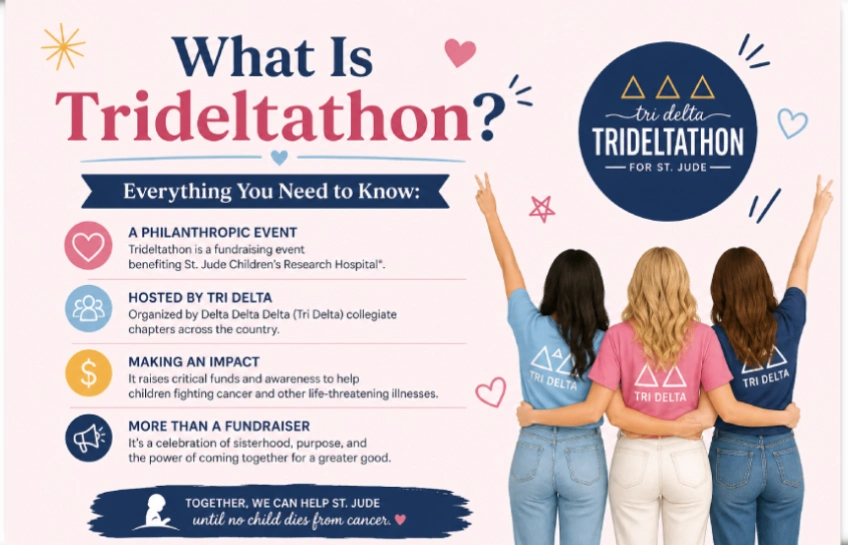
If you’ve come across the word “Trideltathon” and weren’t sure what it means, you’re not alone. Some people think it’s a sorority event. Others assume it’s a standard road race. It’s actually neither — or rather, it’s both and more.
Here’s the short version: Trideltathon is a sprint triathlon held in Knoxville, Tennessee, organized with the support of the Delta Delta Delta sorority, with proceeds going to East Tennessee Children’s Hospital. But there’s quite a bit more to it than that one sentence covers.
Where It Started
In 1984, Tri Delta launched the annual Trideltathon as a fundraiser for Camp Eagles’ Nest — a summer camp for children with cancer and blood disorders, sponsored by the East Tennessee Children’s Hospital.
That’s over four decades of the same race, still going, still raising money for the same cause. That kind of consistency is rare in any community event, let alone a college-organized one.
From its very first year, all proceeds have gone to Camp Eagles’ Nest, which gives young patients a chance to step away from the routine of hospital life and simply be kids for a while. The camp is free for patients and their families — funded entirely by what events like Trideltathon raise.
What Makes It Historically Significant
Here’s something most people don’t know: Trideltathon is considered one of the oldest triathlons in the South, and is recognized as the first pool triathlon in the country.
That’s not a small claim. Most triathlons use open water — lakes, rivers, or the ocean. This one has always used an indoor pool, which makes it distinct and, honestly, a lot more approachable for people who aren’t comfortable in open water.
The event has been described as “the granddaddy of them all” in local triathlon circles, and that’s a fair label. It’s been a fixture in Knoxville’s athletic calendar for longer than most of its participants have been alive.
What the Race Actually Involves
Trideltathon follows the classic triathlon format — swim, bike, run — but at a beginner-friendly distance.
The course starts with a 400-meter indoor pool swim, followed by a 6-mile bike tour of the University of Tennessee campus and Neyland Drive, and finishes with a 3-mile campus run that passes Neyland Stadium and Thompson Boling Arena.
A few things worth knowing:
The swim: Swimmers enter the water one at a time, at roughly 7-second intervals, and swim each 50-meter lane by ducking under the rope at the end of each length and crossing to the next lane. It’s a time-trial style start, which keeps things organized and avoids the chaotic mass-start that puts off many first-timers.
The bike and run: The course stays on and around campus. It’s not brutally hilly, but it’s not flat either. The bike section covers two 3-mile laps with twists and turns, and the run is a rolling tour of campus with a couple of water stops.
It’s not USAT sanctioned: Trideltathon is not a USAT sanctioned event, which means it doesn’t count toward official USA Triathlon rankings. But that also means less red tape and a more relaxed atmosphere overall.
Who Shows Up to Race?
This is where a lot of people get the wrong idea. They assume it’s a sorority-only thing, or a Greek life event that outsiders don’t really belong at. That’s not the case.
“It is by no means a Greek-centered event,” the sorority’s public relations chair has said. “Trideltathon has been one of Knoxville’s most popular triathlons for the past 25 years.”
The vast majority of participants are non-Greeks, and the event has drawn people ranging from age nine to 90. It’s consistently been recommended as one of the better beginner races in the region — low-pressure, well-organized, and open to relay teams so people who can’t do all three legs on their own can still participate.
The event regularly draws 400-plus participants, with the Tri Delta sorority members lining the course and cheering on racers throughout.
The Charity Behind It
Camp Eagles’ Nest gives kids with cancer and blood disorders a chance to relax, forget about their medical situation for a while, and just enjoy being at camp with other kids going through similar experiences. That’s what the entry fees actually pay for.
In a good year, the event raises well over $17,000 for the camp. Back in 2008, Trideltathon raised $17,500 for Camp Eagles’ Nest, with the sorority aiming to exceed that figure every subsequent year.
Tri Delta as a national organization has a long history of children’s health philanthropy. Since partnering with St. Jude Children’s Research Hospital in 1999, the sorority has raised more than $84 million in support of St. Jude’s mission to find cures and save children. Trideltathon is part of that broader commitment, specifically tied to local East Tennessee efforts.
You can learn more about Tri Delta’s philanthropy work directly on their official site: tridelta.org/our-story/philanthropy.
Can Beginners Actually Do It?
Yes — and that’s a genuine answer, not just encouragement.
The distances are short enough that most reasonably active people can complete them. The indoor pool swim removes the anxiety of open water. The relay option means you can split the three legs with teammates if going solo feels like too much.
The event has always welcomed people who want to try a triathlon for the first time — it was described by organizers as a fun way to combine physical activity with the enjoyment of being outdoors.
If you’ve been curious about triathlons but felt the full Ironman or even an Olympic-distance race was too intimidating, this is exactly the kind of event designed for you.
Common Questions About Trideltathon
Is it only for University of Tennessee students? No. Anyone can register. There are student pricing options available, but the race is open to the general public.
Do you have to be in a sorority to participate? Not at all. The sorority organizes and volunteers at the event, but the racers are mostly everyday people from the Knoxville community and beyond.
Where does the money go? Proceeds go to East Tennessee Children’s Hospital and Camp Eagles’ Nest, a summer camp for children with cancer and rare blood disorders.
Is it competitive? There are overall and age group awards, so yes, there’s a competitive element. But the atmosphere skews more community-friendly than cutthroat. People show up to finish, not just to win.
What’s the swim format like? It’s done in an indoor pool with a staggered time-trial start — one swimmer at a time enters the water. If you’ve never raced open water and don’t plan to, this format removes that stress entirely.
Why It Keeps Going
Forty-plus years is a long time for any recurring event. The reason Trideltathon has lasted comes down to something pretty simple: it gives people a reason to show up that’s bigger than personal achievement. You finish a sprint triathlon, and some of that entry fee helps a kid with cancer go to summer camp. That combination keeps drawing people back year after year.
It’s also genuinely well-run. Volunteer support is provided by the Tri Delta sorority throughout the race, which means the course is covered and racers aren’t left guessing where to go.
If you’re in or around Knoxville and looking for an accessible race that actually means something, Trideltathon is worth putting on the calendar.



No Comment! Be the first one.