

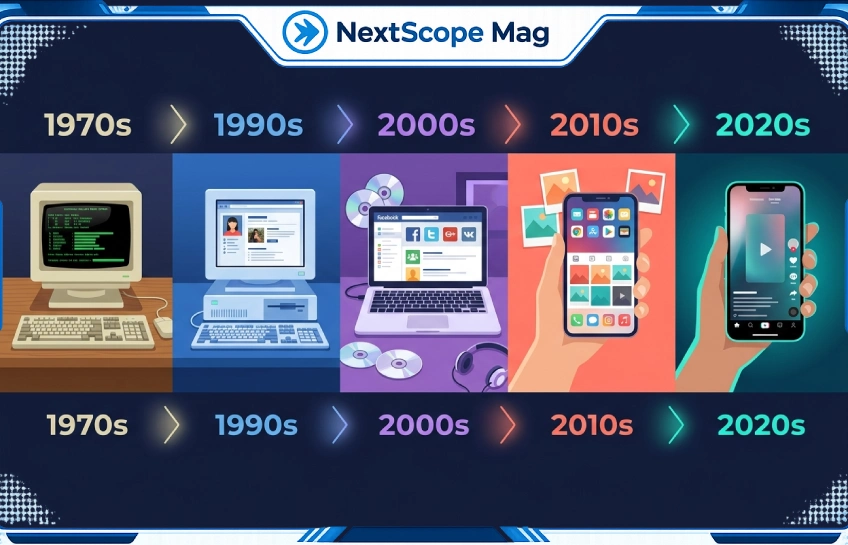
Social media is everywhere today. People scroll through Instagram while eating breakfast, post on Twitter during lunch, and binge TikTok videos before bed. But have you ever wondered how all of this actually started? The history of social media is way more interesting — and way older — than most people think.
It didn’t begin with Facebook or Instagram. It didn’t even begin with the internet as we know it. The story of social media goes back decades, and it’s a story about people doing what they’ve always done: trying to connect with each other.
Let’s take a walk through the full journey — from clunky early computer networks to the billion-user platforms we use today.
Early Digital Communication Before Social Media
Before there was Twitter or TikTok, people were still finding ways to talk online — they just had to work a lot harder for it.
Back in the late 1970s, computer enthusiasts used something called Bulletin Board Systems, or BBS. Think of it like a digital corkboard. People would dial in using a phone line, leave messages, and wait for someone else to respond. It was slow, it was text-only, and it was honestly pretty complicated to set up — but people loved it.
Then came Usenet in 1980, which let users post messages in discussion groups sorted by topic. It was kind of like Reddit before Reddit existed. A few years later, Internet Relay Chat (IRC) showed up in the late 1980s, and that was the first time people could actually have live conversations online in real time.
These platforms weren’t pretty or easy to use. But they planted the seed. They proved one thing clearly: people want to connect with strangers who share their interests. That idea never went away — it just kept growing.
The Birth of Social Media: First Social Networking Platforms
The 1990s brought the internet into more homes, and with it came the first platforms that actually look a little like modern social media.
Classmates.com launched in 1995, and it let people find old friends from high school and college. It was simple — no newsfeed, no stories, no reels — but people found it genuinely useful. Then in 1997, a site called SixDegrees took things a step further.
SixDegrees is widely considered the first real social network. Here’s why: it let users create a personal profile, send messages to others, and even browse who their “friends of friends” were. Sound familiar? That’s basically what every social platform still does today.
The site was named after the idea of “six degrees of separation” — the theory that any two people in the world are connected by no more than six social links. SixDegrees tried to map that out online. It was ahead of its time, honestly. The internet just wasn’t ready for it yet, and the site shut down in 2001.
But the blueprint it created? That stuck around.
The Rise of Social Networking in the Early 2000s
Once broadband internet started spreading and more people got online, social networking really started picking up speed. The early 2000s were a big moment in the history of social media.
Friendster launched in 2002 and quickly became a sensation. It was designed around real-world friendships and introduced a lot of people to the concept of an online social circle. At its peak, Friendster had millions of users — but it also struggled with technical problems that frustrated people, which opened the door for competitors.
In 2003, two very different platforms launched. LinkedIn came out as a professional networking site — basically, a place to put your resume and connect with coworkers or job opportunities. It’s still going strong today. MySpace launched the same year and went in a completely different direction. It was loud, colorful, and totally focused on music and youth culture. Users could customize their pages with glittery backgrounds and autoplay songs. It was a mess — but a fun mess.
The thing these platforms all had in common? They were building the habits that billions of people would later bring to Facebook, Instagram, and beyond: creating profiles, making friend lists, sharing updates, and engaging with communities online.
How Facebook, YouTube, and Twitter Changed Social Media
If the early 2000s were the warm-up, then 2004 was the moment things changed forever.
Facebook launched in February 2004, originally just for Harvard students. Its creator, Mark Zuckerberg, rolled it out to other universities over the next year, then opened it to everyone in 2006. The platform hit 1 million users fast — then 10 million, then 100 million. Today, Facebook has over 3 billion monthly users. No platform in the history of social media has had that kind of impact on global connectivity.
What made Facebook different? It was clean, it was organized, and it felt personal. The newsfeed — introduced in 2006 — changed how people consumed content. Instead of visiting individual profiles, everything came to you.
YouTube launched in 2005 and introduced something totally new: social video. Before YouTube, sharing a video online was complicated and often impossible for regular people. YouTube made it easy. Suddenly, anyone could upload a clip and the whole world could watch it. The platform got so big that Google bought it in 2006 for $1.65 billion.
Twitter arrived in 2006 with a wild idea: limit every post to 140 characters. That’s it. At first, people thought it was a gimmick. But microblogging — the practice of posting short, frequent updates — caught on fast. Twitter became the go-to place for breaking news, live commentary, and public conversation.
Together, these three platforms defined what the internet would look like for the next decade.
The Mobile Revolution and Visual Social Media Era
Somewhere around 2007–2010, everyone got a smartphone — and social media changed with it.
When the iPhone launched in 2007, it wasn’t just a phone. It was a pocket-sized portal to the internet. Suddenly, people weren’t just checking social media from their desktop at home. They were doing it on the bus, in line at the grocery store, at 2 a.m. in bed.
This shift toward mobile created an opening for a new kind of platform — one built around photos and visuals, not just words.
Instagram launched in 2010 and immediately felt different. It was simple: take a photo, apply a filter, share it. That’s it. But that simplicity was the point. Instagram grew from 1 million users in two months to over 10 million in a year. Facebook acquired it in 2012 for $1 billion — which seemed outrageous at the time, but turned out to be one of the shrewdest deals in tech history.
Pinterest also launched in 2010, built around the idea of “pinning” images to virtual boards. It became a go-to platform for home decor, recipes, fashion inspiration, and DIY projects — especially popular with women.
Snapchat came in 2011 with a feature nobody had tried before: disappearing messages. Photos and videos would vanish after a few seconds. It felt private, playful, and fun — especially for younger users. Snapchat also introduced the “Stories” format, which Instagram and Facebook later borrowed (okay, copied) heavily.
The history of social media had made a clear turn: it was no longer about text status updates. It was about visuals, moments, and real-time sharing.
The Rise of Influencers, Algorithms, and Social Media Marketing
As platforms grew, something interesting happened. A new kind of celebrity appeared — one without a TV deal or record label. Just a camera, an internet connection, and an audience.
Influencers — people who built large followings by creating content others loved — started partnering with brands to promote products. Instagram became the hub for this. Fitness influencers, beauty gurus, travel bloggers, food photographers — they all built businesses on the backs of platforms that were, technically, free to use.
Behind the scenes, algorithms were quietly taking over. Early social media showed posts in chronological order — newest first. But as platforms got bigger, they started using algorithms to decide what you see. Posts that got more likes, comments, and shares got pushed to the top. The goal was to keep people scrolling longer.
This changed everything about how content was created. People stopped making things just because they wanted to share them. They started making things designed to perform — to get the engagement the algorithm rewarded.
For businesses, social media became one of the most powerful marketing tools ever invented. Targeted ads, brand pages, sponsored posts — the creator economy and digital advertising ecosystem that exists today wouldn’t be possible without these platform shifts.
The Evolution of Short-Form Video and Modern Platforms
Just when it seemed like Instagram had everything figured out, a Chinese app called TikTok came along and rewrote the rules.
TikTok launched internationally around 2016–2018 and exploded during the COVID-19 pandemic in 2020. Its secret? A For You Page (FYP) algorithm so powerful it could show you content you’d love — from creators you’d never heard of — within minutes of opening the app. It didn’t depend on who you followed. It just knew what you’d watch.
TikTok made short-form vertical video the dominant content format. And every other platform scrambled to catch up. Instagram launched Reels. YouTube launched Shorts. Even Facebook tried. The format that Snapchat started had become the industry standard — fast, punchy, highly watchable clips of 15 to 60 seconds.
Live streaming also grew massively during this era. Platforms like Twitch made watching people play video games into a billion-dollar industry. Instagram and TikTok added live features too. Content became not just watchable — but participatory. Viewers could comment, react, and interact in real time.
Major Milestones and Turning Points in Social Media History
Not everything in the history of social media is a triumph. There have been some serious bumps along the way.
Here are a few of the biggest turning points:
- 2011 – Arab Spring: Activists used Twitter and Facebook to organize protests across the Middle East. It was one of the first major real-world examples of social media driving political change.
- 2016 – U.S. Election and Misinformation Concerns: Facebook faced intense criticism for allowing the spread of false information during the election cycle. It triggered global conversations about platform responsibility.
- 2018 – Cambridge Analytica Scandal: It was revealed that data from millions of Facebook users had been harvested without their consent and used for political advertising. Facebook faced massive backlash and government hearings.
- 2022 – Twitter Acquisition: Elon Musk bought Twitter for $44 billion and rebranded it as “X.” The changes sparked huge debates about free speech, moderation, and the future of public discourse online.
These moments show that social media isn’t just a technology story. It’s a political, cultural, and ethical story too.
The Future of Social Media and Emerging Trends
So where does social media go from here?
Artificial Intelligence is already reshaping how content is created, recommended, and moderated. AI-generated videos, images, and even entire social media personas are becoming common. This raises real questions: How do you tell what’s real? Who’s responsible for AI-generated misinformation?
Decentralized platforms are gaining interest. Apps like Mastodon and Bluesky are built on open protocols, meaning no single company owns or controls them. Whether they’ll ever go mainstream is still an open question — but they represent a growing frustration with Big Tech’s grip on social media.
Niche communities are also on the rise. People are tired of the chaos of massive platforms and are moving to smaller, more focused spaces — private Discord servers, newsletters, Substack communities. The future might not be one giant platform for everyone. It might be many smaller ones.
One thing’s for sure: social media will keep evolving. It always has.
Conclusion
The history of social media is really a story about human connection. People have always wanted to talk, share, and belong — and technology has just kept finding new ways to make that easier (and sometimes messier).
From Bulletin Board Systems in the 1970s to TikTok’s algorithm-powered feed today, every era brought something new. Every platform tried to solve a problem. Every innovation changed how people lived, worked, communicated, and consumed the world around them.
Social media isn’t perfect. It’s had real harms — misinformation, privacy scandals, mental health impacts. But it’s also connected people across borders, built communities, launched careers, and given a voice to millions who wouldn’t have had one otherwise.
Whether you’re a casual scroller or someone building a brand online, understanding where social media came from helps make sense of where it’s going.
Want to learn more? Explore how social media marketing works, how algorithms shape what you see, or what the next generation of social platforms might look like. The story is still being written — and you’re part of it.

Other Articles

Competitive Advantage Strategy: How to Build a Real Edge
When to Consult a Lawyer and Why Early Legal Advice Matters

No Comment! Be the first one.