

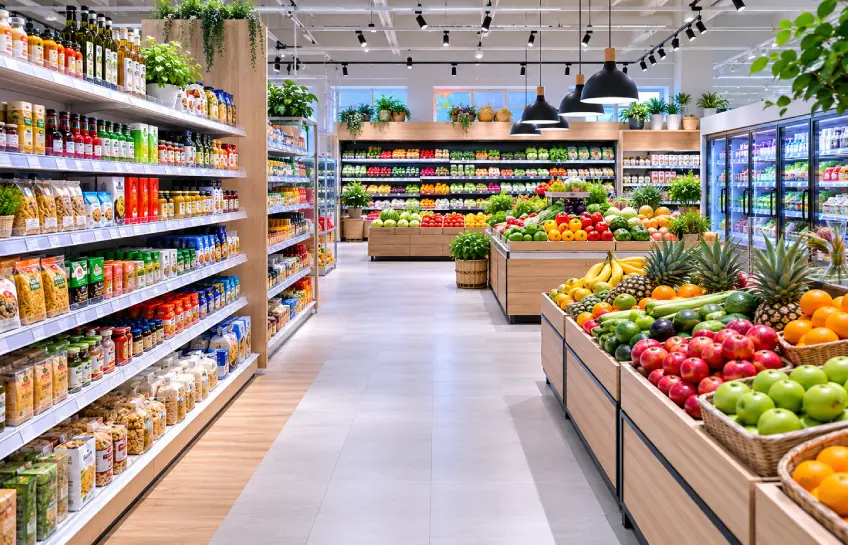
Supermarked is the Danish and Norwegian word for supermarket — a large, self-service retail store selling groceries, household products, and everyday essentials. Both Denmark and Norway use the term in daily speech, and each country has its own set of dominant chains that shape how millions of people shop each week. This article explains what supermarked means, which retailers lead these markets, how the two countries compare, and what’s changing in Scandinavian grocery retail heading into 2026.
What Does Supermarked Mean?
Supermarked simply translates to “supermarket” in English. The word is used identically in both Danish and Norwegian, referring to a self-service grocery store larger than a convenience shop but typically smaller than a hypermarket.
The concept arrived in Scandinavia after World War II, following the American model that had taken hold in the 1930s. By the 1960s and 1970s, supermarked shopping had become the standard way for Danish and Norwegian households to buy food. Today both countries have highly developed and competitive grocery markets, with a small number of large retail groups controlling the majority of sales [SOURCE: ESM Magazine, 2024].
The word itself follows straightforward compound logic common in Germanic languages: “super” (large/above) + “marked” (market). It’s not slang or informal — it’s the standard term used on signage, in legislation, and in everyday conversation across both countries.
Supermarked in Denmark: How the Market Works
Salling Group is the largest supermarket retail chain in Denmark, with an annual turnover of €8.94 billion as of 2022. Originally known as Dansk Supermarked, the group operates brands including Bilka, føtex, Netto, and Salling, with 653 outlets across Denmark.
Coop Danmark continues operating its supermarket chains including Kvickly, SuperBrugsen, 365discount, and Brugsen, and remains a significant force in the Danish grocery sector alongside Salling Group.
The Rise of Discount Formats
Discount supermarked chains have been the biggest growth story in Danish retail over the past decade. In 2025, a sector analysis named Rema 1000 Denmark’s largest discount supermarket chain, with an 18.2% market share — narrowly ahead of rival Netto’s 17.9%. In 2024, Netto still held the discount lead at 17.7%, compared to Rema 1000’s 17.6%.
REMA 1000 was founded on 15 February 1979 by Odd Reitan in Trondheim, Norway. It expanded into Denmark in 1994 and operates on a franchised discount model. Its approach — limited product range, low prices, no-frills stores — has proven consistently effective with Danish shoppers.
Cross-Border Shopping
One factor unique to Denmark’s supermarked landscape is cross-border shopping. A report by trade association De Samvirkende Købmænd indicated that Denmark missed out on over DKK 5 billion (€670 million) in VAT and excise duties due to cross-border trade in 2023. Much of this is driven by Danish consumers buying alcohol and certain groceries in Germany, where prices are lower due to different tax structures.
Supermarked in Norway: Key Players and Structure
Norway’s grocery market is one of the most concentrated in Europe. NorgesGruppen alone held roughly 43.5% of the national grocery market in 2024, while the three largest retail groups together control more than 96% of food retail sales.
NorgesGruppen operates the Kiwi, Meny, Joker, and Spar chains, among others. Kiwi is their discount brand and one of the most widely used budget supermarkets in Norway. Coop follows with a market share of around 29%, operating chains such as Coop Extra, Coop Mega, and Coop Obs!
Rema 1000 in Norway
REMA 1000 held a 27.1% market share in the Norwegian grocery sector in 2024, reflecting steady growth driven by its emphasis on competitive pricing. The chain operates on a franchise model and is known for keeping its product range deliberately narrow — the name “1000” originally referred to offering exactly one thousand different products.
NorgesGruppen is still the largest company with 43.5% of the market in 2024, but its market share has declined the most in recent years. Rema 1000 has increased its market share the most during this period.
Denmark vs Norway: Supermarked Compared
| Feature | Denmark | Norway |
|---|---|---|
| Word used | Supermarked | Supermarked |
| Largest group | Salling Group | NorgesGruppen |
| Leading discount chain | Rema 1000 (2025) | Kiwi / Rema 1000 |
| Market concentration | High | Very high (top 3 hold ~96%) |
| Notable trend | Cross-border shopping | Price collusion fines (2024–2025) |
| Sunday trading | Permitted in many stores | Restricted by law |
Norway’s market is notably more concentrated than Denmark’s. It’s also faced more regulatory scrutiny. In a landmark 2024 case upheld in 2025, the Norwegian competition authority imposed fines totalling NOK 4.9 billion on NorgesGruppen, Reitan Group, and Coop Norge for illegal information sharing on pricing through “price hunter” tools, enabling tacit coordination that harmed market competition.
What’s Changing in Scandinavian Supermarked Retail in 2025–2026?
The supermarked model in both countries is shifting across several areas — technology, sustainability, and market consolidation are the main drivers.
In 2025, Salling Group completed the €1.3bn acquisition of Rimi Baltic, giving the group direct scale in Estonia, Latvia, and Lithuania. This marks a broader push by Danish retail groups beyond their home market into the wider Nordic-Baltic region.
In 2025, total grocery sales volume in Norway reached approximately NOK 266 billion, reflecting steady growth driven by population increases and inflation recovery, with the discount segment expanding notably since post-2020 economic pressures heightened price sensitivity.
Digital tools are becoming more central to the supermarked experience. REMA 1000’s app provides automatic 10% discounts on fruits, vegetables, and a customer’s top 10 most-purchased items per household, along with personalised offers — without requiring manual coupon clipping. This kind of app-based loyalty approach is becoming standard across Scandinavian chains.
Sustainability reporting is also becoming a commercial requirement rather than a PR choice. Danish retailers now demand CO₂-per-unit data from suppliers, with suppliers unable to provide verified sustainability reporting risking losing shelf access regardless of price competitiveness.
Prizmatem.co.uk covers broader European retail developments across its general and tech sections.
People Also Ask
Q: What does supermarked mean in English? A: Supermarked is the Danish and Norwegian word for supermarket. It translates directly to “supermarket” in English and refers to a large, self-service grocery store.
Q: What is the biggest supermarked chain in Denmark? A: Salling Group is the largest supermarket retail chain in Denmark by turnover, operating brands including Bilka, føtex, Netto, and Salling. At the individual chain level, Rema 1000 held the largest discount market share in Denmark in 2025 at 18.2%.
Q: Is the grocery market in Norway competitive? A: Not especially. The three largest retail groups in Norway control more than 96% of food retail sales, making it one of Europe’s most concentrated grocery markets. This concentration has drawn significant regulatory attention, including major fines in 2024.
FAQs
Q: Is “supermarked” used in Swedish too? A: No. Swedish uses “snabbköp” (literally “quick purchase”) for supermarket, or informally “affär” (store). Supermarked is specific to Danish and Norwegian.
Q: Which is cheaper — Danish or Norwegian supermarkets? A: Norway is generally considered more expensive for groceries than Denmark. Norway’s high wages, strict import regulations, and concentrated market structure contribute to food prices that are among the highest in Europe [SOURCE: Eurostat food price data].
Q: Does Aldi operate in Denmark? A: Aldi exited the Danish market. Rema 1000 gained the largest share of former Aldi locations after that exit, which contributed significantly to its growth.
Q: What does “Netto” mean in Danish retail? A: Netto is a discount supermarked chain owned by Salling Group. The name means “net” in Danish, suggesting straightforward, no-extras pricing. As of late 2023, Netto operated 514 stores across Denmark.
Q: Can you shop at Norwegian supermarkeds on Sundays? A: It depends on the store size and location. Norway’s grocery retail operations are shaped by strict regulations including limited Sunday trading, which differs from Denmark where Sunday opening is more widely permitted.
Conclusion
Supermarked is more than just a translation — it points to two distinct but related grocery markets with their own dominant players, pricing pressures, and regulatory histories. Denmark’s market is led by Salling Group, with Rema 1000 now the top discount chain. Norway’s market is even more concentrated, with NorgesGruppen holding the largest share and all three major groups having faced significant fines for anti-competitive behaviour. If you’re researching Scandinavian retail, the supermarked sector is a clear window into how each country approaches food, pricing, and consumer choice.

Other Articles


No Comment! Be the first one.