

You are staring at your phone. A trade offer just popped up in your fantasy league. You look at it, close the app, open it again, and stare some more. You check the projections. You read three different articles.
You are stuck.
If you accept, what if the guy you trade away goes off for 30 points on Sunday? If you decline, what if your player gets hurt, and you miss out on a great deal?
This is the exact moment where fantasy sports stop being fun and start feeling stressful. Whether you are dealing with start sit decisions or a massive blockbuster trade, the fear of making the wrong move is real.
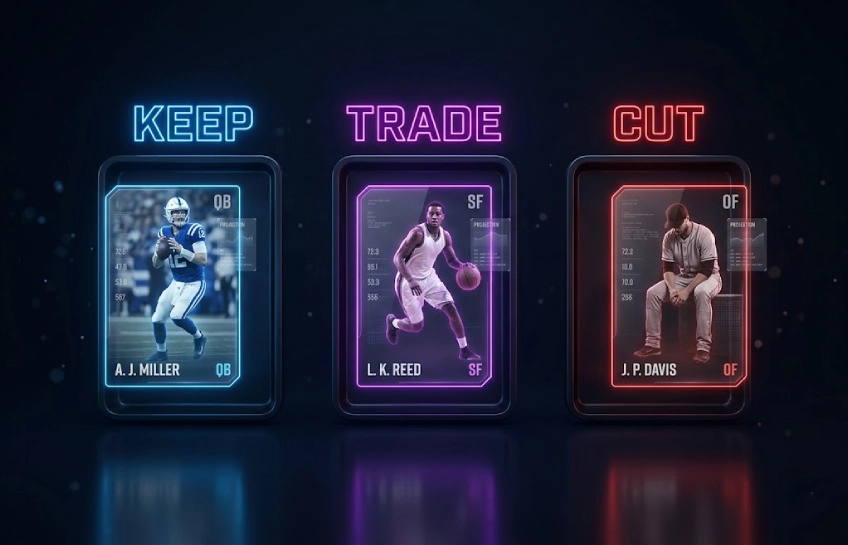
This is why you need a keep trade cut system.
It is a simple way of looking at your team. Instead of letting emotions run your roster, you force yourself to put every player into one of three buckets: Keep, Trade, or Cut. In this guide, we are going to break down why you struggle with these choices, how to fix your mindset, and how to build a simple system to make winning decisions.
Why Keep Trade Cut Decisions Feel So Hard
You are not bad at trades. You are not unlucky. You are just acting like a human being.
When it comes to roster management, we let our brains play tricks on us. We get attached to players we drafted. We remember that one amazing game a player had three weeks ago, and we ignore the three terrible games since.
Here are the real reasons you get stuck:
1. The Fear of Getting “Robbed”
Nobody wants to be the laughingstock of their league group chat. You are terrified of trading away a player who breaks out, so you hold onto everyone tightly. Because of this fear, you decline fair offers and miss out on making your team better.
2. Overvaluing Your Own Players
In psychology, this is called the “endowment effect.” Because a player is on your team, you think they are worth more. You value your bench warmer like a starter, but you want the other guy’s starter for pennies. This makes it impossible to find common ground in a trade.
3. Hype Over Strategy
You spend too much time scrolling social media. You see a flashy highlight and suddenly think a backup running back is the next superstar. You ignore basic fantasy football strategy and chase hype instead of volume and opportunity.
What is the Keep Trade Cut Mindset?
The idea of “keep trade cut” started as a fun debate game. Given three players, who do you keep, who do you trade away, and who do you drop?
But in real fantasy leagues, it is a survival tool. It forces you to look at your roster honestly and assess true player value.
Community crowdsourcing sites like KeepTradeCut have made this concept famous, especially for dynasty leagues. They use thousands of user votes to rank players. While these tools are great, you should not follow them blindly. You need to use them as a guide while applying your own logic.
Here is how you actually do it.
The 5-Step Keep Trade Cut System
Stop staring at your screen hoping the right answer will magically appear. Follow these five simple steps the next time you need to make a move.
Step 1: Check Your League Format
A player’s value changes wildly depending on your league rules. Are you in a redraft league or a dynasty league? If you are looking at dynasty rankings, youth is king. A 22-year-old receiver is a “Keep” in dynasty, but he might be a “Cut” in a redraft league if he isn’t getting any targets right now. Always judge a player based on the game you are actually playing.
Step 2: Look at Volume, Not Just Points
Touchdowns are largely luck. Volume is a skill. When deciding to keep, trade, or cut someone, look at how many times they touch the ball or get targeted. Did your guy score 15 points on only two catches? That is a lucky week. He is a prime candidate to trade. Did your guy score 4 points but had 10 targets? That is bad luck. Keep him. The points will come.
Step 3: Check the Market
Before you make a move, see what the rest of the world thinks. Look at a trusted trade value chart or run the deal through a fantasy trade calculator. Do not treat the calculator like a god. Treat it like a thermometer. It just tells you the temperature of the market. If the calculator says you are losing the trade by a tiny bit, but you are getting a player you really need to fill a starting spot, do the deal anyway.
Step 4: The “Replacement Level” Test
If you are thinking about cutting a player, look at your waiver wire. Who would you pick up? If the players on the waiver wire are scoring the same amount of points as the guy on your bench, cut your guy. Stop holding onto recognizable names who do not produce. Waiver wire decisions win championships, and you need an empty roster spot to make them.
Step 5: Execute “Buy Low, Sell High”
This is the oldest piece of fantasy football tips out there, but no one actually does it because it feels uncomfortable. Selling high means trading a player when everyone loves them (even you). Buying low means trading for a player who just had two terrible weeks. Use the keep trade cut mindset to spot players on your roster who are overvalued by your league, and trade them for a massive haul.
A Realistic Keep Trade Cut Example
Let’s put this into practice. Imagine you have these three players on your redraft roster, and you need to make some moves to improve your starting lineup.
Player A: The Hyped Rookie He had one huge game in Week 1. Since then, he has been decent, but not amazing. Everyone in your league is still talking about his upside.
Player B: The Boring Veteran He is 29 years old. He isn’t fast. He doesn’t make highlight reels. But he gets 8 targets a game and quietly scores 12 points every single week.
Player C: The Boom-or-Bust Deep Threat He scores 20 points one week, and 2 points the next three weeks.
Here is how you apply the system:
- Trade: The Hyped Rookie. He still carries a ton of name value. You can plug him into a trade calculator and swap him to a manager who loves shiny new toys in exchange for a reliable starter.
- Keep: The Boring Veteran. Winning fantasy sports is about predictable points. Boring is good. Keep him in your lineup.
- Cut: The Boom-or-Bust Deep Threat. You can never trust him in your lineup anyway. He is just clogging up your bench. Cut him and use that spot to take a chance on a backup running back who might become a starter if an injury happens.
Small Habits That Actually Work
You don’t need to be a math genius to win your league. You just need better habits.
Stop checking your trade 10 times. Send the offer. Close the app. If you stare at it, you will convince yourself it is a bad deal and cancel it.
Do a weekly roster review. Every Tuesday morning, look at your team. Be honest. Who is actually helping you win? Who is just taking up space because you drafted them in the 8th round?
Don’t react to one bad week. Even superstars have bad games. Do not panic drop a great player just because he got shut down by a tough defense.
Common Traps to Avoid
Even with a system, you can fall into traps. Watch out for these:
- Trading just to trade: Being bored is not a good reason to trade. If your team is winning, leave it alone.
- Ignoring bye weeks: Don’t trade for three guys who all have the same bye week unless you are prepared to take a guaranteed loss that week.
- Relying on just one source: If you only use one website’s rankings, you have a blind spot. Look at a few different sources before deciding on a player’s value.
Frequently Asked Questions (FAQs)
How accurate is a fantasy trade calculator? They are good baselines, but they are not perfect. They cannot measure your specific team’s needs. If a calculator says you lose a trade by 5%, but you get a starting tight end and you currently don’t have one, it is a winning trade for you.
How do I know when to cut a drafted player? Give them three weeks. Unless they suffer a season-ending injury, three weeks of data is enough to show you their true role in the offense. If they aren’t getting the ball by Week 3, cut them.
What is the biggest difference between dynasty keep trade cut and redraft? Age. In dynasty, a 28-year-old running back loses value every single day, so you want to trade them away before they crash. In redraft, age does not matter at all. All that matters is how many points they will score by December.
Should I trade my depth for a star? Usually, yes. In a standard league, you can only start a limited number of players. Having five good receivers on your bench doesn’t score you any points. Package two or three good players for one elite superstar.
Take Action Today
Reading about strategy is easy. Actually pressing the “accept trade” or “drop player” button is hard.
Open your fantasy app right now. Look at your bench. Find the one player you have been holding onto for three weeks who hasn’t done anything. That is your cut.
Find the player who just had a wildly lucky two-touchdown game. Go send a trade offer to your league mates and see what you can get for him.
Stop letting fear and attachment run your roster. Use a simple keep trade cut system, trust the volume, check the market, and start managing your team like a winner.

Other Articles


No Comment! Be the first one.