

You’ve got a business idea. Maybe a side hustle that’s starting to bring in real money. Or a freelance gig that feels ready to grow. And the same question keeps popping up — should you make it official?
If that’s where you are, you’re in the right place. This guide walks you through how to start an LLC in USA, one clear step at a time. No legal jargon. No long paperwork lectures. Just the real steps, fees, and decisions that actually matter in 2026.
An LLC feels complicated before you start it. By the end of this guide, it won’t.
What Is an LLC, Really?
An LLC (Limited Liability Company) is a business structure that separates you from your business. Your personal stuff — your home, your car, your savings — stays protected if your business gets sued or owes money.
Think of it like a legal wall between “you the person” and “you the business owner.”
It’s the most popular business structure in the United States, and for good reason:
- Your personal assets stay protected from business debts and lawsuits
- You choose how it gets taxed (sole prop, partnership, S-Corp, or C-Corp)
- Less paperwork than a corporation — no board of directors, no shareholder meetings
- Banks, clients, and vendors take you more seriously when they see “LLC”
That’s why freelancers, Amazon FBA sellers, eCommerce owners, consultants, and even non-U.S. residents use it.
Who Should Form an LLC?
You probably need one if:
- Your side hustle is starting to earn real income
- You’re freelancing with bigger clients who ask for an invoice
- You’re selling physical products on Amazon, Shopify, or Etsy
- You’re running a consulting or coaching business
- You live outside the U.S. and want a U.S. business entity
- You want legal protection before a lawsuit actually shows up
If you’re still testing an idea with no income yet, you can wait. But the moment real money starts coming in, form the LLC.
How to Start an LLC in USA — The Full LLC Formation Process
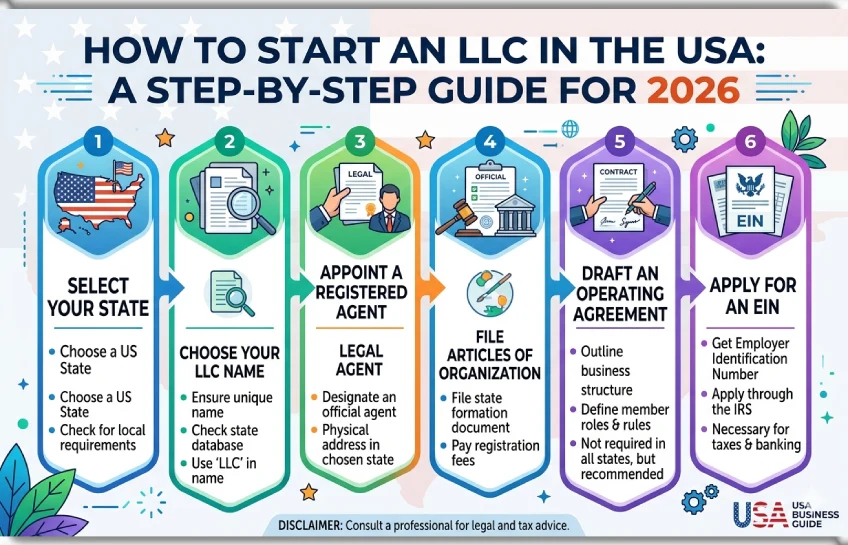
Here’s the complete LLC formation process, step by step.
Step 1: Pick Your State
LLCs are formed at the state level. That means each state sets its own rules, fees, and deadlines.
For most people, the best state is simply the one you live and do business in. Don’t overthink it.
People hear about Delaware, Wyoming, or Nevada and assume those states are “better.” Usually they’re not — unless you have a specific reason like large investors or a non-U.S. ownership structure. If you form out-of-state but operate in your home state, you’ll likely have to register as a “foreign LLC” too — which means two sets of fees and two sets of paperwork.
Keep it simple. Form where you live.
Step 2: Choose Your Business Name
Your LLC name has to be unique in your state, and it has to include something like “LLC” or “Limited Liability Company” at the end.
Before you fall in love with a name:
- Search your Secretary of State’s business name database
- Check if the matching domain is available
- Do a quick USPTO trademark search
- Avoid words your state restricts (like “bank,” “insurance,” or “trust”)
A good LLC name is short, easy to spell, and different enough from existing brands that you won’t confuse customers or trigger a trademark issue.
Step 3: Choose a Registered Agent
Every LLC needs a registered agent for LLC purposes. This is the person or company that receives legal mail — lawsuits, tax notices, official state papers — on behalf of your business.
You have three options:
- Be your own registered agent — free, but your home address becomes public
- Use a trusted person — must live in the state and be available during business hours
- Hire a registered agent service — usually $50 to $300 per year
Most beginners hire a service. It keeps your home address off public records and makes sure you never miss an important legal notice. Missing one can lead to a default judgment against your business.
Step 4: File Your Articles of Organization
This is the moment your LLC actually comes to life.
You file a document called the Articles of Organization (some states call it a Certificate of Formation or Certificate of Organization) with your state’s Secretary of State office. It’s usually one or two pages.
You’ll need to provide:
- Your LLC’s name
- Your registered agent’s name and address
- Your business address
- Management structure (member-managed or manager-managed)
- Names of members (in some states)
You can file online in almost every state. Processing takes anywhere from the same day to a few weeks, depending on where you file.
State filing fees vary. Most states charge between $50 and $200. Some go as low as $35 (Montana), and a few go higher — Massachusetts charges around $500, and California adds an $800 annual franchise tax. The U.S. average is around $132. Always check the current fee on your state’s Secretary of State website before paying.
Step 5: Create an Operating Agreement
An LLC operating agreement is a document that explains how your LLC works internally. Who owns what. How profits get split. What happens if a member leaves. How big decisions get made.
A few states require one. Most don’t. But here’s the thing — every LLC should have one anyway.
Even for a single member LLC setup, an operating agreement:
- Shows banks and courts that your LLC is real and separate from you
- Strengthens your personal liability protection
- Prevents arguments down the line if a partner joins later
You don’t need a lawyer for a simple one. Free templates are everywhere online. Fill it out, sign it, save it with your business records. Done.
Step 6: Get Your EIN (Free From the IRS)
An EIN (Employer Identification Number) is your business’s federal tax ID. Think of it as a Social Security number for your LLC.
You’ll need it to:
- Open a business bank account
- File federal and state taxes
- Hire employees
- Work with certain clients and vendors
And the best part? It’s completely free. Don’t pay any third-party website to get it for you.
Apply directly on the IRS website — the IRS EIN application takes minutes for U.S. residents and issues the number instantly. If you’re a non-U.S. resident without a Social Security number, you can apply by fax or mail using Form SS-4. Processing usually takes 4 to 6 weeks that way.
Step 7: Open a Business Bank Account
Now that you have an EIN, open a business bank account right away. This is non-negotiable.
Why? Because mixing personal and business money can destroy your LLC’s liability protection. Courts call this “piercing the corporate veil,” and it happens when your business looks like just another pocket of your personal finances.
Keep every business dollar in the business account. Every deposit, every expense, every transfer. Get a business debit or credit card too, and use only that for business purchases.
Step 8: Get Business Licenses and Permits
Your LLC is now legal — but that doesn’t mean you can just start operating.
Most cities and counties require a general business license (sometimes called a business tax certificate or occupational license). Some industries need extra permits — food, health, construction, childcare, and more.
Check with:
- Your city clerk or county business office
- Your state’s business license portal
- The SBA’s licenses and permits guide
This step is easy to skip and costly to ignore. Local fines add up fast, and some cities will shut your business down if you operate without a license.
LLC Filing Requirements Most Beginners Miss
Here are the ongoing LLC filing requirements that trip people up after formation:
- Annual or biennial reports — Most states want a short filing every year or two to keep your info current. Fees typically run $10 to $300.
- Franchise taxes — A few states (California, Delaware, Texas) charge a flat yearly fee even if you made zero income.
- State taxes — Sales tax, employer tax, state income tax — depends on your state and what your business does.
- Registered agent updates — If your agent or their address changes, you must file an update with the state.
- New York LLCs (2026 update) — As of January 1, 2026, New York’s LLC Transparency Act requires LLCs formed or registered in New York to file a Beneficial Ownership Information report (or an attestation of exemption) with the NY Department of State. If you’re forming in New York, check their current portal for the form and deadline.
Ignore any of these and your LLC can lose “good standing” — or worse, get dissolved by the state.
How Much Does It Cost to Start an LLC in 2026?
Here’s a realistic breakdown of the cost to start an LLC this year:
- State filing fee: $35 to $500 (most states fall in the $50–$200 range)
- Registered agent service: $0 (DIY) to $300/year
- Operating agreement: $0 (template) to $200+ (lawyer)
- EIN: Free from the IRS
- Business license: $20 to a few hundred dollars, depending on city
- Annual report fee: $10 to $300
- Franchise tax (some states): $0 to $800+
Most people can fully form their LLC for under $300 in the first year. Don’t pay for $1,000 “LLC packages” unless you genuinely need the extras inside.
Common LLC Mistakes to Avoid
I see new owners make the same mistakes over and over:
- Forming in Delaware or Wyoming without a real reason
- Mixing personal and business money in the same account
- Skipping the operating agreement to “save time”
- Paying a third-party site for an EIN (it’s free from the IRS)
- Forgetting the annual report and losing good standing
- Using a P.O. box as a registered agent address (most states don’t allow it)
- Picking an LLC name without checking trademarks
Avoid these and you’ll save yourself a lot of money, stress, and paperwork later.
LLC vs Sole Proprietorship
A sole proprietorship is the default — if you start earning money without registering anything, you already are one.
The real differences:
- Liability: Sole prop gives you no protection. An LLC shields your personal assets.
- Taxes: Both use pass-through taxation by default. But an LLC gives you more options — like electing S-Corp status later to save on self-employment tax.
- Credibility: “LLC” after your name signals a real business. Sole prop doesn’t.
- Paperwork: Sole prop has almost none. LLC has some filings, fees, and reports.
If your business has any real risk or real income, the LLC wins every time.
FAQs: How to Register an LLC in USA
How long does it take to form an LLC? Most states approve LLCs within 1 to 14 business days. Many offer same-day or expedited filing for an extra fee.
Can non-U.S. residents form a U.S. LLC? Yes. You don’t need to live in the U.S. or hold a Social Security number. You’ll need a U.S. business address (or a registered agent service), and you’ll apply for your EIN using Form SS-4 via fax or mail.
Do I need a lawyer to start an LLC? No, not for a standard one. Most small businesses either file the paperwork themselves or use a formation service for under $100. Hire a lawyer only if your structure is complex — multiple investors, special ownership splits, or international layers.
How do I get EIN for LLC if I don’t have an SSN? Fill out Form SS-4 and fax or mail it to the IRS. Non-residents usually receive their EIN within 4 to 6 weeks. No application fee, ever.
Can I run multiple businesses under one LLC? Yes — by adding “DBAs” (doing business as names) under your LLC. It’s cheaper than forming separate LLCs, but only works if the businesses share the same liability profile.
What’s the easiest state to form an LLC in? For most people, your home state. It’s the simplest, the cheapest long-term, and saves you from having to register as a foreign LLC elsewhere. Wyoming and New Mexico are popular with non-residents for low fees and privacy.
Your Next Step
Starting an LLC sounds scary — until you actually do it. The truth is, most people can finish the whole thing in under an hour of focused work.
Here’s what to do right now:
- Pick your state (almost always your home state)
- Check that your LLC name is available on the Secretary of State site
- Choose a registered agent
- File the Articles of Organization
- Write a simple operating agreement
- Get your free EIN at IRS.gov
- Open a business bank account
- Grab any city or industry licenses you need
Once those eight steps are done, your business is officially real — protected, legal, and ready to grow.
You don’t need to be a lawyer. You don’t need to wait until the idea is perfect. You just need to take the first step.

Other Articles

No Comment! Be the first one.