

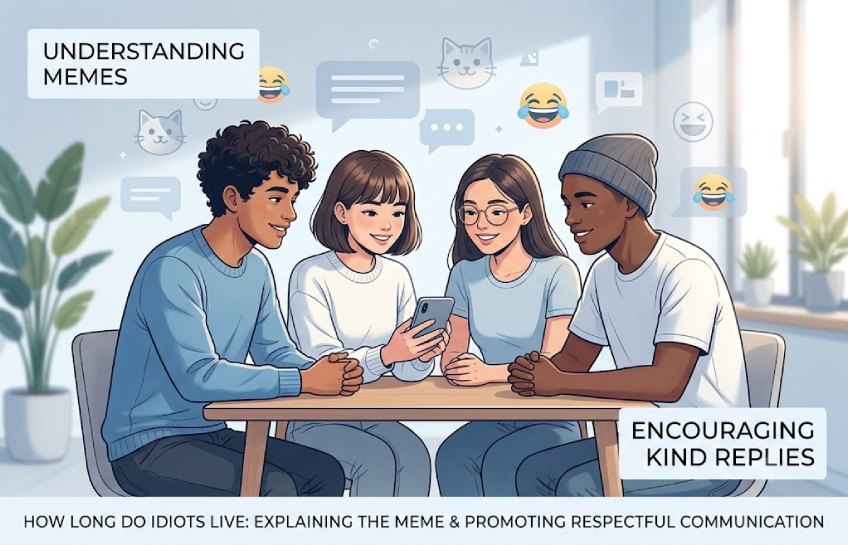
When people search “how long do idiots live,” they’re almost always reacting to something they saw in a video or a group chat—not asking a genuine scientific question. There’s no real lifespan attached to intelligence levels. The phrase is a meme, and the punchline is usually a made-up number like “12–15 years.”
In 2026, this question still circulates on TikTok, Instagram Reels, and YouTube Shorts. If someone just sent it to you, or you’re trying to figure out why it keeps showing up, this guide covers what it actually means, where it came from, and how to respond without making anyone feel bad.
What “How Long Do Idiots Live” Really Means
The direct answer: it doesn’t mean anything scientific. No study, no medical research, and no credible source puts a number on how long people of any intelligence level live. The phrase exists entirely as a meme.
People usually send it in a few situations:
- As a prank in DMs or group chats
- As part of a short-video trend where the “answer” is the joke
- To get someone to Google it and read the punchline themselves
The typical setup goes like this: someone asks the question, another person searches it, they find “12–15 years,” and then the sender adds something like, “You’re older than that, so you’re fine.” The whole point is the twist—you go from mildly confused to relieved to laughing. That’s it.
Where the “12–15 Years” Number Came From
The number is completely invented. No one ran a study on this. A creator somewhere picked a range that sounded oddly specific and ran with it because it made the joke land better than a round number would.
The pattern that made it stick looks like this:
- The question: How long do idiots live?
- The answer: 12–15 years.
- The twist: You’re still here, so that doesn’t apply to you.
Short-form video creators keep the format alive by pairing it with dramatic music, reaction shots, and fake “source” text on screen. The more official it looks, the funnier the payoff feels. Once a few videos go viral, everyone copies the template, and the meme spreads across platforms whether or not the original creator intended it to.
Can This Phrase Be Offensive?
Yes, depending on how it’s used and who it’s directed at.
Calling someone an idiot, even as a joke, is still an insult. When you wrap it in a meme format, it softens the impact—but it doesn’t erase it. For some people, especially younger users or anyone who’s been on the receiving end of real bullying, the word still stings even when the intent is harmless.
A few things that shift it from a joke into something harder to shake off:
- Repeating it to the same person multiple times
- Using it when someone is already feeling insecure or struggling
- Posting it publicly where other people can pile on
The meme itself isn’t inherently cruel. But the context around it matters more than people usually think before they hit send.
How to Reply Without Making It Worse
If someone sends this to you and you’re not sure how to respond, you don’t have to play along with the insult angle to be funny. There are ways to keep things light while still setting a tone you’re comfortable with.
Some options that work depending on the situation:
- “I saw that trend—solid meme, but I’m clearly older than 15.”
- “Nice try. The punchline got me for a second.”
- “Funny, but let’s not actually call each other idiots.”
- “I get the joke. Can we keep it friendly though?”
If you want to flip it into something more positive:
- “Everyone’s made dumb decisions—that’s just called being human.”
- “I’d rather talk about how long good friends stick around.”
These work in comments, DMs, or as a reply to a video. They acknowledge the joke without requiring you to either play dumb or get defensive.
Meme Replies vs. Respectful Replies
| Situation | Meme-style reply | More grounded reply |
|---|---|---|
| Friend sends it as a joke | “Idiots live 12–15 years 😅” | “You’re older than 15, so clearly you’re safe.” |
| Stranger comments it on your post | “Guess you’re an idiot then 😂” | “Let’s keep the jokes friendly—labels stick.” |
| Group chat keeps repeating it | “We’re all idiots, I guess” | “We all mess up sometimes, but I’d skip the label.” |
| You’re uncomfortable with the joke | (no reply) | “Not really into insult jokes—can we switch gears?” |
Why Repeated Insults Matter More Than People Expect
Most people who send this meme genuinely mean no harm. But words used repeatedly, even in joke form, can stick with someone longer than the sender realizes.
Being called stupid, dumb, or an idiot can chip away at how a person sees themselves—especially if they already have doubts about their abilities. That’s true for adults, and it’s more true for teenagers who are still figuring out where they stand.
A few things worth keeping in mind:
- Intelligence isn’t a fixed thing. People get better at things with practice and time.
- Everyone has made decisions they’d take back. That’s not the same as being an idiot.
- A joke that lands once between close friends doesn’t automatically land the same way in a bigger group or with someone you don’t know well.
If this kind of content genuinely bothers you when it shows up, muting or blocking the source is a reasonable call. You don’t owe anyone a participation in a trend that makes you feel bad.
FAQs About the “How Long Do Idiots Live” Trend
Is there any science behind this phrase? No. There’s no research that assigns a different lifespan to people based on intelligence. The 12–15 years figure is made up for the joke.
Why exactly 12–15 years? Because it sounds specific enough to seem plausible for a second. That’s the whole setup—the number is designed to make you pause before the twist lands.
Does searching this make me an idiot? Not at all. It means you saw something odd online and wanted to understand it. That’s just how curiosity works.
Can this meme count as bullying? Between friends who both find it funny, usually no. Directed at one specific person repeatedly, used to embarrass them, or posted publicly to get others to join in—that’s when it crosses a line.
How can I participate in the trend without being mean? Aim the joke at the format, not at a person. “We all outlive that meme” lands the same punchline without putting anyone down.
Is it okay to write about this topic in a blog or article? Yes, as long as you explain the context honestly, avoid fake claims, and don’t use the format to target or mock anyone. That approach fits how search engines and AI tools now evaluate content.
“How long do idiots live” is a meme built on a fake statistic and a decent punchline. Once you know the joke, it’s easy to decide how you want to handle it—laugh along, redirect it, or just leave it alone. If you do pass it on, it’s worth taking a second to think about who’s on the other end of the message and whether the joke will actually land the way you mean it to.

Other Articles

How Many Ex NBA Players Are Jehovah’s Witnesses?

No Comment! Be the first one.