

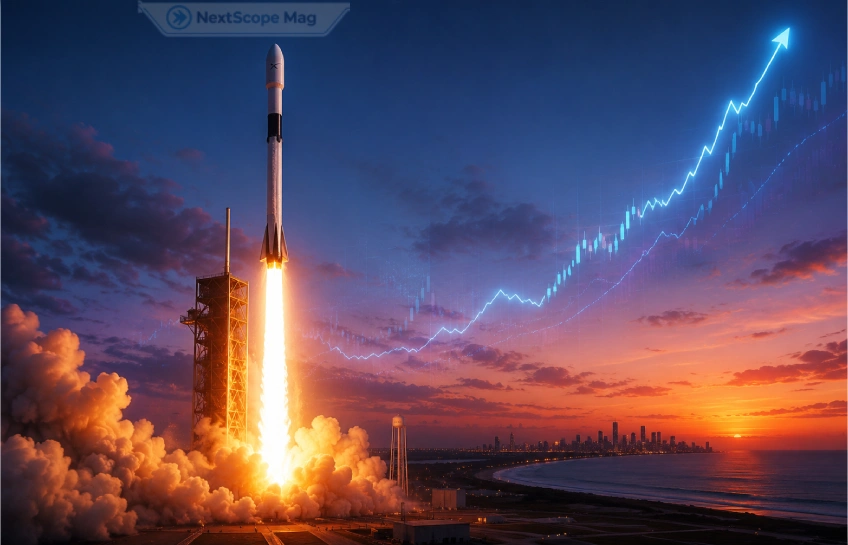
On June 12, 2026, SpaceX listed on the Nasdaq under the ticker SPCX. It raised $75 billion at an IPO price of $135 per share — the largest public offering in stock market history. The valuation at listing was $1.77 trillion. By June 16, trading had pushed that figure above $2.6 trillion. The event made Elon Musk the world’s first trillionaire.
That’s a remarkable headline. But the more interesting question is: how did a company that nearly went bankrupt in 2008 get here?
From PayPal Money to a Risky Rocket Bet
When Musk sold his stake in PayPal in 2002, he walked away with around $165 million. Most people in that position buy a beach house and maybe a sports team. Musk spent roughly $100 million founding SpaceX.
The goal was blunt: cut the cost of getting to space by building reusable rockets. Every major aerospace company at the time treated rockets as single-use hardware. Musk thought that was the core reason space was so expensive, and he was right.
The early years were rough. SpaceX’s first rocket, the Falcon 1, failed on its first three launch attempts between 2006 and 2008. Each failure burned through millions. By mid-2008, Musk was almost out of money. He’d also poured much of his own cash into Tesla, which was also struggling. He said later that if the fourth Falcon 1 launch had failed, SpaceX was done.
It didn’t fail. The fourth launch succeeded in September 2008, and NASA awarded SpaceX a $1.6 billion contract to resupply the International Space Station just three months later. That contract is what kept the company alive.
The Business Insight Nobody Else Was Running With
SpaceX’s core economic idea was simple but radical: if you can reuse a rocket instead of throwing it away after one flight, launch costs drop dramatically.
A typical rocket launch cost $150 million or more in the mid-2000s. SpaceX’s Falcon 9 could launch for around $60 million to start, and over time the cost per launch came down further as reusability improved. The Falcon 9 has now completed over 300 missions, and the same booster has flown more than 20 times.
That cost gap didn’t just make SpaceX competitive. It made every other launch provider look expensive. NASA and the Department of Defense started shifting contracts. Commercial satellite operators followed. The market share story after 2015 essentially became a SpaceX story.
This is vertical integration in a very specific sense: SpaceX makes its own engines, builds its own rockets, runs its own launch operations, and owns the customer relationship. There’s no middleman. That means more margin and more control over the product.
The Funding and Valuation Timeline
SpaceX stayed private for a long time, but it raised capital regularly through private funding rounds. Here’s how the valuation moved:
- 2012: ~$2.4 billion valuation after first commercial ISS docking
- 2015: ~$12 billion after a $1 billion investment round (Google and Fidelity participated)
- 2019: ~$33 billion
- 2021: ~$74 billion
- 2023: ~$137 billion
- Late 2025: ~$800 billion (December tender offer, pre-split pricing)
- February 2026: ~$1.25 trillion (following the merger with xAI)
- June 2026 IPO: $1.77 trillion
That’s not a gradual climb. Most of the value was created after SpaceX proved reusability worked at scale and after Starlink started generating serious revenue.
Starlink: Where the Recurring Revenue Came From
Rockets are impressive, but launch services alone don’t explain a $1.77 trillion valuation. Starlink does.
Starlink is SpaceX’s satellite internet service. SpaceX started deploying the constellation in 2019. By 2025, it had around 10 million subscribers. At roughly $81 in average monthly revenue per user, that’s close to $10 billion in annual revenue from Starlink alone.
Starlink is now SpaceX’s only profitable segment and its biggest revenue generator. For 2025, SpaceX posted $18.7 billion in total revenue, with Starlink accounting for the largest share. The other major chunk — around $5.9 billion — came from U.S. government contracts with NASA, the Department of Defense, and intelligence agencies.
The business model here is unusual. SpaceX launches its own satellites using its own rockets. The vertical integration isn’t just a cost advantage — it’s why Starlink could be built at a scale no competitor has matched.
The xAI Move and the Data Center Play
In February 2026, Musk merged xAI — his artificial intelligence company — with SpaceX at a combined valuation of $1.25 trillion. The integration brought Colossus 1, a data center housing 220,000 Nvidia GPUs built in 120 days, under the SpaceX umbrella.
In March 2026, Colossus 1 secured a deal with Anthropic worth $1.25 billion per month through May 2029, totaling approximately $40 billion over the contract’s life. That’s a significant revenue line, though analysts note either party can exit with 90 days’ notice.
This move shifted SpaceX from being a pure aerospace company to something that straddles rockets, satellite internet, and AI infrastructure. Revenue streams that would have been impossible to predict in 2002 now make up a meaningful part of the company’s financial picture.
Musk’s Ownership and Why It Matters
One of the least-discussed parts of the SpaceX story is how Musk structured his ownership. He retained a dominant equity stake throughout the company’s private years, even as SpaceX raised billions from outside investors.
When SpaceX went public, Musk still controlled more than 80% of shareholder voting power. He didn’t dilute himself down to a small percentage in exchange for early capital. He raised money selectively, kept control, and let the long-term bet play out.
That’s why the IPO made him a trillionaire. If he’d sold off large equity blocks during those early funding rounds to stay liquid, the same IPO event would have been worth far less to him personally. Concentrated ownership, sustained over two decades of near-failures and eventual wins, is what turned the bet into that outcome.
Business Lessons From the SpaceX Story
You don’t need to build rockets to apply the logic here. A few things stand out clearly:
Hold equity as long as you can. The value Musk captured came from not selling early. If you’re building something, diluting less often means more upside when the outcome arrives.
Find the unit economics problem, not the product problem. SpaceX didn’t just try to build a better rocket. It identified why rockets were expensive (single-use) and attacked that specific problem. That’s a very different kind of thinking.
Tolerate visible failures. Falcon 1 failed three times in public. SpaceX kept going. Companies that need every launch to look perfect don’t iterate fast enough to find what works.
Vertical integration is a moat. When you control manufacturing, operations, and customer delivery, you control cost and quality. Starlink only works as a business because SpaceX launches its own satellites at a fraction of what it would cost externally.
Government contracts can fund private ambitions. NASA’s 2008 contract kept SpaceX alive. The company used government money to develop technology it eventually sold commercially at scale. That’s not unusual — it’s a pattern worth studying.
One business can fund the next. Launch services funded Starlink development. Starlink revenue is now funding Starship and AI compute. Each segment bankrolls the next bet.
SpaceX Growth at a Glance
| Year | Milestone |
|---|---|
| 2002 | SpaceX founded with ~$100M of Musk’s PayPal proceeds |
| 2008 | Falcon 1 fourth launch succeeds; NASA awards $1.6B contract |
| 2012 | First private spacecraft to dock with ISS |
| 2015 | Falcon 9 first-stage landing — reusability proved |
| 2019 | Starlink satellite deployment begins |
| 2021 | Valuation hits $74 billion |
| 2023 | Valuation reaches $137 billion |
| 2025 | Revenue: $18.7B; Starlink has ~10M subscribers |
| Feb 2026 | xAI merger; combined valuation $1.25 trillion |
| Jun 2026 | IPO raises $75B; company valued at $1.77 trillion |
Frequently Asked Questions
What is SpaceX’s current valuation? SpaceX went public on June 12, 2026, at a $1.77 trillion valuation. By June 16, 2026, market trading had pushed the valuation above $2.6 trillion.
How much did the SpaceX IPO raise? SpaceX raised $75 billion in its IPO, selling 555,555,555 shares at $135 each on the Nasdaq under the ticker SPCX. It’s the largest IPO in stock market history.
How does SpaceX make money? SpaceX’s revenue comes from three main areas: Starlink subscriber fees (roughly $10 billion in 2025), U.S. government launch and contract revenue (~$5.9 billion in 2025), and commercial launch services. The Colossus 1 AI data center also now generates compute infrastructure revenue.
Is Elon Musk a trillionaire because of SpaceX? Yes. The June 2026 IPO is widely credited with making Musk the world’s first trillionaire, driven by his retained equity stake and voting control of more than 80% of SpaceX shares.
What made SpaceX worth so much more than its revenue would suggest? Investors are pricing in Starlink’s growth potential, Starship’s capabilities, AI infrastructure revenue, and SpaceX’s dominant market position in commercial launch services. The company traded at roughly 94x its 2025 revenue at IPO — a multiple that reflects future expectations, not current profitability.
SpaceX’s story isn’t about one brilliant idea. It’s about a specific combination of equity discipline, cost-focused engineering, long holding periods, and building revenue streams that compound on each other. The trillion-dollar outcome was the result of decisions made decade by decade — not a single bet that paid off overnight.

Other Articles


No Comment! Be the first one.