

If you’ve spent any time browsing German online shops for a compact electric bike, you’ve probably noticed the name bikesly pop up. It’s not a heavyweight in the cycling industry, but it keeps showing up in product listings, second-hand posts, and the occasional blog roundup about budget e-bikes in Europe. This article covers what bikesly actually is, where the brand comes from, what the bikes look like under the hood, where you can buy one, and whether it’s worth comparing to other options in the same price range.
What Is Bikesly?
Bikesly is a brand name used mainly on folding fat-tire e-bikes sold through online marketplaces in Germany. There’s no global flagship store or sprawling manufacturer behind it — it’s more of a label applied to a specific line of compact electric bikes rather than a vertically integrated company with its own factories.
Most people will encounter bikesly through product pages on OTTO or second-hand listings on Kleinanzeigen. A standalone bikesly brand homepage with full specs, support info, and a product catalog doesn’t really exist in any prominent form. That’s worth knowing before you go looking.
Brand Background and Origins
The word mark “BIKESLY” is registered in Germany and tied to AHW GmbH, a company based in Siegen that operates in online retail, online marketing, consulting, and import/export of various goods. That background explains a lot — bikesly functions as a retail label on imported products rather than as a brand that engineers its own bikes from the ground up.
The bikesly name also appears on scooters and kids’ products sold through the same seller network, which suggests it’s positioned as a broader light-mobility label rather than a cycling-only brand. Some recent blog content has framed “bikesly” in the context of modern online bike marketplaces centered on convenience, though much of that content is SEO-driven rather than editorial.
Because the official brand presence is thin, most of what’s publicly available comes from seller descriptions, marketplace product pages, and user reviews. That’s the reality of shopping for a bikesly bike — you’re relying on third-party sources rather than a central brand voice.
Bikesly E-Bike Design and Specs
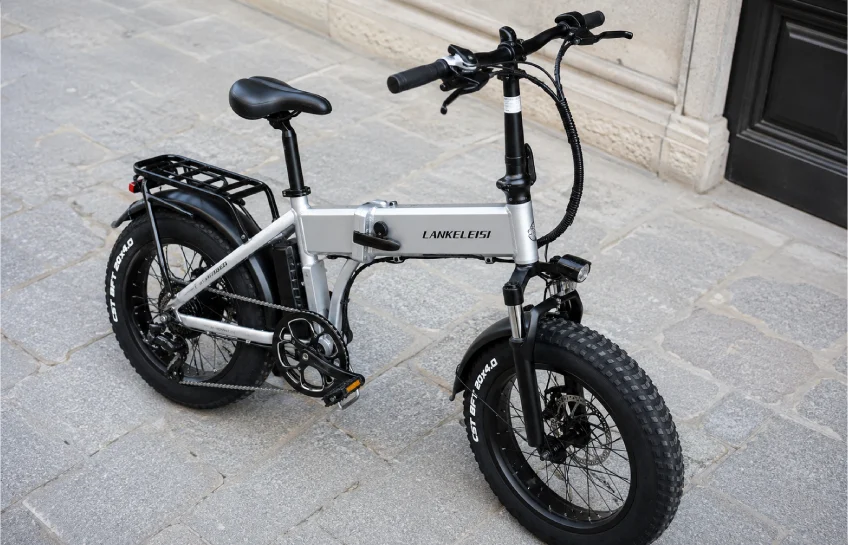
The main bikesly product that shows up consistently across German listings is a folding fatbike with 20-inch wheels. It runs a 250W brushless motor, a 42V lithium-ion battery with around 400Wh of capacity, and a 7-speed Shimano derailleur. The frame is aluminum, which keeps the overall weight reasonable given the chunky tires.
The folding mechanism is one of the more practical features. It lets you collapse the bike down to a size that fits in a car boot, an RV storage compartment, or a small apartment — genuinely useful if you don’t have a dedicated bike shed or outdoor rack.
Some listings also show a “zweite Wahl” (second choice) or B-stock version of the same model, usually at a lower price. The core specs tend to stay consistent, but included accessories and cosmetic condition can vary. Here’s a quick spec summary:
| Spec | Detail |
|---|---|
| Wheel size | 20 inches |
| Motor | 250W brushless |
| Battery | 42V lithium-ion (~400Wh) |
| Gears | 7-speed Shimano |
| Frame | Aluminum, foldable |
Where Can You Buy Bikesly?
The primary place to find a new bikesly e-bike is OTTO’s online shop, where it’s usually listed under the seller “SPIEL-und-SPORT.” OTTO is one of Germany’s largest e-commerce platforms, so availability tends to be fairly consistent, though stock levels shift.
Used bikesly bikes also appear regularly on Kleinanzeigen, where previous owners list them for resale. Prices on Kleinanzeigen are often noticeably lower, but you’re dealing with private sellers, so verifying condition and sorting out any warranty coverage falls entirely on you.
Interestingly, the bikesly name shows up in rental contexts too — “Bikesly Vienna” has appeared among Vienna bike rental options on third-party listing sites. But an official website for that service isn’t easy to track down, and details are limited. For most buyers, marketplace product pages and seller descriptions will be the main information source throughout the buying process.
Riding Experience and Use Cases
The combination of fat tires and a folding frame makes bikesly bikes well-suited for mixed riding — city streets, gravel paths, light trails, and camping trips where you need a compact bike that can still handle rougher ground. Fat tires give a noticeably more cushioned ride compared to standard narrow tires, which matters if your local roads aren’t consistently smooth.
Commuters who use public transport or park in tight spaces should find the folding design genuinely practical. And the 7-speed Shimano gearing means you’re not stuck grinding uphill at a fixed resistance. Owner listings often describe these bikes as solid travel companions for campers and anyone moving between different riding environments.
Pros and Limitations of Bikesly E-Bikes
Every bike has trade-offs, and bikesly is no different. Here’s a straightforward breakdown:
What works in its favor:
- Fat tires handle varied terrain without requiring suspension
- Folding frame fits in cars, campers, and small living spaces
- 7-speed Shimano gearing covers a decent range of terrain
- Aluminum frame keeps weight manageable
- Available through OTTO, a major German retailer with buyer protections
Where it falls short:
- Very little official brand information available online
- Customer support runs through the retailer, not a central brand team
- Spare parts availability and servicing options aren’t clearly communicated
- Warranty terms can differ between individual sellers and listings
- Accessories and charger inclusion vary by listing
Before buying, read the specific listing carefully — pay attention to battery specs, what’s physically included in the box, and how returns or warranty claims actually work with that particular seller.
How Does Bikesly Compare to Other Budget E-Bikes?
Bikesly sits in a genuinely crowded part of the market. Plenty of other import-label folding fat-tire e-bikes are sold across German and European online channels at similar price points. Brands like Engwe, Eleglide, and other marketplace names compete in roughly the same space with comparable specs.
When comparing options, focus on motor and battery specs — 250W and 400Wh are reasonable entry-level figures but far from the top of what’s available at budget prices. Also check who provides the warranty (the retailer or an actual brand service), whether spare parts are available locally, and what user reviews actually say about long-term reliability.
Because bikesly doesn’t carry a strong standalone brand reputation, it makes sense to treat it as one candidate among several rather than a default choice. That doesn’t make it a poor buy — it just means doing the same comparison work you’d apply to any budget e-bike purchase.
Conclusion
Bikesly is best understood as a brand label covering folding fat-tire e-bikes and related light-mobility products, distributed mainly through German online channels. The core product — a 20-inch folding fatbike with a 250W motor and 7-speed Shimano gearing — is a practical option for commuters, campers, and anyone who needs something portable but capable on varied terrain.
It’s not a name with deep brand infrastructure behind it. But if the specs match what you’re after and the listing details check out, it can be a solid, affordable choice. Just verify battery condition, included accessories, and warranty terms before committing — that due diligence matters more here than it would with a well-established brand.

Other Articles


No Comment! Be the first one.