

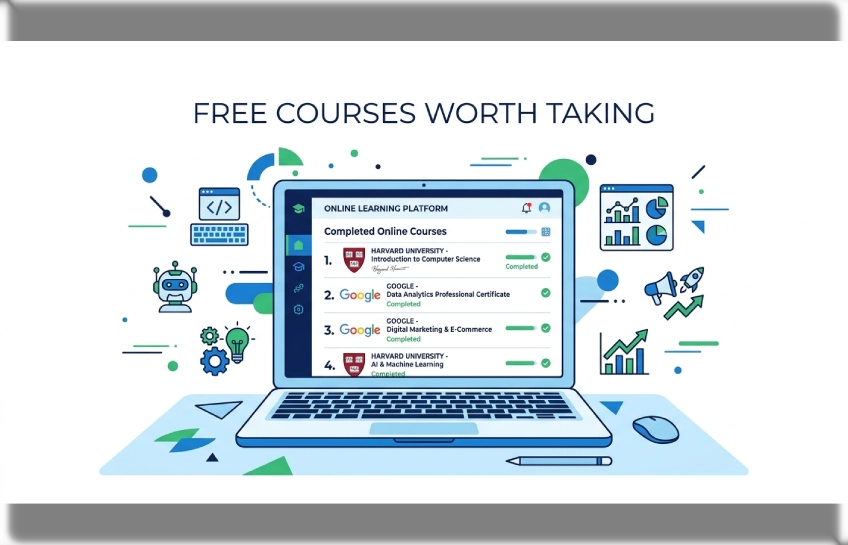
Free learning has come a long way. A few years ago, “free course” usually meant a low-effort video with no real takeaways. Today, that’s completely changed. Some of the best universities and companies in the world now offer genuinely useful content at no cost — covering everything from coding to AI to digital marketing.
But here’s the thing: not every free course deserves your time. Some are outdated, some are just ads for paid upgrades, and some teach so little you’d learn more from a YouTube video. So what are the best free online courses that are actually worth it? That’s exactly what this guide covers.
Whether someone wants to switch careers, pick up a new skill, or just add something solid to their resume, there are real options out there — and they don’t cost a thing.
What Makes a Free Online Course Actually Worth It?
Before getting into specific recommendations, it helps to know what separates a good free course from a forgettable one.
A course is worth taking when it’s taught by a reputable institution or company — think Harvard, Google, MIT, or IBM. These names carry weight, and the material they put out actually reflects real-world standards. Anyone can upload a course, but not everyone can back it up with credibility.
Student reviews matter too. A course with thousands of positive ratings from real learners is a much safer bet than something with almost no feedback. Platforms like Coursera and edX show ratings and enrollment numbers, so it’s easy to spot the popular ones.
Another thing to check: does the course teach job-ready skills, or is it more of a general interest topic? There’s nothing wrong with learning something for fun, but for career growth, courses that focus on practical, in-demand skills will always go further. Things like data analytics, coding, project management, and AI are in constant demand.
One last point — the free vs. paid certificate model. Most platforms let learners access course content for free but charge for the official certificate. That’s fair. The learning itself is what matters most, and in many cases, employers care more about demonstrated skills than a certificate anyway.
Best Free Online Courses for Career Advancement
For anyone trying to grow professionally, a few platforms stand out above the rest.
Google Career Certificates on Coursera cover areas like Data Analytics, IT Support, Project Management, UX Design, and AI Essentials. These aren’t just intro videos — they’re structured programs with assignments, real-world projects, and recognized credentials. The core content is free to audit, which means anyone can go through the material without paying.
Project Management Basics and Business Analytics are two standout picks for people moving into office or remote work roles. They’re practical, well-structured, and don’t assume any prior experience. Employers in many industries know these certificates, which makes them worth the time even if someone never pays for the official certificate.
For those building a portfolio or trying to switch into a more structured career path, [consider checking out related guides on resume-building and job-ready skills here].
Best Free Coding and Tech Courses Worth Taking
This is where one course rises above everything else: Harvard CS50.
CS50 is Harvard University’s Introduction to Computer Science, and it’s one of the most talked-about free courses online. It covers Python, C, algorithms, and web development — all at a real university level. The assignments are challenging, the instructors are excellent, and the community around it is massive. Completing CS50 is something people genuinely put on their resumes.
For pure Python, there are strong beginner options on Coursera and freeCodeCamp. freeCodeCamp in particular is worth mentioning — it’s completely free with no upsells, and it covers web development end-to-end with real projects built along the way.
Cybersecurity is also picking up as a career path, and several free intro courses exist on platforms like Coursera and edX that cover the basics well. If someone’s interested in tech but not sure where to start, CS50 is usually the right answer.
Quick picks for coding:
- Harvard CS50 — best overall beginner programming course
- freeCodeCamp — best for web development with projects
- Python for Everybody (Coursera) — great intro to Python
- Google IT Support Certificate — solid entry point into IT
Top Free AI, Data Science, and Digital Marketing Courses
AI is one of the most searched topics for free learning right now, and thankfully some excellent options are available at no cost.
AI For Everyone by Andrew Ng on Coursera is a great starting point. It doesn’t teach coding — it focuses on understanding what AI is, how businesses use it, and what the ethics around it look like. It’s beginner-friendly and genuinely useful for anyone who works around tech decisions.
Elements of AI from the University of Helsinki is another widely recommended pick. It covers the basics of machine learning, what AI can and can’t do, and the social implications of it all. Many universities in Europe actually encourage students to take it as an introduction to the topic.
For data science, Google Data Analytics on Coursera is one of the most practical free options. It walks through real tools like spreadsheets, SQL, and Tableau, and it builds toward a real outcome — getting comfortable with data in a professional setting.
Digital marketing is a popular free learning area too. Google Digital Garage offers a free Fundamentals of Digital Marketing course with a certification that’s actually recognized by employers. Meta Blueprint also has free beginner courses on social media advertising if that’s the direction someone wants to go.
Best Free University Courses from Top Platforms
Some people want the credibility of a real university without the tuition bill. Platforms like Coursera, edX, and FutureLearn make that possible.
edX hosts free courses from MIT, Harvard, IBM, and Microsoft. The “audit for free” model means anyone can watch lectures, complete readings, and do assignments without spending anything — the only cost is if they want a verified certificate at the end. Courses in Computer Science, Data Science, Business Analytics, and AI are all available this way.
MIT OpenCourseWare is a bit different — it’s not a structured platform with quizzes and completion tracking, but it puts entire MIT syllabi online for free. For self-motivated learners, it’s an incredible resource. The course materials, lecture notes, and problem sets are all there.
Stanford Online also has free options, including courses on machine learning and computer science fundamentals. These aren’t always self-paced, but Stanford’s free offerings are among the most respected available.
The key thing to remember with university platforms: the learning is free, the certificate costs extra. For most people, the learning is the part that actually matters.
Free Online Courses With Certificates That Add Value
Certificates from free courses aren’t all created equal. Some carry real weight, and some won’t impress anyone.
The ones that tend to matter most are those tied to major companies or institutions. Google’s career certificates, for example, are widely recognized in the tech industry. IBM and Microsoft certifications from edX carry credibility in enterprise environments. Harvard CS50’s certificate is well-known in software development circles.
HubSpot Academy is another strong option for marketing and sales professionals. Their free certifications in content marketing, email marketing, and inbound sales are genuinely respected — and they’re completely free, certificate included.
LinkedIn Learning occasionally offers free access to certain courses, and finishing those can show up directly on a LinkedIn profile, which makes them worth considering for anyone actively job hunting.
When deciding whether to pay for a certificate, the honest question is: will this specific certificate be seen by the right person at the right time? For many learners, building skills and doing real projects matters more than the certificate itself.
How to Choose the Right Free Online Course
With so many options, it’s easy to get stuck deciding. Here’s a simple way to think about it.
Start with a goal. Is the point to get a job, improve at a current job, switch fields, or just learn something useful? That one question narrows down the options fast. Someone who wants to work in data doesn’t need a course in UX design right now, no matter how good it looks.
Next, check if the course is current. Technology moves fast. A Python course from 2019 might still be useful, but an AI course from that era probably isn’t. Publication dates and recent reviews help here.
For beginners, courses labeled “no experience required” are the right starting point. It’s tempting to jump into an advanced topic, but most intermediate and advanced courses assume knowledge that beginners haven’t built yet.
Finally, look at the course format. Some people learn better from video lectures. Others prefer reading and quizzes. Some need projects to stay engaged. Most platforms let users preview courses before enrolling, so it’s worth spending five minutes checking the format before committing.
Are Free Online Courses Really Worth It? Pros and Cons
The honest answer is: yes, but with some caveats.
What works well:
- Access to world-class instruction at no cost
- Flexibility to learn at any pace, from anywhere
- Real career impact for in-demand skills like coding, data, and marketing
- Some free certifications genuinely help with job applications
What to watch out for:
- Some free courses are just previews for expensive programs
- Without deadlines or structure, it’s easy to start and never finish
- Free certifications from unknown platforms don’t carry much weight
- Not all course content is updated regularly
That said, free courses from platforms like Coursera, edX, and freeCodeCamp have helped real people land real jobs. The key is treating them seriously — doing the assignments, finishing what gets started, and applying the skills somewhere, even if just in a side project.
When someone approaches a free course with the same focus they’d bring to a paid program, it tends to pay off.
Final Recommendations: Best Free Online Courses to Start With
If someone asked for a simple starting list of the best free online courses that are actually worth it, here’s what holds up:
For beginners:
- Harvard CS50 — best all-around intro to computer science
- Elements of AI — approachable intro to AI concepts
- Google Digital Garage (Fundamentals of Digital Marketing) — practical, free certificate
For career growth:
- Google Data Analytics (Coursera) — strong foundation in data work
- Google IT Support Certificate — entry into IT roles
- HubSpot Content Marketing Certification — useful for marketing careers
For tech learners:
- freeCodeCamp Full-Stack Curriculum — free, project-based, no upsells
- Python for Everybody (Coursera) — reliable Python intro
- MIT OpenCourseWare — self-directed deep learning in CS and beyond
For AI and future skills:
- AI For Everyone (Coursera/Andrew Ng) — great for non-technical learners
- IBM AI Foundations (edX) — solid for those wanting more depth
Start Learning — One Course Is All It Takes
The best time to enroll in a course is before it feels urgent. Skills take time to build, and free platforms like Coursera, edX, and freeCodeCamp make it possible to start without any financial risk.
Picking one course from this list and finishing it — actually finishing it — will do more for any career than bookmarking twenty and never starting. The options are there. The learning is free. The only thing left is to begin.
Ready to explore more? Check out our guides on [free certification courses worth adding to your resume] and [how to build job-ready skills online without paying for a degree].

Other Articles

When to Consult a Lawyer and Why Early Legal Advice Matters
Home Improvement for Beginners: Tools, Tips & Easy Projects

No Comment! Be the first one.