

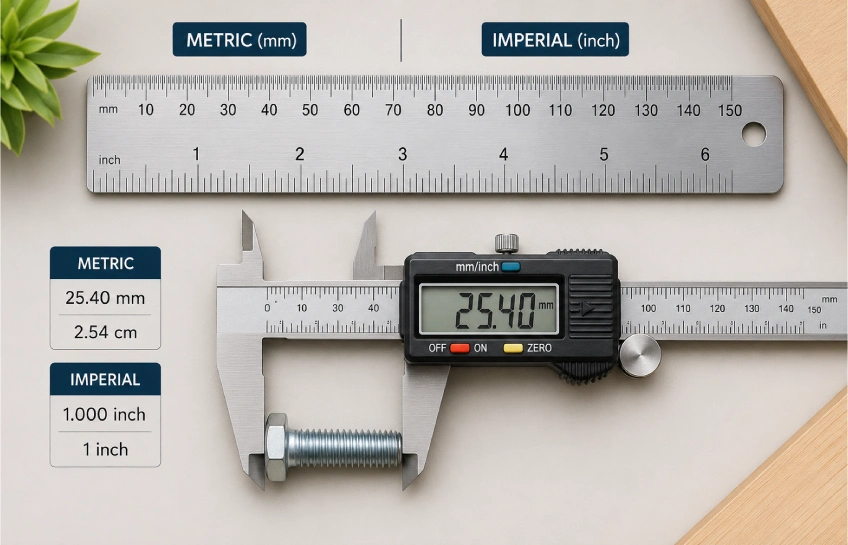
Ever picked up a bolt, a drill bit, or a piece of jewelry that says “12mm” on it and wondered what that actually means in inches? You’re not alone. A lot of people run into this problem, especially if they grew up using inches but now have to deal with metric tools, parts, or measurements.
The short answer: 12mm to inches works out to about 0.4724 inches, which is just a hair under half an inch. But there’s more to it than just one number. In this guide, we’ll break down the math, show you how to do the conversion yourself, and walk through real examples like drill bits, tiles, and rings so you can actually use this in everyday life.
Let’s get into it.
What Does 12mm Equal in Inches?
Here’s the quick answer up front: 12mm equals approximately 0.4724 inches, or roughly 0.47 inches if you round it off. That’s just barely smaller than half an inch (0.5 inches).
This matters more than you’d think. If you’re buying a bolt, a wrench, or a bracelet, mixing up 12mm with “about half an inch” can be a problem. Sometimes that tiny 0.03-inch difference is exactly what causes a bolt to not fit or a socket to slip.
Here’s why people search for this conversion so often:
- They’re shopping for hardware (bolts, screws, drill bits) labeled in millimeters but only have imperial tools.
- They’re working on a DIY project and the instructions mix metric and imperial units.
- They’re buying jewelry, like rings or bracelets, sized in millimeters.
- They’re students or professionals who need to switch between measurement systems for math, engineering, or design work.
Whatever the reason, knowing that 12mm sits just under half an inch gives you a quick mental shortcut. But if you need something more exact, keep reading.
The Basic Formula for Converting Millimeters to Inches
Here’s the rule that makes all of this possible: 1 inch equals 25.4 millimeters. This is the official standard, and it never changes.
So, to turn any millimeter measurement into inches, you just divide by 25.4:
Inches = Millimeters ÷ 25.4
That’s it. That one formula works for every mm-to-inch conversion you’ll ever need, not just for 12mm.
Why 25.4, though? It comes down to how the inch was officially defined. Back in 1959, the United States, the United Kingdom, and a few other countries agreed on an international standard: one inch is exactly 25.4 millimeters. Before that, different countries had slightly different definitions of an inch, which caused all kinds of confusion in trade and manufacturing. Locking it down to 25.4mm fixed that problem for good.
So when you convert 12mm to inches, you’re really just applying this same rule that engineers, machinists, and scientists use every single day.
Step-by-Step Conversion of 12mm to Inches
Let’s actually do the math together. It’s easier than it sounds.
Step 1: Start with your formula. Inches = mm ÷ 25.4
Step 2: Plug in 12 for the millimeter value. Inches = 12 ÷ 25.4
Step 3: Do the division. 12 ÷ 25.4 = 0.47244…
Step 4: Round the answer depending on how precise you need it to be.
Here are the common rounding levels people use:
- 0.4724 inches – four decimal places, good for engineering or precise work
- 0.472 inches – three decimal places, a solid middle-ground option
- 0.47 inches – two decimal places, simple and good enough for everyday use
And if you just need a quick, casual answer for something like woodworking or jewelry sizing, you can round it even further and say “about 1/2 inch.” It’s not exact, but it’s close enough for a lot of real-world situations.
The important thing is knowing which level of precision your project actually needs. A machinist building a part for an engine needs that 0.4724 number. Someone hanging a picture frame probably just needs “about half an inch.”
12mm vs 1/2 Inch: Are They the Same?
Short answer: no, they’re close, but not identical. Half an inch equals 0.5 inches exactly, while 12mm equals 0.4724 inches. That’s a difference of about 0.0276 inches, or roughly 0.7mm.
That might sound tiny, and in a lot of cases, it is. But depending on what you’re doing, that small gap can actually matter:
- Bolts and screws: A 12mm bolt won’t thread properly into a hole sized for a 1/2-inch bolt. The threads are cut differently, and forcing it can strip the threads or damage the part.
- Drill bits: Using a 1/2-inch drill bit instead of a 12mm one can leave a hole that’s slightly too big or too small for what you need.
- Jewelry: A ring or bracelet listed as 12mm might feel a little different than one listed as 1/2 inch, especially for people who are sensitive to fit.
- Woodworking: For rough cuts or spacing, the difference barely matters. But for precise joinery, it can throw off your measurements over time.
So here’s a simple rule of thumb: if you’re doing something precise, like machining, engineering, or exact-fit hardware, always use the real 12mm or 0.4724-inch value. If you’re doing something casual, like a quick DIY fix, “about half an inch” is usually fine.
Real-World Examples of 12mm Measurements
Seeing 12mm to inches in real products helps make the whole conversion click. Here are some common places you’ll run into a 12mm measurement:
- 12mm drill bit – used for medium-sized holes in wood, metal, or masonry, roughly 0.4724 inches wide
- 12mm bolt – a standard metric bolt size used in furniture, machinery, and automotive parts
- 12mm socket or wrench – common in car repair and mechanical work
- 12mm plywood – a popular thickness for furniture building and light construction
- 12mm tile – a common thickness for floor and wall tiles in home renovation
- 12mm laminate flooring – a mid-range thickness that balances durability and cost
- 12mm ring size – refers to the inner diameter of a ring band
- 12mm bead or bracelet – common sizing in jewelry making and beading projects
Why does the exact conversion matter here? Because buying the wrong size part, even by a fraction of an inch, can mean a project that doesn’t fit together right. If you order a drill bit thinking 12mm is “half an inch,” you might end up with a hole that’s slightly too small for the bolt you’re trying to fit through it.
For hobbies like jewelry making or woodworking, this kind of precision is often the difference between a piece that looks professional and one that looks a little off.
Using Online Tools to Convert 12mm to Inches
If you don’t want to do the math by hand every time, plenty of free online calculators can convert 12mm to inches instantly. You just type in the millimeter value, and it spits out the inch equivalent, often in multiple decimal formats.
Here’s what to look for in a good conversion tool:
- Instant results – no need to hit a “calculate” button and wait
- Multiple decimal options – some tools show 2, 3, and 4 decimal places at once
- Fraction conversion – handy tools also show the nearest fraction, like 15/32 inch
- Mobile-friendly – useful for checking measurements on the go, like at a hardware store
Pros of using a calculator:
- Fast and accurate
- No math errors
- Great for converting several measurements quickly
Pros of doing it manually:
- You don’t need internet access
- You actually understand the math behind it
- It’s useful for double-checking a calculator’s answer
Honestly, most people use a mix of both. They memorize the basic formula (mm ÷ 25.4) for quick mental math, but pull up a calculator when they need something more exact or when converting a bunch of measurements at once.
Common Millimeter to Inch Conversions Near 12mm
Since 12mm doesn’t work alone in most projects, it helps to know how nearby millimeter sizes convert too. Here’s a quick reference table:
| Millimeters | Inches (rounded) |
|---|---|
| 10mm | 0.3937 in |
| 11mm | 0.4331 in |
| 12mm | 0.4724 in |
| 13mm | 0.5118 in |
| 15mm | 0.5906 in |
Looking at this table, you can see that 12mm sits right between 11mm and 13mm, and just below the 13mm mark, which is the closest common size to a true half-inch (0.5 inches, which is actually closest to about 12.7mm).
This kind of side-by-side view is super handy when you’re shopping for hardware or comparing sizes at a store, since products often come in a range of nearby metric sizes.
Tips for Switching Between Metric and Imperial in Everyday Projects
Working between two measurement systems can get confusing fast, but a few simple habits make it a lot easier.
- Keep the 25.4 rule handy. Write it down or save it in your phone notes. It’s the only number you really need to remember.
- Don’t mix systems mid-project. If your plans are in millimeters, try to stick with millimeters the whole way through instead of switching back and forth.
- Use a dual-unit tape measure or caliper. Many tape measures and digital calipers show both mm and inches side by side, which saves you from doing conversions altogether.
- Round carefully. Know when precision matters (engineering, machining) and when it doesn’t (rough estimates, casual DIY).
- Double-check hardware compatibility. Metric and imperial bolts, screws, and drill bits are not interchangeable, even when they look close in size.
Following these habits helps you avoid small but annoying mistakes, like buying the wrong size bolt or cutting a piece of wood a little too short.
Frequently Asked Questions About 12mm to Inches
Is 12mm considered small or medium in common products? It depends on the product, but generally, 12mm falls in the small-to-medium range. For drill bits and bolts, it’s a common mid-size option. For tile or flooring thickness, 12mm is often considered a solid, mid-range choice, not too thin and not overly thick.
Should I round 12mm to 0.47 or 0.5 inches? It depends on what you’re doing. For precise work like machining or hardware fitting, stick with 0.4724 or 0.47 inches. For casual, everyday estimates, rounding to “about 1/2 inch” is usually fine.
How do I convert other millimeter values to inches quickly? Just use the same formula: divide the millimeter value by 25.4. For example, to convert 20mm, you’d calculate 20 ÷ 25.4, which gives you about 0.7874 inches. The formula stays exactly the same no matter what millimeter value you’re starting with.
Conclusion
At the end of the day, converting 12mm to inches isn’t complicated once you know the trick. Just remember: 12mm equals about 0.4724 inches, or roughly half an inch if you’re rounding casually. The formula behind it, dividing by 25.4, works for any millimeter measurement you’ll ever come across, not just this one.
Whether you’re picking out a drill bit, buying a ring, or working through a school math problem, having this conversion in your back pocket saves you time and helps you avoid sizing mistakes. Bookmark this page next time you need a quick millimeter-to-inch answer, or share it with a friend who’s stuck staring at a metric tape measure.



No Comment! Be the first one.