

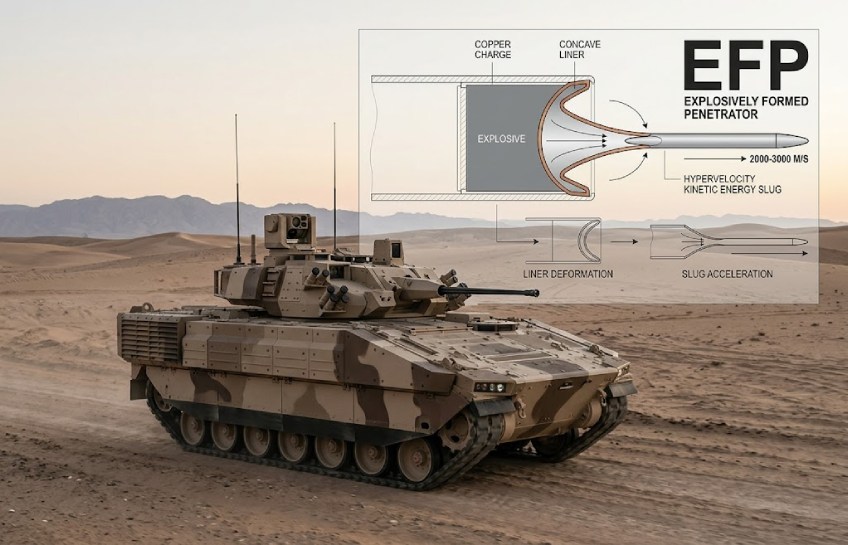
An EFP bomb is one of the most dangerous anti-armor weapons ever adapted for roadside use. It doesn’t just blast a target — it punches through it.
When news reports mention “explosively formed penetrators,” they’re describing a specific type of explosive that turns a metal plate into a high-speed projectile. That projectile can defeat thick armor at a distance that most conventional explosives simply can’t match.
This guide explains what an EFP bomb is, how the science behind it works, where these weapons have been used, and what the safety and legal picture looks like in 2026.
Basic Definition of an EFP Bomb
An EFP bomb is an explosive device that uses a shaped metal liner and a precisely directed explosive charge to form a single, dense, high-velocity slug that can penetrate armored vehicles from a significant distance.
EFP stands for explosively formed penetrator or explosively formed projectile. You may also see the terms self-forging warhead or self-forging fragment — all refer to the same underlying physics.
What sets an EFP apart from most improvised explosive devices is where its lethality comes from. A typical roadside bomb kills and injures through blast force and flying fragments. An EFP’s primary threat is the penetrator itself — a focused, aerodynamic slug of metal that keeps its shape over distance and can breach armor that would stop almost anything else.
How an EFP Bomb Works
An EFP bomb works by using explosive energy to reshape and propel a concave metal plate into a compact projectile traveling at extreme speed.
When the charge detonates, the force pushes the center of the dish-shaped metal liner forward while simultaneously squeezing the edges inward. The result is a dense slug — formed in microseconds — that launches toward the target. Unlike many other shaped-charge designs, this slug holds its shape over a much greater distance, which is what gives EFPs their standoff capability.
Shaped Charge vs. Explosively Formed Penetrator
Understanding the difference between an EFP and a conventional shaped charge helps explain why militaries take EFPs so seriously.
| Feature | Conventional Shaped Charge | EFP |
|---|---|---|
| Liner shape | Deep cone | Shallow dish |
| Projectile formed | Thin, fast metal jet | Dense slug or rod |
| Effective range | Short standoff distance | Long standoff distance |
| Armor penetration depth | Very high (close range) | Moderate but consistent |
| Fragility of projectile | Breaks up quickly | Maintains shape over distance |
| Primary use case | Anti-tank warheads (close contact) | Roadside bombs, top-attack weapons |
A conventional shaped charge like a HEAT (high-explosive anti-tank) warhead produces a narrow, extremely fast metal jet using what’s known as the Munroe effect. That jet is devastating at close range but breaks apart quickly as distance increases.
An EFP, by contrast, applies the Misnay-Schardin effect — using a shallower liner geometry to produce a slower but far more stable projectile. The trade-off is slightly less maximum penetration than the best jet-forming charges, but the ability to defeat armor from hundreds of feet away. That makes EFPs ideal for hidden roadside weapons and top-attack systems designed to strike vehicles from above.
History and Origins of EFP Technology
The technology behind EFP bombs didn’t start on a battlefield. It started in the oil industry.
American petroleum engineers in the 1930s developed shaped-charge perforating tools to punch holes through well casings underground, allowing oil and gas to flow into production wells. Those tools used the same basic physics — an explosive reshaping a metal liner into a penetrating slug — that would later be adapted for weapons.
Military researchers recognized the potential, and EFP-style warheads were developed and used in World War II. Over the following decades, the technology was refined and integrated into artillery submunitions, anti-tank missiles, and top-attack weapon systems.
By the late 20th century, EFP technology had spread far beyond conventional military programs. Armed groups in various conflicts began adapting the physics into improvised roadside weapons, with devastating effect.
Use of EFP Bombs in Modern Conflicts
EFP bombs have appeared in a range of conflicts across several decades. Their presence typically signals a level of technical capability beyond basic improvised explosives — either developed locally or supplied by a state or organization with relevant expertise.
Iraq and the Middle East
The Iraq War brought EFP roadside bombs to global attention. During the insurgency period following the 2003 invasion, these devices became one of the most feared threats to coalition convoys and patrols.
Unlike standard IEDs, EFP bombs were able to penetrate armored Humvees and some mine-resistant vehicles specifically designed to handle blast-based threats. The penetrator didn’t need direct contact — it could breach a vehicle from the side of the road with the device concealed in debris, concrete blocks, or roadside objects.
U.S. and allied military officials publicly linked many of the EFP devices found in Iraq to Iran and Hezbollah, stating that designs, components, or complete devices were being supplied to insurgent groups operating in the country. The Long War Journal and other defense-focused outlets documented this supply chain extensively.
Similar EFP technology has been reported in Yemen, where advanced anti-armor roadside bombs have been used against military vehicles in an ongoing conflict that has drawn international attention and counter-IED efforts.
Northern Ireland
Dissident republican groups in Northern Ireland also adopted EFP technology. Devices were used against police and security vehicles, including armored Land Rovers, with incidents recorded into the 2010s and early 2020s. These attacks demonstrated that EFP knowledge had spread well beyond major state actors and into smaller, regionally focused armed organizations.
Other Applications
Beyond warfare, EFP physics have been used in peaceful scientific research. A Japanese space mission used an EFP-based impactor to create a crater on an asteroid for sampling purposes — the same shaped-charge principles that make EFPs dangerous in conflict zones also make them precise enough for space science.
Why EFP Bombs Are So Dangerous
A well-designed EFP can accelerate a multi-kilogram metal slug to speeds around Mach 6 — approximately 2,000 meters per second — and defeat tank-level armor from roughly 100 meters away or more.
That combination of speed, mass, and standoff distance is what makes these weapons exceptional threats to armored vehicles. Even heavily protected vehicles can be penetrated, and when the slug enters a vehicle, it generates secondary fragments — called spall — that cause severe casualties to anyone inside.
Several factors compound the danger:
- Standoff range: The device doesn’t need to be directly under or against a vehicle. It can be concealed at a distance and still be lethal.
- Concealment: EFP devices can be hidden in ordinary roadside objects, making detection extremely difficult.
- Targeting precision: Devices can be angled and positioned to strike specific parts of a vehicle — wheels, crew compartment, fuel systems.
- Scalability: Military-grade EFP warheads can use multiple detonators or multiple liners (MEFPs — multiple explosively formed penetrators) to spread the threat across a wider area or against multiple targets simultaneously.
These characteristics explain why militaries have invested heavily in counter-EFP technologies, including electronic jamming, vehicle armor upgrades, route clearance operations, and detection systems.
Civilian Safety and Humanitarian Impact
For civilians in conflict-affected or post-conflict areas, the core safety message is simple: never approach or touch any suspicious object that might be an explosive device.
International organizations including the United Nations Mine Action Service (UNMAS) consistently emphasize the same guidance:
- Move away from any suspicious object immediately.
- Do not touch, move, or attempt to examine it.
- Warn others in the area.
- Contact local authorities, peacekeepers, or emergency services and report the location.
Explosive remnants of war — including EFP components, unexploded ordnance, and abandoned IED materials — remain dangerous for years or decades after active conflict ends. Children are particularly at risk, as unfamiliar objects can appear interesting or valuable.
The humanitarian impact of EFP bombs extends beyond direct casualties. These weapons:
- Block roads and restrict movement of people and aid.
- Reduce access to hospitals, schools, and markets.
- Create lasting fear in communities, preventing a return to normal life.
- Require expensive, dangerous, and time-consuming clearance operations to make areas safe again.
International demining and victim-assistance programs work in post-conflict regions to address these long-term effects, but the scale of contamination in places like Iraq and Yemen remains significant.
Legal and Anti-Terrorism Context
EFP bombs occupy a serious position in international law, criminal law, and civil litigation — not just in military doctrine.
When used against civilian or non-combat targets, EFP attacks are often prosecuted under terrorism laws. In the United States, a significant body of litigation has developed around EFP attacks during the Iraq War. Veterans and families of those killed or injured have brought lawsuits alleging that financial institutions facilitated the funding of groups responsible for EFP attacks.
One major category of cases involves claims that banks processed wire transfers that ultimately helped fund militant groups manufacturing or deploying EFP roadside bombs. These cases have been argued under the Anti-Terrorism Act and have pushed the boundaries of financial institution liability for downstream violence.
The legal principle being tested: responsibility for EFP attacks doesn’t stop with the people who built or detonated the device. Financial networks, arms suppliers, and training providers have all faced legal scrutiny.
Outside of strictly controlled military, law enforcement, and scientific research contexts, the manufacture, possession, or use of explosive devices — including EFP-type devices — is illegal in virtually every jurisdiction. Laws covering explosives, terrorism, and weapons manufacture apply with severe penalties.
FAQs About EFP Bombs
What does EFP stand for in bombs? EFP stands for explosively formed penetrator or explosively formed projectile. It refers to a type of shaped charge that produces a dense slug instead of a thin metal jet.
How powerful is an EFP bomb compared to a normal IED? Against armored vehicles, an EFP bomb is significantly more dangerous than a standard blast IED. Its metal slug can penetrate thick armor at standoff distances that most conventional explosives cannot match.
Can an EFP bomb be stopped by modern armor? Modern vehicles use thicker armor, reactive armor panels, and other protective systems that reduce EFP effectiveness. However, advanced EFP designs remain capable of defeating many existing protection systems, making them an ongoing priority in vehicle protection research.
Are EFP bombs still used in conflicts today? Yes. Reporting and defense analysis through the mid-2020s confirms that EFP-style devices and warheads continue to appear in conflicts in the Middle East and other regions.
Is it illegal to build or possess an EFP device? In nearly every country, manufacturing or possessing explosive devices outside of authorized military, law enforcement, or research contexts is illegal under explosives, weapons, and terrorism laws. Penalties are severe.
What should civilians do if they see a suspicious roadside object? Do not approach or touch it. Move away calmly, warn others nearby, and immediately report it to local police, military authorities, or emergency services.
Conclusion
An EFP bomb is a specific, sophisticated type of explosive — one designed not just to cause a blast but to defeat armor through physics. From its origins in oil well engineering to its use in some of the most significant conflicts of the last 30 years, the explosively formed penetrator has reshaped how militaries think about roadside threats and vehicle protection.
Understanding what EFP bombs are, where they’ve appeared, and why they’re so dangerous helps put news stories, military policies, and anti-terrorism lawsuits into proper context. And for anyone in or near conflict zones, the safety message stays constant: suspicious objects on roadsides are never worth investigating. Report and move away.

Other Articles

How Many Ex NBA Players Are Jehovah’s Witnesses?
Builder Gel Nails: Easy Guide to Strong, Natural Nails

No Comment! Be the first one.