

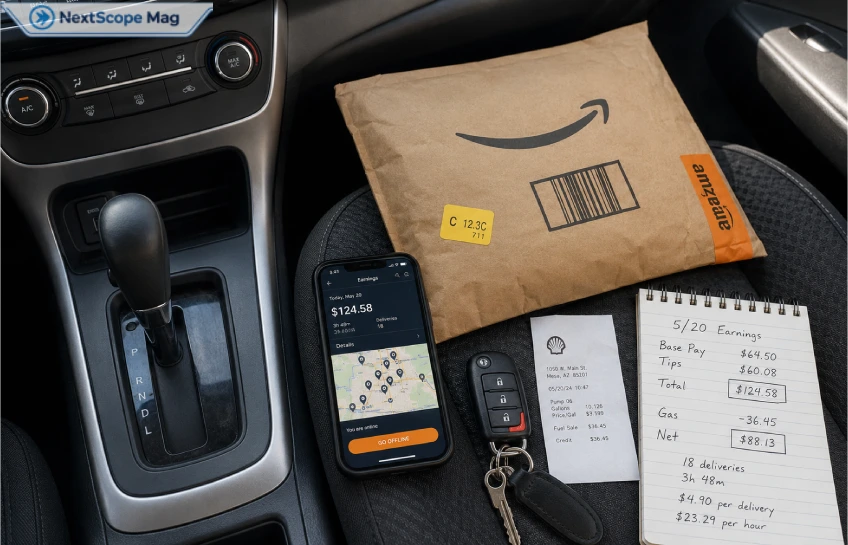
Amazon Flex sounds like a solid deal on paper — pick your own hours, deliver packages, get paid. But is Amazon Flex worth it once you factor in gas, car wear, and all the unpaid time spent waiting for blocks? The answer depends on who you are and what you’re expecting from it.
This article breaks down real driver earnings, the actual costs most people forget, and which types of people tend to do well with Flex versus who should probably look elsewhere.
What Is Amazon Flex and How Does It Work?
Amazon Flex is a delivery program where drivers use their own car to pick up and drop off Amazon packages, groceries, or same-day orders. Drivers are independent contractors, not employees.
Drivers open the Amazon Flex app and grab “blocks” — pre-scheduled shifts usually lasting two to four hours. Each block has a fixed payout, and some delivery types also include customer tips.
How the Amazon Flex App Assigns Delivery Blocks
Blocks appear in the app throughout the day. They go fast, especially in busy markets. Drivers need to refresh the app frequently and be ready to accept a block the moment it shows up.
There’s no guaranteed minimum number of blocks per week. In high-demand areas, getting a few blocks most days is realistic. In quieter markets, drivers can go days without finding anything.
Types of Deliveries You’ll Handle
Amazon Flex covers three main delivery types:
- Standard packages — boxes from regular Amazon orders dropped at front doors
- Amazon Fresh / Prime Now groceries — bagged grocery orders that need careful handling and sometimes refrigerated bags
- Same-day orders — faster-moving blocks that pay slightly differently depending on location
Basic Requirements to Get Started
To sign up for Amazon Flex, drivers need:
- A valid driving license
- A car that meets Amazon’s requirements (most standard sedans qualify)
- A background check clearance
- A smartphone to run the Flex app
- Proof of insurance
Where Amazon Flex Operates in 2026
Flex is available across the US, UK, Canada, Australia, and Germany, among other markets. Within those countries, coverage is concentrated in larger cities and metro areas. Drivers in New York, Los Angeles, Chicago, London, and Manchester tend to have the most consistent block availability.
Rural drivers often find far fewer blocks available, which significantly affects whether it’s worth doing at all.
How Much Do Amazon Flex Drivers Really Earn?
Amazon Flex pays roughly $18–$19 per hour in the US and £14–£18 per hour in the UK — but those are gross figures before expenses. Net earnings after costs are notably lower.
Advertised Pay vs. What Drivers Actually Take Home
Amazon’s own figures quote competitive hourly rates, and third-party salary data from ZipRecruiter puts the average Amazon Flex driver’s full-time equivalent pay at around $38,383 per year in the US — about $18–$19 an hour.
That sounds decent. But those numbers don’t subtract anything. No gas. No wear on the car. No self-employment tax. No unpaid time spent waiting.
Many drivers in Reddit communities — particularly r/AmazonFlex and r/couriersofreddit — say the real net figure can be significantly lower once everything comes out.
Sample Earnings Math for a Typical 3-Hour Block
Here’s a rough example for a US driver taking one 3-hour block at $18/hour:
| Item | Amount |
|---|---|
| Gross block pay | $54.00 |
| Fuel (30 miles at $0.21/mile) | −$6.30 |
| Vehicle wear estimate ($0.10/mile) | −$3.00 |
| Unpaid waiting time (30 min) | −$9.00 worth of time |
| Self-employment tax (~15.3%) | −$8.26 |
| Estimated net take-home | ~$27–$34 |
That puts real net hourly earnings closer to $9–$11 depending on the car and location. It’s not nothing, but it’s a long way from the advertised rate.
How Surge Pay and Peak Seasons Can Boost Income
Pay rates aren’t flat year-round. During peak seasons — especially Q4 leading up to Christmas — block rates go up noticeably. Surge pricing also applies during unusually high demand periods.
Drivers who specifically target peak blocks can see their gross hourly rate climb to $22–$25+ in some US cities. For side hustlers who treat Flex as a seasonal income boost, this is where it actually starts to make financial sense.
The Hidden Costs Most New Amazon Flex Drivers Forget
The costs of driving for Amazon Flex go well beyond gas. They’re the main reason many drivers are disappointed after their first few weeks.
Fuel, Maintenance, and Car Depreciation Explained
Fuel is the most obvious cost, but it’s not the biggest one long-term. Every mile put on a personal vehicle adds wear. Tires, brakes, oil changes, and eventually major repairs all come faster when a car is doing delivery routes daily.
Vehicle depreciation — the drop in resale value — is harder to see in real-time but adds up fast. A fuel-efficient compact car keeps these costs manageable. An older, thirstier vehicle can eat through earnings quickly.
Insurance and Safety Gear Costs
As an independent contractor, the driver’s personal auto insurance applies by default. Some standard personal policies don’t cover commercial delivery use. Drivers who don’t check their policy or get commercial riders added could face denied claims after an accident.
There’s also the cost of useful gear:
- A phone mount for safe navigation
- A dash cam for protection in disputes
- Thermal bags for Fresh grocery orders (sometimes required)
- A mileage tracking app for tax deductions
None of these are expensive individually, but they’re costs the gross hourly rate doesn’t account for.
Unpaid Time: The Hidden Earnings Killer
This one surprises new drivers the most. Time spent refreshing the app waiting for a block to appear doesn’t pay. The drive to the warehouse pick-up point doesn’t pay. Standing in line at the delivery station waiting for packages doesn’t pay.
When drivers include that unpaid time in their real hourly calculation, the effective rate drops considerably. A three-hour block that takes four-and-a-half hours of total time commitment is really paying for four-and-a-half hours, not three.
How Taxes Hit Amazon Flex Drivers
Amazon Flex drivers are self-employed, which means they pay self-employment tax on top of income tax. In the US, that’s around 15.3% on net earnings, on top of whatever income tax bracket applies.
The upside is that fuel, mileage, and certain vehicle expenses are tax-deductible as business costs. Tracking every mile with an app like Stride or MileIQ makes a real difference at tax time.
Pros of Driving for Amazon Flex (When It Feels Worth It)
For the right person in the right situation, Amazon Flex genuinely works. Here’s when it tends to pay off.
Flexibility and Control Over Schedule
Flex has no set shifts assigned by a manager. Drivers choose which blocks to accept and when to work. That makes it genuinely compatible with school schedules, childcare commitments, or a second job.
Early morning blocks (4–7am) and late night blocks are often easier to grab because fewer drivers want them. For someone who’s already awake at those hours, it’s low-competition income.
Using Amazon Flex to Stack With Other Gig Apps
Amazon Flex works well alongside DoorDash, Instacart, or Uber Eats. Drivers can fill dead time between other gig jobs with Flex blocks, or use Flex for its more predictable block structure while relying on food delivery for flexible top-up income.
When Earnings Can Beat a Part-Time Job
In high-demand cities during peak blocks, Flex can genuinely outpay a standard part-time retail or customer service job — especially for people who already own a fuel-efficient car and don’t need to factor in extra insurance costs.
Cons of Amazon Flex (When It’s Probably Not Worth It)
The downsides are real, and they catch a lot of new drivers off guard.
Inconsistent Blocks and Unpredictable Income
There’s no guarantee of work. Some weeks a driver might grab 15–20 hours of blocks. Other weeks, especially in slow seasons or saturated markets, blocks dry up fast. Anyone relying on Flex as their primary income quickly discovers this problem.
Physical and Mental Strain
Delivery driving is more tiring than it sounds. Navigating traffic for hours, carrying packages of varying weights, finding addresses in unfamiliar neighbourhoods at night, and dealing with parking all take a toll. It’s not a desk job.
App Frustrations and Route Problems
The Flex app has a reputation for occasional glitches, poorly optimized routes, and slow loading times. Customer issues — such as incorrect addresses, access-code problems, or missed delivery instructions — fall on the driver to resolve without much support infrastructure.
When a Regular Hourly Job Might Be Better
If someone needs stable, predictable income, Flex isn’t it. A part-time retail or service job at $15/hour with guaranteed weekly hours often beats Flex’s net earnings and comes with far less uncertainty.
Is Amazon Flex Worth It Compared to Other Gig Apps?
Amazon Flex holds its own against some competitors but falls short in others. The right choice depends on a driver’s priorities.
| App | Pay Structure | Schedule Control | Tips Possible? |
|---|---|---|---|
| Amazon Flex | Fixed block pay + tips (Fresh) | High — choose blocks | Yes (Fresh/Prime Now) |
| DoorDash | Per-order + tips | High — log in anytime | Yes |
| Uber Eats | Per-order + tips | High | Yes |
| Instacart | Per-order + tips | Moderate | Yes |
| Uber/Lyft | Per-ride + tips | High | Yes |
Amazon Flex vs Rideshare (Uber, Lyft)
Rideshare pays per trip and tends to be better in busy urban nightlife or event areas. Flex is more predictable because the block pay is guaranteed upfront, whereas rideshare income depends entirely on demand moment-to-moment.
Amazon Flex vs Food Delivery (DoorDash, Uber Eats)
Food delivery apps let drivers log on and off anytime, which is more flexible than grabbing blocks. But income per hour varies more. Some drivers run both apps simultaneously to maximize earnings in a single shift.
Amazon Flex vs Grocery Delivery (Instacart, Shipt)
Instacart and Shipt shoppers spend time inside stores picking orders before delivering. That indoor time is better for bad weather but can extend a shift considerably. Flex is purely driving, which some people strongly prefer.
Who Amazon Flex Is Actually Good For (Real-World Scenarios)
Scenario 1 — Student Looking for Weekend Cash
A university student with a small, fuel-efficient car and free mornings or weekends can do reasonably well with Flex. They’re not depending on it, competition for blocks is lower at odd hours, and the cash supplements their budget without requiring a fixed schedule.
Scenario 2 — Full-Time Worker Adding Early Morning Blocks
A nine-to-five worker grabbing 6am blocks two or three mornings a week can realistically add $200–$400 a month in extra income with minimal disruption to their main job. In this context, Flex is one of the cleaner side income options available.
Scenario 3 — Retiree or Stay-at-Home Parent Seeking Flexible Income
Retired people or parents with children in school during the day often find Flex fits their lives well. They’re not chasing peak-hour money — they just want meaningful activity and supplementary cash during hours that suit them.
Scenario 4 — Rural vs Urban Driver
Urban drivers in cities with high Amazon delivery volume almost always have better experiences. More blocks means more income and less wasted waiting time. Rural drivers often struggle to find enough blocks to make the driving and prep time worthwhile.
How to Decide if Amazon Flex Is Worth It for You
Before signing up, it’s worth doing a quick personal earnings check. The math isn’t complicated, and it’ll save a lot of frustration.
Simple Formula to Estimate Your True Hourly Rate
Here’s how to get a realistic number:
- Start with the advertised block rate (e.g., $18/hour × 3-hour block = $54)
- Subtract fuel cost (miles driven × local fuel cost per mile)
- Subtract vehicle wear estimate ($0.08–$0.15 per mile is reasonable)
- Subtract self-employment tax (~15% of net)
- Divide by total time committed, including waiting and travel to the warehouse
That number is the real effective hourly rate.
Checklist: Signs Amazon Flex Might Be a Good Fit
- They already own a fuel-efficient car with low mileage
- They live in or near a major city with high Amazon delivery volume
- They want supplementary income, not a primary salary
- They have flexible time — especially odd hours when blocks are easier to grab
- They’re comfortable with income that varies week to week
When to Walk Away From Amazon Flex
Drivers who find themselves spending more than 30–40 minutes waiting for blocks that pay out below $18/hour in expensive fuel markets should reconsider. At that point, other gig apps or even a straightforward part-time job will net more per hour with less hassle.
Is Amazon Flex Worth It in 2026? The Honest Answer
So, is Amazon Flex worth it? For a side hustle, it can be — particularly for people in busy cities who own a fuel-efficient car and aren’t relying on it to pay the bills. The flexibility is real, the pay is decent on a gross basis, and peak season earnings can be surprisingly good.
But it’s not a solid income source for most people. The hidden costs — fuel, wear, taxes, and unpaid time — take a serious bite out of those advertised hourly rates. Anyone treating it like a full-time income will likely be disappointed.
The drivers who get the most out of Flex are the ones who go in with clear expectations, track their real expenses from day one, and use it as one piece of a broader income strategy rather than the whole thing.
Thinking about signing up? Calculate your real estimated hourly rate using the formula above before taking your first block. That one step saves a lot of disappointment later.

Other Articles

Best Restaurants Near Me for Every Taste & Budget
Lamps4U – Sustainable LED Lighting for UAE & GCC

No Comment! Be the first one.