

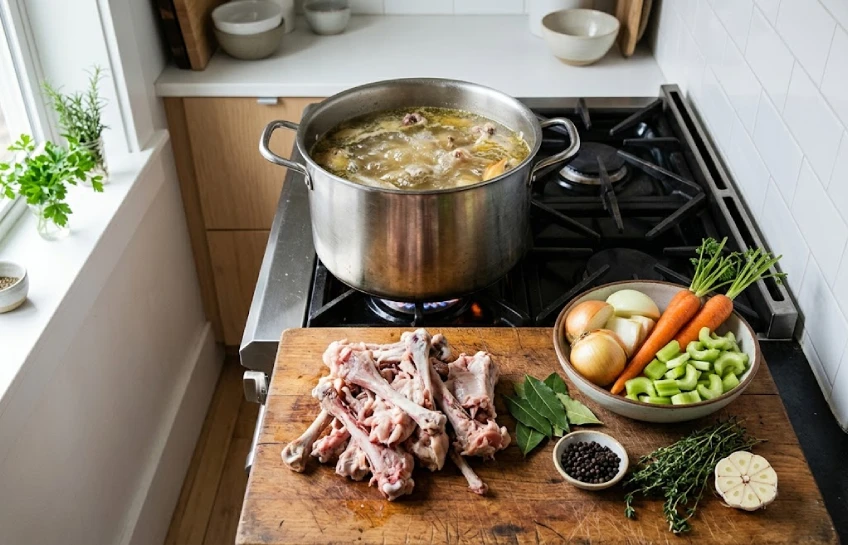
If you cook even once a week, learning how to make soup stock is one of those skills that quietly changes everything. A good stock turns basic vegetables, grains, and leftover meat into food that actually tastes like something you’d order in a restaurant.
In this guide, I’ll walk you through exactly how to make rich, reliable soup stock at home, even if you’re starting with nothing more than bones and vegetable scraps.
What Soup Stock Actually Is (And Why It Matters)
Most people use “stock” and “broth” interchangeably, but they’re not exactly the same. Stock is usually made by simmering bones, connective tissue, and aromatic vegetables in water over a longer period, so you extract flavor, minerals, and gelatin. Broth tends to be lighter, often made from meat and vegetables, and usually seasoned more aggressively.
In practical terms, stock is your flavor base. You use it to build soups, sauces, gravies, risottos, and braises. If the stock is weak or flat, the final dish will never taste great, no matter how much salt or seasoning you throw at it.
Professional kitchens treat stock like liquid gold: it runs quietly in the background and powers almost everything on the menu. At home, one pot of good stock can support your cooking for the entire week.
Stock vs broth – does it really matter?
For everyday home cooking, you don’t need to obsess over the terminology.
- If it’s made mostly with bones and simmered for hours: you’re essentially making stock.
- If it’s based on meat and more lightly flavored, seasoned enough to sip straight: that’s closer to broth.
The good news: any “good pot of flavored cooking liquid” will already put you miles ahead of boxed stock.
The four classic types of stock
Classically, you’ll see four main stock families:
- Meat stock (often beef or veal)
- Poultry stock (chicken, turkey)
- Fish stock (and fumet, a concentrated version)
- Vegetable stock
You’ll use poultry and vegetable stock most at home. Fish stock is great for chowders and seafood soups, and beef stock supports stews and gravies.
Core Principles of Making Soup Stock
Before we get into recipes, a few core principles matter more than any exact ratio.
Start with cold water
You always want to start with cold water. When you add bones and vegetables to cold water and then gently bring everything up to temperature, proteins and impurities rise slowly to the surface. That makes it much easier to skim and gives you a clearer, cleaner stock.
If you pour boiling water over raw bones, you tend to lock some of those impurities into the liquid, which can give you a cloudy, murky result.
Simmer, don’t boil
This one is huge.
A stock that rolls at a full boil:
- Emulsifies fat into the liquid
- Breaks up impurities and distributes them through the pot
- Often turns cloudy and can taste “muddy”
A stock that gently simmers with tiny lazy bubbles:
- Extracts flavor and gelatin gradually
- Lets scum and foam collect at the surface so you can skim it
- Gives you a clean-tasting, clear stock with more control over texture
The visual cue: you want to see tiny bubbles lazily breaking the surface, not a roiling boil.
Time is your best ingredient
You can’t rush extraction. The longer you simmer bones, the more gelatin and flavor you get. Rough guideline:
- Vegetable stock: 45–120 minutes
- Light chicken stock: 3–4 hours
- Rich bone stock (chicken carcasses, wings, feet, etc.): 6–12 hours
- Beef/veal stock: often 8+ hours
You don’t have to stand over it. Once you manage heat and skim early on, stock mostly minds its own business.
Essential Ingredients for a Good Soup Stock
You don’t need anything fancy. A professional-tasting stock usually comes from simple ingredients used correctly.
Bones or vegetable base
For animal-based stock, you can use:
- Leftover roast chicken carcasses
- Raw chicken wings, backs, necks, or feet
- Beef bones (marrow bones, knuckles, shank bones)
- Fish bones and heads (for fish stock, very short simmer)
For vegetable stock, you use:
- Onion, carrot, celery as the base
- Leek tops, fennel tops, mushroom stems for extra depth
- Herb stems like parsley, thyme, coriander stalks
Avoid too many starchy or bitter vegetables (large amounts of potato, beet, turnip, or cabbage) unless you know exactly what flavor you’re chasing.
Mirepoix – the classic flavor trio
Most stocks start with mirepoix, the classic mix of:
- Onion (usually the largest component)
- Carrot
- Celery
You don’t have to be exact, but a common proportion is roughly 2 parts onion, 1 part carrot, 1 part celery by volume. You roughly chop them; precision knife work doesn’t matter here.
H3: Aromatics, herbs, and spices
You can keep aromatics simple and still get great results. Common choices:
- Garlic cloves (crushed)
- Bay leaves
- Fresh parsley, thyme, or rosemary
- Peppercorns
- Leek or fennel tops
- A small piece of ginger for certain cuisines
You want to use whole aromatics, not ground spices. Ground spices will cloud the stock and can leave a sandy texture.
How to Make Classic Chicken Stock (Step-by-Step)
Chicken stock is the most practical stock for most home cooks. It’s flexible, relatively quick, and works in everything from noodle soups to risottos.
Ingredients for basic chicken stock
Here’s a reliable starting formula (scale up or down):
- 1 whole chicken carcass or 1–1.5 kg chicken bones (wings, backs, necks)
- 2 medium onions, quartered (no need to peel, just remove very dirty outer skin)
- 2 carrots, roughly chopped
- 2 celery stalks, roughly chopped
- 3–4 garlic cloves, lightly crushed
- A few sprigs of parsley and thyme
- 1–2 bay leaves
- 6–8 peppercorns
- Cold water to cover (about 3–4 liters in a large stockpot)
You’ll notice salt is missing. I’ll explain why in a moment.
Step-by-step chicken stock method
You can use this as a repeatable template:
- Add bones and water
Place the chicken bones in a large pot. Cover completely with cold water by 3–5 cm. - Bring up to a gentle simmer
Put the pot on medium heat and bring it slowly toward a simmer. Don’t start on high. Watch for scum (grayish foam) forming on top. - Skim impurities
Before you add vegetables, skim off the foam with a ladle or spoon. This first 15–30 minutes of skimming is crucial for clarity. - Add vegetables and aromatics
Once skimming slows down, add onions, carrots, celery, garlic, herbs, bay leaves, and peppercorns. - Control the heat
Reduce heat so you only see an occasional bubble breaking the surface. Partially cover the pot if needed to keep a very gentle simmer. - Simmer for hours
Let it go for at least 3–4 hours. For a richer, more gelatinous stock, 6–8 hours is common. Top up with a bit of hot water if bones become exposed. - Strain the stock
Turn off the heat. Use tongs to remove large solids. Then pour the liquid through a fine-mesh sieve into another pot or large bowl. - Cool safely
Cool quickly by placing the pot in a sink of cold water and stirring. Once cooled to room temp, move it to the fridge. - Remove fat layer
After chilling, you’ll see a solid fat cap on top. Lift it off with a spoon. Underneath is your clear, golden stock.
Why I don’t heavily salt stock
I keep stock almost unsalted for control. Stock gets reduced in soups, sauces, and braises. If it’s already heavily seasoned, it’s easy to oversalt the final dish. A small pinch of salt while simmering is fine, but I prefer to season aggressively later in the final recipe.
How to Make Vegetable Stock (Perfect for Everyday Cooking)
Vegetable stock is faster, lighter, and ideal if you cook vegetarian, vegan, or just want to rely less on meat.
Ingredients for everyday vegetable stock
Use this as a flexible base:
- 2 medium onions, quartered
- 3–4 carrots, chopped
- 2 celery stalks, chopped
- 1–2 leeks or leek tops, cleaned and chopped
- 4–6 garlic cloves, crushed
- A handful of parsley stems
- A few sprigs of thyme
- 2 bay leaves
- 8–10 whole peppercorns
- 3–4 liters cold water
Optional boosters:
- Mushroom stems (for extra umami)
- Fennel tops (very nice with fish or seafood dishes)
- Tomato paste (1–2 tablespoons, lightly browned first, for deeper color)
Step-by-step vegetable stock method
- Sweat the vegetables (optional but recommended)
Add a bit of oil to the pot. Cook onions, carrots, and celery over medium heat for 5–10 minutes until slightly softened and aromatic. - Add aromatics and water
Add garlic, herbs, peppercorns, and cold water. Stir to release any browned bits from the bottom. - Bring to a simmer
Bring up to a simmer over medium heat, then drop to low to maintain gentle bubbling. - Simmer briefly
Simmer 45–60 minutes for a light, fresh stock. You can go up to 2 hours for deeper flavor, but don’t cook vegetables endlessly or they can become dull and muddy. - Strain and cool
Strain through a fine-mesh sieve, cool quickly, and refrigerate.
Using vegetable scraps smartly
You can collect vegetable scraps in a freezer bag: onion ends, carrot peels, celery leaves, herb stems, leek tops. When the bag is full, you have the base for a pot of stock.
Avoid:
- Large amounts of brassicas (broccoli, cabbage) – they can make stock sulfurous if overdone
- Beet scraps – they will turn everything red
- Strong bitter greens in excess
White, Brown, and Specialty Stocks
Once you’re comfortable with basic stock, you can adjust technique to suit different dishes.
White stock vs brown stock
- White stock: Bones and vegetables are used raw. The flavor is cleaner and lighter. Ideal for delicate soups and white sauces.
- Brown stock: Bones and vegetables are roasted until browned before simmering. This adds depth, color, and a more robust flavor, perfect for gravies and dark sauces.
For brown stock, roast bones at around 200°C until nicely browned, roast vegetables in the same pan, deglaze with water or wine, and then move everything to the stockpot.
Fish stock and short-simmer stocks
Fish stock is a different animal:
- Use fish heads and bones (non-oily fish are best).
- Sweat aromatics briefly.
- Simmer gently for 20–30 minutes only.
Go much longer and fish stock can become overly strong and slightly bitter.
How Long Should You Simmer Soup Stock?
Time is one of the first questions people Google, so let’s spell it out clearly.
Typical simmer times by stock type
| Stock type | Main base | Typical simmer time |
|---|---|---|
| Vegetable stock | Mirepoix + herbs | 45–120 minutes |
| Light chicken stock | Whole chicken or carcasses | 3–4 hours |
| Rich chicken bone | Backs, feet, wings, carcasses | 6–12 hours (very low) |
| Beef/veal stock | Roasted bones + aromatics | 6–10+ hours |
| Fish stock/fumet | Fish bones and heads | 20–30 minutes |
You don’t need to hit exact times on the minute. Taste as you go. If the stock tastes thin, keep going; if it’s strong and flavorful, you can stop.
How to tell when stock is “done”
I look for:
- Smell: your kitchen should smell deeply savory, not just like hot water with vegetables.
- Taste: a small spoonful should taste clearly of chicken/vegetables, even before seasoning.
- Texture (for bone stocks): once chilled, the stock should have at least a slight wobble from gelatin.
How to Keep Stock Clear and Clean-Tasting
Cloudy stock still tastes fine, but if you want that professional, clear look, a few details matter.
Skimming technique that actually works
The easiest way:
- Use a wide shallow spoon or small ladle.
- Skim frequently in the first 30–45 minutes.
- Don’t stir vigorously, or you’ll redistribute the foam you’re trying to remove.
If you’re aiming for ultra-clear stock, some chefs strain first, then pass through cheesecloth or a very fine filter.
Common mistakes that make stock cloudy
- Boiling instead of simmering
- Stirring aggressively
- Adding ground spices instead of whole
- Not skimming early on
Even if you do everything “wrong,” your stock is still usable. Clarity is a quality goal, not a safety measure.
Salt, Seasoning, and Adjusting Flavor
One of the most common questions people ask is how much salt belongs in stock.
How much salt should you add to stock?
My rule: very little. Think of stock as a base ingredient, not a finished soup.
Why:
- Stocks often get reduced in sauces or braises. Any salt gets concentrated.
- Different recipes need different salt levels. A risotto wants more seasoning than a very delicate soup.
I’ll add just enough salt to keep the stock from tasting dead flat, then do most of the seasoning in the final dish.
Fixing bland stock
If your stock tastes weak:
- Reduce it: simmer with no lid to evaporate water and concentrate flavor.
- Add a second wave of aromatics and simmer another 30–45 minutes.
- Use it in dishes that will naturally add flavor (e.g., long-simmered stews).
Cooling, Storing, and Freezing Stock Safely
You’ve made your stock. Now you need to store it properly so it’s safe and convenient to use.
H3: Cooling stock the right way
Large pots of hot liquid cool slowly and can stay in the “danger zone” (roughly 5–60°C) for too long if you just leave them on the counter.
Better approach:
- Strain into smaller containers.
- Sit the pot or containers in a sink filled with cold water and ice, stirring occasionally.
- Once it’s no more than slightly warm, refrigerate.
How long does stock last?
General kitchen guidelines many cooks follow:
- In the fridge:
- 3–4 days for meat or poultry stock
- 4–5 days for vegetable stock
- In the freezer:
- About 3 months for best flavor, though many people safely keep it longer if stored airtight
Freeze in a mix of sizes: some in 1–2 cup containers, some as ice cubes for quick pan sauces.
Defatting and clarifying after chilling
Once the stock is cold, lift off the solid fat cap. You can discard it or use it to cook onions or vegetables for a recipe where that flavor makes sense.
The liquid underneath is usually clearer and cleaner than it was hot.
Practical Ways to Use Homemade Soup Stock
Homemade stock is only worthwhile if you actually use it. Luckily, it’s extremely versatile.
Everyday uses for stock
A few easy ideas:
- Quick noodle soups (add leftover meat, vegetables, and noodles)
- Cooking rice, quinoa, or couscous in stock instead of water
- Deglazing pans for a fast sauce after searing meat or vegetables
- Thinning puréed soups while adding flavor instead of water
If you’re used to store-bought stock, you’ll notice your dishes taste rounder and more complete with a homemade base.
Example: turning leftover roast chicken into three meals
One of my go-to “micro case studies”:
- Day 1: Roast a whole chicken.
- Day 2: Use the carcass and leftover bones to make chicken stock.
- Day 3: Turn the stock and leftover meat into a pot of chicken noodle soup or a simple rice soup with vegetables.
From one chicken, you’ve essentially built three separate, flavorful meals with minimal waste.
PAA-Style Questions (H3 Subheadings)
Can you make soup stock in a slow cooker?
Yes. Add bones, vegetables, aromatics, and cold water to your slow cooker, set it to low, and let it run 8–12 hours. It’s one of the easiest hands-off ways to build a rich chicken or beef stock. Just remember to skim a bit at the start if you can, or pour through a fine-mesh sieve at the end.
Can you reuse bones for a second batch of stock?
You can, but the second batch will be noticeably lighter and thinner. If you do a “second extraction,” combine it with the first batch or reduce it more aggressively so it doesn’t taste like flavored water.
What’s the difference between bone broth and stock?
The terms are used loosely, but generally:
- Stock: simmered bones and aromatics, often 3–6 hours, used as a cooking ingredient.
- Bone broth: simmered longer (12–24 hours or more) and often seasoned to drink as a hot beverage.
In practice, the technique overlaps heavily; bone broth is essentially a long-simmered, more concentrated stock that you might drink straight.
FAQ: How to Make Soup Stock
1. Do I have to roast bones for stock?
No. Roasting is optional. It gives you a deeper, darker flavor (great for beef stock and rich sauces), but for a clean chicken or vegetable stock, using raw bones and vegetables is perfectly fine.
2. Can I use vegetable peels and scraps?
Yes, as long as they’re clean and from vegetables that you’d be happy to eat. Onion skins, carrot peels, celery ends, leek tops, and herb stems are all useful. Skip anything moldy or extremely bitter.
3. Why does my stock taste bitter?
Common causes are too many bitter vegetables (like overused cabbage or turnips), scorched ingredients at the start, or simmering delicate vegetables for many hours. Next time, keep the veg mix balanced and stick closer to the recommended simmer times.
4. Can I pressure cook soup stock?
You can. A pressure cooker or Instant Pot will extract flavor and gelatin much faster. The trade-off is that you sometimes lose a bit of freshness and clarity. If you pressure cook, keep the time moderate (e.g., 45–60 minutes for chicken bones) and strain carefully.
5. Is cloudy stock unsafe?
No. Cloudiness is a quality issue, not a safety issue. As long as you cooled and stored it properly, cloudy stock is fine to eat. It just won’t look as refined.
6. Should I always peel vegetables for stock?
Not necessarily. Many cooks leave peels on carrots and onions (after washing) because they add color and flavor. Just avoid dirty or damaged outer layers.
7. Can I mix different bones in one stock?
You can, but be deliberate. Combining chicken and beef, for example, can produce a confusing flavor if you’re not careful. For most home cooking, keeping each batch to one primary animal base makes your stock more versatile.
Conclusion
Good soup stock isn’t about fancy ingredients. It’s about understanding a few fundamentals: start with cold water, skim early, keep the simmer gentle, give it enough time, and avoid oversalting. Once you’ve done it once or twice, it stops feeling like a “project” and becomes a background routine that keeps your cooking consistently better.
If you start with one thing, I’d suggest a simple pot of chicken or vegetable stock this week, using whatever bones or scraps you already have. After that, you’ll have a reliable base waiting in the fridge or freezer every time you want your food to taste like it came from a real kitchen, not just a box.



No Comment! Be the first one.