

Here’s something that trips people up constantly: you’re holding a bolt, a ring, a watch case, or a drill bit, and the spec sheet says 31mm — but your ruler only shows inches. Suddenly a simple task turns into a guessing game.
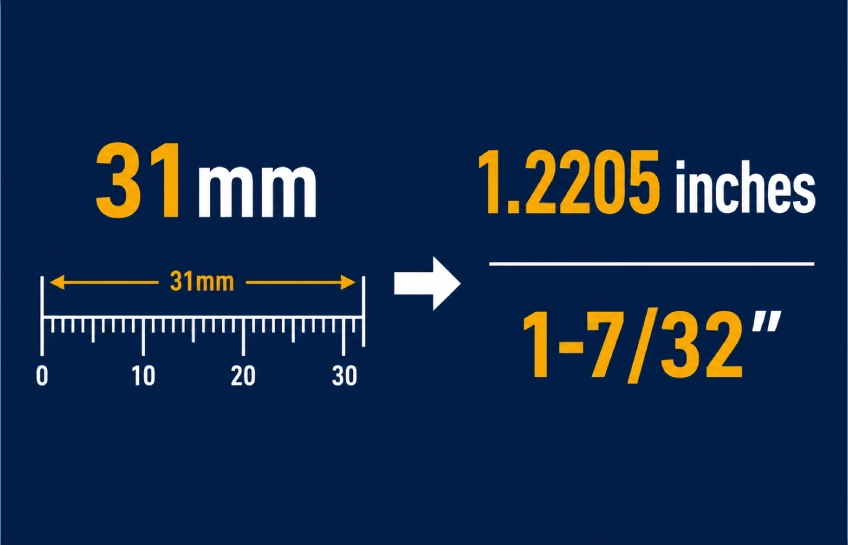
Converting 31mm to inches is straightforward once you know the formula, but most people either grab a random online converter and never understand why the answer is what it is, or they round it wrong and end up with parts that don’t fit. 31mm equals exactly 1.2205 inches (or more precisely, 1.22047244 inches). This article breaks down where that number comes from, how to use it correctly, and where it actually matters in the real world.
You’ll get the exact decimal and fractional equivalents, a step-by-step conversion method you can use without a calculator, a comparison table for nearby measurements, and answers to every common question around this conversion.
Why Millimeters and Inches Still Coexist
Two Systems, One World
The metric system and the imperial system have been fighting for dominance for over 200 years. Metric won most of the world — about 95% of countries use it officially. But the United States, Liberia, and Myanmar still rely heavily on imperial units for everyday use, and many industries worldwide still work in inches regardless of where they’re based.
This split creates a real practical problem. A German-manufactured watch case might be listed as 31mm. The American jeweler resizing it works in inches. A Canadian engineer sourcing hardware deals with both. The friction between these systems costs time and causes errors every single day.
Understanding how to convert 31mm to inches — and why the conversion factor works — puts you ahead of most people who just punch numbers into a phone and hope for the best.
The History Behind the Conversion Factor
The inch was officially defined in 1959, when the U.S., UK, Canada, Australia, New Zealand, and South Africa agreed on a single international inch. They settled on: 1 inch = 25.4 millimeters exactly. That number isn’t an approximation — it’s a defined constant. Everything flows from there. Divide any millimeter value by 25.4, and you get inches. Multiply any inch value by 25.4, and you get millimeters.
Why This Matters More in 2025–2026
Global manufacturing supply chains have made cross-system measurement fluency more important than ever. Tools, parts, and consumer products now routinely cross metric/imperial borders. The global hardware market exceeded $150 billion in 2024, with a significant portion of trade happening between metric-using manufacturers and imperial-using markets. Getting conversions wrong isn’t just annoying — it can mean returned orders, wasted materials, or safety issues.
5 Key Areas Where 31mm to Inches Matters
The Core Conversion — Math, Formula, and Exact Value
What It Is
Converting millimeters to inches is division. The formula is:
Inches = Millimeters ÷ 25.4
For 31mm: 31 ÷ 25.4 = 1.22047244 inches
Rounded to four decimal places: 1.2205 inches. Rounded to two decimal places: 1.22 inches.
Why It Matters
Which rounding you use depends entirely on your application. For casual reference, 1.22 inches is fine. For precision machining, you’d want 1.2205 or even the full eight-decimal figure. Using the wrong precision can mean a part that’s off by a hair — which in engineering often means it doesn’t fit at all.
How It Works
The factor 25.4 is exact by definition, so the only source of error is how much you round. Here’s the quick mental math approach:
- Take your millimeter value (31)
- Divide by 25 first for a rough estimate: 31 ÷ 25 = 1.24
- Adjust slightly downward (since 25.4 > 25): your answer is just under 1.24
- The actual answer, 1.2205, confirms this
Real-World Example
A Rolex Submariner has a case diameter of 40mm, but smaller watches like the Cartier Tank Française come in a 30mm or 32mm case. A 31mm case sits right in between — a size popular in women’s luxury watches. Jewelers resizing bands or making custom bezels for these need the inch equivalent precisely: 1.2205 inches.
Common Mistakes
The most common mistake is using 25 instead of 25.4 as the divisor — it’s faster mentally but throws off the result by about 1.6%. For a 31mm measurement, that’s roughly 0.02 inches of error. Small-sounding, but enough to matter when you’re fitting hardware.
Pro Tip
If you’re converting frequently, memorize that 1 inch = 25.4mm, and work backwards: 25.4mm = 1 inch, so 31mm = 1 inch + 5.6mm. And 5.6mm ÷ 25.4 = 0.2205 inches. Adding: 1.2205 inches. This two-step approach is faster to verify than pure division.
Fractional Inch Equivalents — What 31mm Looks Like on a Standard Ruler
What It Is
Decimal inches are precise, but American rulers are marked in fractions: 1/2, 1/4, 1/8, 1/16, 1/32, 1/64. So what fraction is closest to 1.2205 inches?
- 1 and 1/4 inches = 1.2500 (off by 0.0295)
- 1 and 7/32 inches = 1.2188 (off by 0.0017)
- 1 and 15/64 inches = 1.2344 (off by 0.0139)
The closest standard fraction is 1-7/32 inches — it’s only 0.0017 inches from the exact value.
Why It Matters
Woodworkers, plumbers, and general contractors often work from fractional rulers. If you’re marking a cut line at 31mm and your ruler only shows fractions, knowing that 1-7/32″ is the target prevents costly errors.
How It Works
To find the nearest fraction, multiply your decimal remainder by the denominator you’re targeting. For 32nds: 0.2205 × 32 = 7.056, which rounds to 7. So: 1 and 7/32.
Real-World Example
A standard door strike plate in the U.S. uses a 31mm (1-7/32″) hole spacing. Carpenters who know this fraction don’t need a conversion — they just mark 1-7/32 directly on the door frame.
Common Mistakes
Rounding 31mm to 1-1/4 inches (1.25 inches) is the most common error. It looks close, but it’s 0.8mm off — enough to misalign a hinge or a bolt pattern.
Pro Tip
Print a pocket-sized reference card with mm values from 25–40 mapped to their nearest 32nd-of-an-inch fraction. Laminate it. It saves more time than any app when you’re working on-site.
31mm in Real Products — Watches, Hardware, and Optics
What It Is
31mm is a surprisingly common measurement across multiple industries. It’s not arbitrary — it falls within ranges that manufacturers have standardized around.
Why It Matters
When you’re shopping for replacement parts, accessories, or compatible components, knowing the inch equivalent of 31mm to inches means you can cross-reference spec sheets across both measurement systems without ambiguity.
How It Works
Here’s where 31mm shows up regularly:
- Watch cases: 31mm is a popular mid-size case diameter, especially for women’s dress watches
- Watch straps: A 31mm lug width is less common but exists in some vintage and specialty pieces
- Socket wrenches: 31mm is a standard deep socket size used on truck lug nuts and larger fasteners
- Scope tube diameters: Some European rifle scopes use 31mm rings (between the standard 30mm and 34mm)
- PVC pipe OD: Certain European plumbing fittings have a 31mm outer diameter
Real-World Example
The Festool Systainer connector pin is 31mm. Workshops buying American-made cabinet hardware to interface with Festool storage systems need to know that 31mm = 1.22 inches — and that a 1-1/4-inch American component won’t quite fit without modification.
Common Mistakes
Assuming that because a product is labeled “approximately 1.25 inches” it’s compatible with a 31mm spec. The gap is small but real: 1.25 inches = 31.75mm, not 31mm.
Pro Tip
When sourcing hardware internationally, always list both the mm and inch equivalent in your purchase specs. Suppliers in different regions default to whichever system they use — listing both eliminates back-and-forth and shipping delays.
Digital and Printing Applications — Pixels, Points, and Resolution
What It Is
In graphic design and printing, measurements often need to move between physical millimeters and inch-based digital units. At 300 DPI (dots per inch), which is standard print resolution, 31mm converts to approximately 366 pixels.
Calculation: 1 inch = 25.4mm, so 31mm = 1.2205 inches. At 300 DPI: 1.2205 × 300 = 366.14 pixels.
Why It Matters
Designers setting up print files in Illustrator or InDesign work in inches or pixels. If a client spec says “31mm bleed” or “31mm image width,” the designer needs the pixel count to work at the right resolution.
How It Works
The formula: Pixels = (mm ÷ 25.4) × DPI
For 31mm at 300 DPI: (31 ÷ 25.4) × 300 = 366 pixels For 31mm at 72 DPI (screen): (31 ÷ 25.4) × 72 = 87.9 ≈ 88 pixels
Real-World Example
A business card in Europe is commonly 85mm × 55mm. A logo section 31mm wide on that card equals 366 pixels wide in the print file. Get that wrong, and the printed logo comes out blurry or the wrong size.
Common Mistakes
Forgetting to account for DPI when converting. 31mm at 72 DPI (web) vs 300 DPI (print) gives dramatically different pixel counts — 88 vs 366. Using the web pixel count in a print file produces a pixelated result.
Pro Tip
Adobe Illustrator and InDesign let you toggle document units between mm and inches in real time. Set your document units to match your client’s spec system so you avoid manual conversions entirely.
Metric to Imperial Conversion in Professional Contexts
What It Is
In engineering, medicine, and science, precision matters. A 31mm measurement in a medical device spec, a CNC machining drawing, or an aerospace component has to be converted without rounding errors.
Why It Matters
The NASA Mars Climate Orbiter crashed in 1999 — a $327 million mission lost — because one team used metric units and another used imperial, and nobody caught the mismatch. That’s the extreme case, but smaller errors happen constantly in manufacturing.
How It Works
For high-precision contexts, use the full decimal: 31mm = 1.22047244094 inches. CNC machines and precision measuring equipment (calipers, micrometers) can handle this level of precision.
In medical device manufacturing, 31mm might be the inner diameter of a tube or the width of a bracket. The tolerance might be ±0.05mm — which is ±0.002 inches. That tolerance band is narrow enough that rounding to 1.22 would put you right at the edge.
Real-World Example
Stryker, one of the largest medical device manufacturers, produces orthopedic implants specified in millimeters to match global surgical standards. Their U.S. manufacturing partners work in inches. Every dimension has a dual-unit specification table to prevent exactly this type of error.
Common Mistakes
Rounding at the wrong stage. If you round 31mm to 1.22 inches before doing further calculations, the rounding error compounds. Always carry full precision through your calculations and round only at the final output stage.
Pro Tip
In Excel or Google Sheets, use the formula =CONVERT(31,"mm","in") — it returns the full-precision decimal without manual calculation and updates automatically if the source value changes.
Top 6 Benefits of Knowing How to Convert 31mm to Inches
1. Faster purchasing decisions When you can quickly verify that 31mm = 1.2205 inches, you don’t waste time waiting on supplier confirmations. You match specs immediately. A contractor sourcing 31mm anchor bolts from an American supplier can confirm the 1-7/32″ equivalent on the spot.
2. Fewer measurement errors on job sites Manual conversion errors cause material waste. Knowing the exact fractional equivalent (1-7/32″) means your marks are accurate the first time. One right mark beats three wrong cuts.
3. Confident international shopping Products from European and Asian markets list dimensions in millimeters. Knowing that a 31mm watch case is 1.22 inches wide lets you compare it directly to an American product listed in inches — no guessing about fit or scale.
4. Better communication with clients and suppliers If you can fluently speak both mm and inches, you reduce miscommunication with suppliers in different regions. This is especially useful in wholesale trade and custom manufacturing.
5. Improved accuracy in design and printing Graphic designers who can translate 31mm to its pixel equivalent at specific DPI values produce print-ready files that don’t need revision. One correct file beats three corrected proofs.
6. Professional credibility Engineers, machinists, and technical buyers who work comfortably across both measurement systems are noticeably more efficient. In technical fields, measurement fluency signals competence.
Challenges and Solutions
Challenge 1: Not knowing when to round Some sources round 31mm to 1.22 inches, others say 1.220. Which is right?
Solution: It depends on your tolerance requirements. For casual use, 1.22 inches is fine. For machining or medical specs, use 1.2205. For CNC or engineering drawings, use 1.22047. Match your precision to your application.
Challenge 2: Fractional rulers with no decimal markings A standard American ruler doesn’t show 1.2205 — it shows 1/8s, 1/16s, maybe 1/32s.
Solution: Use 1-7/32 inches as your working fraction. It’s within 0.002 inches of the exact value, which is well within the tolerance of most manual marking tasks.
Challenge 3: Confusing diameter and radius When a spec says “31mm,” it might mean diameter or radius depending on context. Using the wrong one doubles or halves your answer.
Solution: Always verify whether a dimension is a diameter (across the full circle) or a radius (center to edge). In product specs, diameter is far more common — but confirm before converting.
Challenge 4: Software unit settings CAD and design software can silently work in the wrong unit system if defaults aren’t set correctly.
Solution: At the start of any project, explicitly set your document units and double-check them. In AutoCAD, type UNITS. In Illustrator, go to Document Setup → Units. Verify before your first dimension entry.
Beginner to Expert Roadmap
Beginner — Start Here
- Memorize the core formula: divide millimeters by 25.4 to get inches.
- Learn the exact answer for 31mm: 1.2205 inches (or 1-7/32″ in fractions).
- Bookmark a reliable unit converter like Google’s built-in tool or UnitConverters.net for quick checks.
Intermediate — Build On the Basics
- Practice converting common measurements mentally: 25mm = ~1 inch, 50mm = ~2 inches, 31mm ≈ 1.22 inches.
- Learn the fractional equivalents for the 25–40mm range — these cover most hardware and watch sizing scenarios.
- Set up an Excel or Google Sheets conversion table for your specific industry’s most-used measurements.
Advanced — Expert-Level Precision
- Work with full-precision values (1.22047244094) in technical drawings and never round until the final output.
- Understand tolerance stacking: when multiple converted measurements combine, errors accumulate. Account for this in assemblies.
- Learn to read both ISO (metric) and ANSI (imperial) standards documents — many specs exist in both, and the footnotes explain rounding conventions.
Top 5 Tools for Measurement Conversion
1. Google Search Type “31mm to inches” directly into Google — it returns an instant answer and a unit converter widget. Best for: Quick, one-off conversions Cost: Free
2. UnitConverters.net A dedicated conversion site with high precision outputs, historical context, and formula displays. Best for: Users who want to understand the math, not just the answer Cost: Free
3. Vernier Caliper (Digital) A physical precision measuring tool that displays readings in both mm and inches simultaneously. Best for: Engineers, machinists, jewelers, and anyone measuring physical objects regularly Cost: $15–$200 depending on precision grade
4. Microsoft Excel / Google Sheets — CONVERT Function The formula =CONVERT(31,"mm","in") returns a full-precision decimal instantly. Best for: Bulk conversions, recurring calculations, or building reference tables Cost: Part of existing Office/Google Workspace subscription
5. Machinist’s Reference App (iOS/Android) Apps like “Machinist Calc Pro” handle mm-to-inch conversion alongside thread pitch, drill size, and tolerance calculations. Best for: Machinists, CNC operators, and manufacturing engineers Cost: $10–$30 (one-time purchase)
Comparison Table — 31mm vs Nearby Common Measurements
| Measurement | Inches (Decimal) | Inches (Fraction) | Common Use Case | Notes |
|---|---|---|---|---|
| 25mm | 0.9843″ | 63/64″ | Watch strap width, small bolts | Close to 1 inch but not quite |
| 28mm | 1.1024″ | 1-7/64″ | Pipe fittings, watch straps | Common in plumbing |
| 30mm | 1.1811″ | 1-3/16″ | Scope rings, watch cases | Very common standard |
| 31mm | 1.2205″ | 1-7/32″ | Hardware, watches, sockets | Focus measurement |
| 32mm | 1.2598″ | 1-17/64″ | Socket wrenches, door hardware | Near-common hardware size |
| 35mm | 1.3780″ | 1-3/8″ | Film format (historic), pipe | Classic photography standard |
| 38mm | 1.4961″ | 1-1/2″ | Watch cases, large hardware | Very close to 1.5 inches |
Myths vs. Facts
Myth 1: “31mm is basically 1.25 inches — close enough.” Fact: 1.25 inches = 31.75mm, not 31mm. That’s a 0.75mm gap. For most hardware applications, that difference prevents a proper fit. “Close enough” depends entirely on your tolerance requirements.
Myth 2: “You need a calculator to convert millimeters to inches.” Fact: With a few reference points memorized — 25.4mm = 1 inch, 12.7mm = 0.5 inches — you can estimate most conversions mentally within a few hundredths. It’s a learnable skill, not a calculator-only task.
Myth 3: “Metric is more precise than imperial.” Fact: Neither system is inherently more or less precise. Precision depends on the measuring instrument and the number of decimal places used, not the unit system. You can specify 1.22047244 inches just as precisely as 31mm.
Myth 4: “The U.S. is the only country that uses inches.” Fact: The U.S. is the most prominent, but the UK still uses inches for road distances and human height. Canada uses a mix. Many industries worldwide — aviation, oil and gas, photography — use inches regardless of the country.
Myth 5: “Metric will completely replace imperial in the U.S. within a few years.” Fact: Despite decades of metrication efforts, this hasn’t happened and there’s no strong legislative push currently underway. Dual-system literacy will remain relevant in the U.S. for the foreseeable future — likely well past 2030.
Future Outlook
What’s Ahead for Measurement Standards
The push toward global manufacturing standardization is gaining speed. Industry 4.0 — the shift toward connected, automated factories — favors metric because most industrial control systems default to SI units (the International System of Units, which is metric). As more U.S. manufacturers integrate with global supply chains, internal documentation is quietly shifting toward metric even when customer-facing specs stay in inches.
Emerging trends to watch:
- Digital twin technology in manufacturing requires perfectly matched unit specifications between physical products and their digital models. Errors from unit mismatches are becoming more visible and more costly.
- 3D printing has grown significantly in dual-unit markets. Slicing software now defaults to mm, quietly pushing more American hobbyists and engineers to think in metric.
- AI-powered design tools are starting to auto-detect unit systems in uploaded documents and flag mismatches before they become problems.
For anyone working with precise measurements — machinists, engineers, designers, medical device professionals — knowing how to convert 31mm to inches fluently will remain a practical skill. The units themselves may converge slowly, but in the meantime, people who can move between systems without friction have a clear advantage.
What to prepare for now: Learn to read dual-unit spec sheets. Invest in measuring tools that display both mm and inches simultaneously. Build conversion tables for your most-used measurements and keep them accessible.
Frequently Asked Questions
Q1: What is 31mm in inches exactly? 31mm equals exactly 1.22047244094 inches. For practical use, this is rounded to 1.2205 inches (4 decimal places) or 1.22 inches (2 decimal places). The exact fraction equivalent is 1 and 7/32 inches, which is 0.0017 inches away from the true value.
Q2: How do I convert 31mm to inches without a calculator? Divide 31 by 25.4. A quick mental shortcut: 25mm ≈ 1 inch, so 31mm is 1 inch plus 6mm. Since 6mm ÷ 25.4 ≈ 0.236, but the more accurate answer is 0.2205, you get approximately 1.22 inches. Close enough for most casual applications.
Q3: Is 31mm the same as 1 and 1/4 inches? No. 1 and 1/4 inches = 31.75mm, which is 0.75mm larger than 31mm. For precision work, these are not interchangeable. For very rough estimates only, 1-1/4 inch might be acceptable — but always confirm the tolerance allows it.
Q4: What size wrench fits a 31mm bolt? A 31mm wrench or socket fits a 31mm bolt head. In inch terms, the nearest standard American wrench size is 1-1/4 inches (which is 31.75mm) — it’s slightly too large and won’t grip properly. You’d need an actual 31mm metric socket, not an imperial substitute.
Q5: How many pixels is 31mm at 300 DPI? At 300 DPI (standard print resolution), 31mm = approximately 366 pixels. The formula: (31 ÷ 25.4) × 300 = 366.14. At 72 DPI (screen), 31mm = approximately 88 pixels.
Q6: What watch size is 31mm? A 31mm watch case diameter falls in the small-to-mid range — considered a women’s watch size by most contemporary standards, though historically many men wore watches this size. For reference, a modern men’s dress watch typically runs 38–42mm. A 31mm case in inches is 1.2205 inches across.
Q7: Is 31mm a standard metric measurement? 31mm is a valid metric measurement but not a standard modular size (those tend to fall on 5mm and 10mm increments). It appears in product specs where it’s the precise functional size required, rather than a rounded standard. Common examples include certain socket sizes, optical components, and watch case specifications.
Conclusion — Key Takeaways
Here’s what this article covered:
- 31mm equals 1.2205 inches (or 1-7/32″ in standard fractions) — that’s the number to remember.
- The formula is simple: divide any millimeter value by 25.4 to get inches. No special knowledge required.
- Rounding matters: use 1.22 for casual work, 1.2205 for general technical work, and the full decimal (1.22047244) for high-precision applications.
- Context changes everything: the same 31mm to inches conversion works differently in woodworking, watchmaking, graphic design, and engineering — each field has its own precision standards.
- Neither measurement system is going away soon. Dual-system fluency is a practical skill worth building, especially if you work across international supply chains.
Your next step: write the conversion on a sticky note — 31mm = 1.2205″ = 1-7/32″ — and keep it wherever you do your work. Then learn the conversions for the measurements you encounter most often. That small habit will save you real time.
Measuring twice still only works if you know what the numbers actually mean.



No Comment! Be the first one.