

Most traders don’t fail because they can’t read charts. They fail because they don’t have a consistent process. ETRSTrading was built to fix exactly that — giving traders a repeatable, rules-based approach that removes the guesswork from every decision. Whether you’re trading stocks, ETFs, or crypto, this guide breaks down how the system works and why structure beats gut instinct every time.
What Is ETRSTrading?
The Meaning Behind the Name
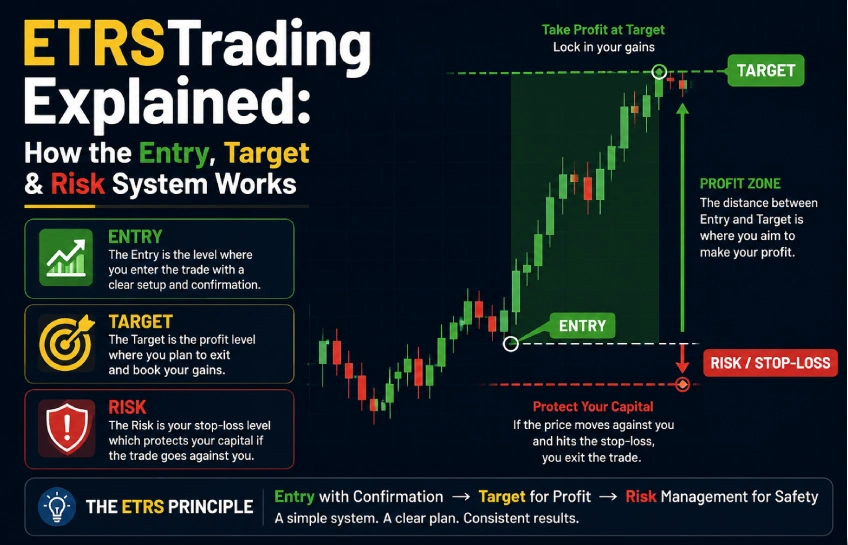
ETRS stands for Entry, Target, and Risk System. It’s a rules-based framework designed to remove the guesswork from trading decisions. Each letter refers to a specific function in the trade lifecycle, and together they form a complete process rather than a collection of loosely connected ideas.
The name “ETRSTrading” also refers to the platform and content ecosystem built around this framework. At its core, it’s a system designed for traders who want fast execution, transparent on-chain settlements, and a structured approach to buying and selling digital assets — without the complexity that scares most people away from decentralized finance.
Where ETRSTrading Fits in Today’s Market
The trading environment today is very different from what it was a few years ago. Institutional involvement has increased, and markets have become more structured. While volatility still exists, it’s often controlled and influenced by larger players.
Retail traders now compete in a space where speed and information matter more than ever. This has made it important to move away from outdated strategies and focus on understanding how the market actually functions. ETRSTrading responds to this shift with a framework built on clarity and discipline rather than prediction.
The Three Pillars of the ETRS System
Entry — Getting In at the Right Time
The entry component uses a confluence approach — waiting for multiple signals to line up before pulling the trigger. Moving average crosses combined with momentum oscillators like RSI create high-confidence setups when they agree.
The goal isn’t to enter early. It’s to enter right. A trade that starts from a strong, confirmed signal has a better chance of moving in your favor before the stop-loss ever comes into play.
Target — Knowing When to Take Profit
Too many traders either exit too early out of fear or hold too long out of greed. The target component solves this by setting realistic price objectives before the trade begins — not in the heat of the moment.
Your entry and exit rules matter more than your market predictions. Writing them down before you place a trade — what signal triggers your buy, what price makes you sell, and what your stop loss is — keeps you accountable.
Risk — Protecting Your Capital
Stop-losses in the ETRS framework are set based on market volatility using Average True Range (ATR). When the market is choppy, trades get more room. When it’s calm, the stops tighten up.
Most professionals risk 1–2% of their account on a single position. It might sound conservative, but it keeps you in the game when trades go sideways. That consistency compounds over time in a way that aggressive sizing never does.
How ETRSTrading Works Step by Step
Pre-Market Preparation
Before the opening bell, traders scan for assets that show the right momentum and volatility patterns, building a focused watchlist instead of trying to watch everything at once. This preparation means you’re not scrambling when the market opens — you already know what you’re watching and why.
Signal Identification and Validation
Once the market opens, the process shifts to monitoring. The key word is “valid.” Not almost valid. Not close enough. You need confirmation before you risk a single dollar.
A practical approach uses the 50-period and 200-period moving averages. When price sits above both, buy opportunities are more favorable. When it’s below, caution is warranted. RSI adds a second layer of confirmation — above 70 signals a market that’s potentially overextended, while below 30 may indicate oversold conditions.
Active Trade Management
Getting into a trade is only half the job. Active management sometimes means moving the stop-loss to break-even once a trade moves in your favor, or using a trailing stop to ride a strong trend without giving back too much profit.
This stage is where discipline gets tested most. Prices don’t move in straight lines, and positions that look great at open can look painful an hour later. Having pre-set rules for how to manage that volatility is what separates traders who survive from those who don’t.
Reviewing and Logging Every Trade
After closing a trade, win or lose, logging it in a journal is non-negotiable. This step separates traders who improve from those who repeat the same mistakes forever.
Reviewing your trade history monthly reveals patterns — whether you’re cutting winners too early, holding losers too long, or whether you trade better at certain times of day. The data is right there. Most people just never look at it.
ETRSTrading for Crypto: The Etherions Connection
What the Faston Protocol Does Differently
The name combines two ideas: Etherions (the blockchain ecosystem and its native token) and fast trading (the execution speed that the Faston protocol makes possible).
The Faston network uses a hybrid consensus model that blends Proof of Stake and Proof of Work elements. PoS validators confirm transactions quickly while using far less energy than traditional mining. The PoW component adds a layer of computational resistance against bad actors.
Why Speed and Low Fees Matter for ETRS Traders
When you’re working within a structured entry and exit framework, execution speed directly affects your results. The Faston protocol processes transactions in seconds, not minutes, and keeps fees low even during high-volume periods. For active traders, every delayed transaction and unexpected fee eats into margins.
The Faston protocol is also EVM-compatible, meaning it supports the same Solidity-based smart contracts that power Ethereum. If you’ve ever used MetaMask or interacted with any Ethereum DeFi protocol, you already know the basics of wallet interaction on EtrsTrading.
Common Mistakes Traders Make (and How ETRS Addresses Them)
Despite access to more information than ever, many traders continue to repeat the same mistakes. Emotional decisions remain one of the biggest problems. Fear and greed often lead to poor timing and unnecessary risks.
Here’s what shows up most often — and what ETRS does about each one:
- No clear entry rules: ETRS requires confluence signals before entry, so you’re never guessing
- Missing a defined exit: Setting targets before you enter forces a profit plan, not a reaction
- Skipping stop-losses: Without a stop-loss, a $100 loss can turn into $500, then $1,000, until you’re paralyzed and hoping for a miracle
- Overtrading: Taking too many positions without clear reasoning reduces overall performance
- Ignoring trade reviews: Not keeping a journal means the same costly patterns repeat month after month
Is ETRSTrading Right for You?
ETRSTrading works best for traders who want a clear process they can actually follow — not a collection of indicators they apply inconsistently. Discipline, patience, and understanding market behavior will always be essential. Strategies like ETRSTrading reflect this balance between modern tools and fundamental concepts.
If you’re comfortable trading based entirely on instinct, this framework will feel restrictive at first. That friction is the point. Your gut is what gets you into trouble. It’s what makes you chase a stock that’s already run 20% or hold onto a loser because you’re sure it’ll bounce back. A process keeps you disciplined when emotions want to take over.
Before committing real capital to any strategy, spend time in small test trades to understand how the platform handles execution during different market conditions. Watch how fees behave during peak and quiet hours. Learn the interface. Only scale up once you’re comfortable.
Frequently Asked Questions About ETRSTrading
What does ETRS stand for? ETRS stands for Entry, Target, and Risk System. It’s a structured trading approach that defines your buy signal, profit target, and risk parameters before you enter any position.
Is ETRSTrading only for crypto? No. The ETRS framework applies to stocks, ETFs, options, and crypto. The Etherions connection makes it especially relevant for crypto traders on the Faston network, but the principles work across asset classes.
How is ETRSTrading different from regular technical analysis? Standard technical analysis gives you tools. ETRSTrading gives you a process. The system tells you not just what to look for, but when to act and how much to risk — removing the most common points of failure.
Do I need experience to use ETRSTrading? It’s helpful to practice with small trades or simulations before committing larger amounts. This builds confidence and reduces the chances of major losses. Over time, traders can gradually incorporate more advanced concepts like liquidity analysis and multi-timeframe strategies.
What indicators work best with the ETRS system? Three core tools cover most situations: moving averages for trend direction, RSI for overbought or oversold conditions, and MACD for spotting momentum shifts before they happen. You don’t need more than these to start.
Before You Go, Read This:FeedCryptoBuzz: The Crypto News Feed Built for Traders Who Hate Missing the Move



No Comment! Be the first one.