

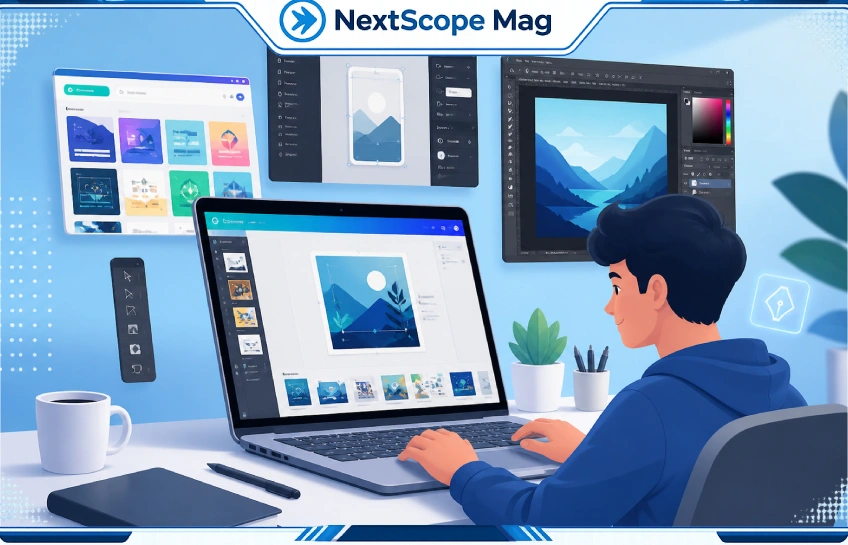
Most people spend more time choosing a design tool than actually designing anything. If that’s you, this article cuts through the noise and tells you exactly what’s worth your time.
Whether you’re making social media posts, building a brand identity, or just trying to make things look less ugly — the right tool changes everything. And the good news? You don’t need to spend hundreds of dollars to get started.
What to Look for Before Picking a Design Tool
Not every beginner needs the same thing. A freelancer designing Instagram content has completely different needs from someone learning UI/UX or creating print materials. Before you download anything, get clear on two things: what you’re designing, and how much complexity you can handle right now.
Ease of Use vs. Feature Depth
There’s always a trade-off. Tools that are easy to pick up — like Canva — give you less control. Tools with deep features — like Adobe Illustrator — have a steep learning curve. Neither is better in absolute terms. It depends on where you are and where you’re headed.
If you’re a complete beginner, start simple. You can always graduate to more powerful software once you understand design fundamentals like spacing, contrast, and typography.
Free vs. Paid — Does Price Equal Quality?
Not necessarily. GIMP is free and rivals Photoshop in several areas. Canva’s free tier is genuinely useful. That said, professional-grade tools like Affinity Designer or Figma (with its paid features) do offer capabilities that free tools simply can’t match.
A good rule of thumb: start free, stay free until you hit a real limitation, then upgrade.
Best Free Graphic Design Tools for Beginners
These are tools you can use today without spending a cent — and they’re good enough to do serious work.
Canva
Canva is where most beginners start, and for good reason. It runs in the browser, has thousands of ready-made templates, and the drag-and-drop interface takes about ten minutes to get comfortable with. You can design social posts, presentations, flyers, and even basic logos without touching a single technical setting.
The free plan covers a lot. You get access to a large template library, basic photo editing, and enough design elements to produce clean, professional-looking work. Canva Pro adds features like a brand kit, background remover, and a larger asset library — but the free version isn’t crippled.
Best for: Social media graphics, presentations, marketing materials
Limitation: You have less control over fine details. If you want precise vector work or custom typography behavior, Canva will frustrate you.
Adobe Express
Adobe Express is Adobe’s answer to Canva. It’s also browser and app-based, template-driven, and beginner-friendly. The free tier is solid, and because it sits inside Adobe’s ecosystem, it plays nicely with Photoshop and Illustrator if you ever move in that direction.
It has a slight learning curve compared to Canva — not because it’s harder, but because the layout is less intuitive at first. Once you get past that, it’s a capable tool, especially for video-based social content.
Best for: Beginners already in the Adobe ecosystem, short-form video graphics
GIMP
GIMP (GNU Image Manipulation Program) is the free alternative to Photoshop. It handles everything from photo retouching and color correction to digital painting and compositing. It’s genuinely powerful.
The catch: the interface isn’t beginner-friendly at all. GIMP was built for function, not for onboarding. You’ll need YouTube tutorials and some patience. But if you’re willing to invest a couple of weeks, you’ll have access to professional-grade photo editing without spending anything.
Best for: Photo editing, digital art, image manipulation
Not ideal for: Vector design, layout-heavy projects, UI work
Inkscape
Most beginners overlook Inkscape, which is a mistake. It’s a free, open-source vector editor that covers a lot of the same ground as Adobe Illustrator. You can create logos, icons, illustrations, and scalable graphics that look sharp at any size.
Like GIMP, it’s not the most polished experience. But for someone serious about learning vector design without paying for Illustrator, Inkscape is a legitimate path.
Best for: Logo design, illustrations, vector graphics
Best Paid Graphic Design Tools Worth the Investment
Once you’ve outgrown free tools — or if you’re entering a field where industry-standard software matters — these are worth paying for.
Adobe Illustrator
Illustrator is the industry standard for vector design. Logos, icons, packaging, editorial illustration — Illustrator handles all of it with precision that free tools can’t match. It’s part of Adobe Creative Cloud, which means it integrates tightly with Photoshop, InDesign, and other Adobe apps.
For beginners, Illustrator has a learning curve. Adobe has improved its onboarding in recent years, and there are enough tutorials online to get you through the rough first few weeks. Pricing sits at around $22–$55/month depending on your plan.
Best for: Professional logo design, print work, brand identity, illustration
Affinity Designer
Affinity Designer from Serif is probably the best value in paid design software right now. It’s a one-time purchase (around $70), handles both vector and raster work in a single app, and performs well enough to replace Illustrator for many use cases.
The interface is clean and thoughtfully designed. Beginners find it more approachable than Illustrator, and professionals use it for real client work. It doesn’t have Illustrator’s ecosystem depth, but for most beginners learning serious design, that’s a fine trade.
Best for: Logo design, UI elements, print and digital design, budget-conscious beginners
Figma
Figma has become the dominant tool in UI/UX design. If you want to design apps, websites, or digital products, Figma is where the industry lives. It’s browser-based, collaborative by default, and has a free tier that’s genuinely generous for individuals.
The free plan allows up to three active projects, which is enough for a beginner to learn the tool and build a small portfolio. Figma also has one of the strongest learning communities out there, so finding tutorials, resources, and design systems to learn from is easy.
Best for: UI/UX design, web design, prototyping, anything digital and interactive
Browser-Based vs. Desktop Design Software — Which Is Better for Beginners?
This question comes up constantly, and the answer is: it depends on your workflow.
When Browser-Based Tools Make Sense
If you work across multiple devices, switch between a laptop and desktop, or collaborate with others regularly — browser-based tools like Canva, Figma, or Adobe Express make life much easier. Everything lives in the cloud. No installations, no file syncing, no version issues.
For beginners, browser-based tools also lower the barrier to entry. You open a tab and start designing. That simplicity matters when you’re still building the habit.
When to Switch to Desktop Software
Desktop applications like GIMP, Inkscape, or Affinity Designer give you more processing power, work offline, and handle larger files better. If you’re doing high-resolution print work, detailed photo editing, or complex illustration, desktop software generally handles it more reliably.
As you grow as a designer, you’ll likely use both. Browser tools for quick work and collaboration; desktop tools for heavier, more detailed projects.
Which Tool Should You Actually Start With?
Here’s the honest answer: it depends on what you’re making.
For Social Media and Marketing Graphics
Start with Canva. It’s the fastest path from zero to a finished, decent-looking design. You’ll learn about layouts, fonts, and color combinations in a practical way. Once you feel limited by it, move to Adobe Express or explore more complex tools.
For Logo and Vector Design
Start with Inkscape if you want free, or Affinity Designer if you can make a one-time purchase. Both will teach you how vectors work. Once you’re comfortable, transitioning to Illustrator is much easier because the core concepts are the same.
For UI/UX and Web Design
Start with Figma. It’s where the jobs are, and the free tier gives you enough to build a solid foundation. The community around Figma — including free design resources, plugins, and UI kits — is exceptional for beginners.
Common Mistakes Beginners Make When Choosing Design Software
Picking the Most Advanced Tool First
A lot of beginners jump straight to Photoshop or Illustrator because those are the “professional” choices. That’s not wrong thinking, but it often leads to frustration. If you’re spending two hours figuring out the interface instead of designing, you’re not learning design — you’re learning software. Build skills in a simpler tool first.
Paying Before You Know What You Need
Don’t subscribe to Adobe Creative Cloud before you know you’ll use it. Start with free tools, figure out your actual design needs, and then invest. Paying for software you don’t fully use is money wasted.
Ignoring Design Fundamentals
No tool fixes bad design fundamentals. If you don’t understand spacing, contrast, alignment, and color — your work will look off regardless of whether you’re using Canva or Illustrator. Pair whatever tool you choose with some basic design theory. There’s plenty of free material from IDEO, Refactoring UI, and the Interaction Design Foundation.
Switching Tools Too Often
Every time you switch design tools, you restart your learning curve. Pick one, commit to it for at least two to three months, and build real fluency. Jumping between five tools because each one seems better will leave you mediocre at all of them.
Conclusion
There’s no single best graphic design tool for beginners — there’s only the right tool for what you’re trying to make. Canva and Adobe Express work great for quick, practical designs. GIMP and Inkscape give you serious capability without cost. Figma is the go-to for digital product design. Affinity Designer earns its price tag for anyone doing vector work.
Pick one tool that matches your immediate goals, spend real time with it, and don’t overthink the rest. Design skills transfer between tools — the fundamentals you build in Canva or Inkscape will still apply when you eventually open Illustrator.
FAQ: Graphic Design Tools for Beginners
Q: What is the easiest graphic design tool for beginners? Canva is consistently the easiest starting point. The interface is intuitive, the templates do a lot of the heavy lifting, and you can produce clean results quickly without any prior design experience.
Q: Is Photoshop good for beginners? Photoshop is powerful but not beginner-friendly. The interface is complex, and there’s a real learning curve before you start producing solid work. For most beginners, GIMP or even Canva is a better starting point unless your specific goal is photo editing.
Q: Can I learn graphic design for free? Yes. Tools like Canva, GIMP, Inkscape, and Figma’s free tier give you everything you need to learn the basics. Pair them with free learning resources from YouTube, Coursera, or platforms like the Interaction Design Foundation.
Q: Is Figma free for beginners? Figma has a free tier that allows up to three active projects. For someone learning UI/UX design or building a beginner portfolio, that’s enough to get meaningful work done without spending anything.
Q: What’s the difference between vector and raster design tools? Vector tools (Illustrator, Inkscape, Affinity Designer) create designs using mathematical paths, so they scale to any size without losing quality. Raster tools (Photoshop, GIMP) work with pixels, making them better for photo editing and digital painting but less suited for logos or scalable graphics.
Q: Do I need to learn multiple design tools? Not at first. Pick one tool that fits your goals and build real proficiency before branching out. Most professional designers use two or three tools regularly, but that specialization comes naturally over time.
Q: Is Affinity Designer a good alternative to Adobe Illustrator? For most use cases, yes. Affinity Designer handles vector and raster work, performs well, and costs a fraction of an Adobe subscription. It doesn’t have the same plugin ecosystem or file compatibility depth, but for beginners and independent designers, it’s a strong choice.

No Comment! Be the first one.