

Most investment advice you’ll find online was written to sell you something. A brokerage account, a managed fund, a trading app, a newsletter subscription. This article isn’t any of that. What follows are real, field-tested investment hacks — stripped of the commercial layer that usually wraps them — so you can actually use them without being nudged toward a product.
“Discommercified” investment knowledge means exactly that: strategies and mental frameworks that exist in the public domain, cost you nothing to implement, and don’t require a middleman.
What Does “Discommercified Investing” Actually Mean?
The financial industry runs on one thing: your recurring fees. Expense ratios, advisory fees, trading commissions, fund loads — these quietly eat into returns over decades. The moment you remove the commercial incentive from investment advice, the advice changes dramatically.
Discommercified investing isn’t a branded philosophy. It’s what happens when retail investors learn what institutional investors already know and apply it without paying someone to hold their hand. Think of it as cutting out the interpreter when you already speak the language.
Why Most “Investment Hacks” Are Just Products in Disguise
Search “investment tips” on any platform and you’ll find affiliate links, sponsored comparisons, and app download CTAs buried in the copy. The advice isn’t wrong, exactly — it’s just incomplete. It stops right before the part where fees, conflicts of interest, or product limitations would become inconvenient to mention.
A genuinely discommercified hack gives you the full picture: what to do, how to do it yourself, what it actually costs, and when it stops working.
The Retail Investor’s Real Disadvantage (It’s Not What You Think)
People assume retail investors lose to institutions because of information gaps. That’s partly true. But the bigger gap is behavioral — and that’s one you can close without spending a cent.
Studies from Dalbar’s QAIB report consistently show that the average equity investor underperforms the S&P 500 by 3–4% annually. Not because they picked bad stocks — because they bought high, sold low, and paid someone to watch them do it. The hack isn’t a secret stock pick. It’s learning to do less.
The Core Investment Hacks Nobody Profits From Teaching You
These aren’t trendy. Some are decades old. That’s actually the point.
Hack #1: Dollar-Cost Averaging Without the Drama
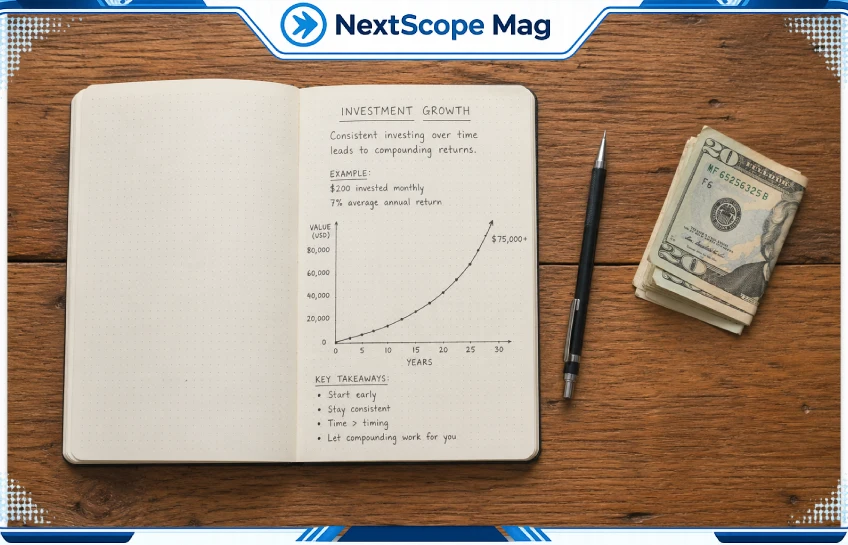
Dollar-cost averaging (DCA) is buying a fixed dollar amount of an asset at regular intervals, regardless of price. You’ve likely heard this before. What you probably haven’t heard is how violently simple the math is in your favor.
When prices drop, your fixed contribution buys more units. When they rise, you own more units that are now worth more. You don’t need to time anything. You don’t need to watch charts. You don’t need a financial advisor to press the “buy” button on a recurring schedule.
The discommercified version: set up automatic investments directly through a low-cost index fund provider (Vanguard, Fidelity, Schwab) and ignore the account for years. That’s the whole hack.
Hack #2: The Expense Ratio Arbitrage Nobody Calculates for You
A 1% expense ratio sounds harmless. On a $100,000 portfolio growing at 7% annually over 30 years, that 1% costs you roughly $270,000 in foregone gains. A 0.03% expense ratio (what you’d pay on Fidelity ZERO or Vanguard’s flagship index funds) costs around $8,000 over the same period.
That’s not a small difference. It’s a car, a college semester, a down payment — compounding silently against you every year.
The hack is just knowing this number exists, then choosing the fund with the lower one. No advisor needed.
Hack #3: Tax-Loss Harvesting Without the Robo-Advisor Markup
Robo-advisors charge 0.25–0.5% annually to automate tax-loss harvesting for you. The concept itself is free to understand and apply manually.
Tax-loss harvesting means selling an investment that’s down to realize a capital loss, which offsets taxable gains elsewhere in your portfolio. You immediately reinvest in a similar (not identical, to avoid wash-sale rules) asset to maintain market exposure.
Done manually, this costs you maybe 20 minutes per year at tax time. Done through a robo-advisor, it costs you a quarter percent of everything you own, forever. Both methods produce similar results for most retail investors with straightforward portfolios.
Psychological Investment Hacks That Compound Faster Than Interest
The behavioral edge is where most investors leave the most money on the table.
How to Use “Commitment Devices” to Protect Your Portfolio From Yourself
Behavioral economists like Richard Thaler have spent careers documenting how humans sabotage their own financial outcomes — and how structural commitment devices fix this better than willpower ever will.
A commitment device in investing means making it mechanically hard to touch your long-term money. Separate brokerage accounts for different goals. Automatic contributions that leave your checking account before you see the money. Longer settlement periods that introduce friction before panic-selling.
The point isn’t discipline. It’s removing the decision entirely.
The “Boredom Premium” in Long-Term Investing
There’s an old study often cited in behavioral finance circles about a Fidelity internal analysis of their best-performing accounts. The accounts that performed best? They belonged to investors who had forgotten they had them, or who were dead.
Whether or not the specific study is apocryphal, the finding aligns with decades of documented research: inactivity frequently beats activity in personal investing. The boredom premium is real. Sitting still is a legitimate strategy.
Why Checking Your Portfolio Less Often Is Statistically Correct
Nobel laureate Richard Thaler’s concept of “myopic loss aversion” explains this cleanly: the more frequently you evaluate your investments, the more often you’ll see losses (because markets fluctuate daily), and the more likely you are to make emotionally driven changes.
Investors who check portfolios monthly experience roughly the same long-term performance as daily checkers — but with far fewer impulsive trades and significantly lower transaction costs. Checking quarterly or less is a documented performance advantage.
Structural Hacks for Building Wealth Outside Traditional Channels
Index Funds as a Wealth Distribution Mechanism
John Bogle launched the first retail index fund in 1976. The financial industry spent 15 years calling it “Bogle’s Folly.” Today, passive index investing accounts for over 50% of U.S. equity fund assets.
Why the resistance? Because index funds transfer fees from fund managers back to investors. Every dollar that doesn’t go to an expense ratio stays in your account compounding. The industry had every commercial reason to discredit a product that works by costing almost nothing.
An S&P 500 index fund bought through a zero-fee account (Fidelity’s FZROX has a 0% expense ratio) with automatic dividend reinvestment is possibly the most powerful retail wealth-building tool in existence. It’s also the least exciting thing you’ll ever read about.
The Roth IRA Conversion Ladder for Early Retirees
If you’re familiar with the FIRE movement (Financial Independence, Retire Early), you’ve probably heard of this. If not, here’s the short version: you can access traditional retirement funds before age 59½ without penalty by converting them to a Roth IRA and waiting five years.
The process: convert a chunk of your traditional IRA to Roth each year during low-income years (ideally keeping the conversion amount within your current tax bracket). After five years, those converted funds — principal only — can be withdrawn tax and penalty-free.
This isn’t a loophole or a gray area. It’s explicitly how the IRS structures these accounts. It’s just not something any financial product needs to exist for you to use it.
H3: Using I-Bonds as an Inflation Hedge Without a Brokerage
Series I Savings Bonds are issued directly by the U.S. Treasury. They pay an interest rate that adjusts with inflation every six months. When inflation ran at 8–9% in 2022, I-Bonds were paying over 9% — more than almost any savings vehicle available.
You buy them at TreasuryDirect.gov. No brokerage. No fees. No advisor. The limit is $10,000 per person per year (plus $5,000 via tax refund). They’re not glamorous, but during high-inflation periods they perform in ways that make most savings accounts look broken.
What Discommercified Investing Looks Like in Practice
Here’s an actual framework — not a funnel, not a product recommendation — for someone starting from scratch.
Step 1: Open a Roth IRA at Fidelity, Vanguard, or Schwab (all have zero account minimums now).
Step 2: Set up automatic monthly contributions from your checking account to a total market index fund (something like FSKAX, VTSAX, or SWTSX). Even $50/month is enough to build the habit.
Step 3: If your employer offers a 401(k) with a match, contribute at least enough to get the full match before doing anything else. That match is an instant 50–100% return on those dollars. Nothing else in investing comes close.
Step 4: Once you’ve maxed your tax-advantaged accounts, a taxable brokerage account with index funds continues the same strategy without limits.
Step 5: Do nothing else. Don’t pick stocks. Don’t time the market. Don’t pay for advice on a portfolio this straightforward.
This isn’t exciting. It doesn’t have a catchy name or a monthly subscription. That’s precisely why it works.
Common Myths That Keep Investors Paying More Than They Should
“You Need a Financial Advisor to Invest Properly”
For complex situations — estate planning, business ownership, divorce, major inheritance — a fee-only fiduciary advisor (one who charges a flat fee rather than a percentage of assets) can add real value. For a salaried employee with a 401(k) and a Roth IRA investing in index funds, you don’t need one.
The National Association of Personal Financial Advisors (NAPFA) maintains a database of fee-only fiduciaries if you ever do need professional guidance. If you want to understand exactly how this works, read our full breakdown on what a fee-only fiduciary advisor actually is — including how to vet one before handing over your money.
“Timing the Market Is Possible With Enough Research”
SPIVA (S&P Indices Versus Active) reports track how actively managed funds perform against their benchmark index each year. Over any 15-year period, roughly 90% of active fund managers underperform the index they’re benchmarking against — after fees.
These are professional investors with research teams, proprietary tools, and decades of experience. If they can’t consistently beat a passive index, the premise that a retail investor can do so with weekend research time deserves real skepticism.
“Crypto Is the New Index Fund”
This comparison is technically coherent in structure (broad exposure to an asset class) but falls apart on fundamentals. Index funds represent ownership stakes in real businesses generating actual revenue. Cryptocurrencies represent speculative positions on future adoption or utility.
Both can produce returns. They’re not interchangeable, and the risk profiles are categorically different. Treating crypto as a core holding rather than a speculative satellite position is one of the more common costly mistakes in retail portfolios right now.
FAQ: Investment Hacks Discommercified
Q: What does “discommercified investing” mean in practical terms? It means using investment strategies that don’t require a financial product, paid service, or advisor to implement. Index fund investing, automatic contributions, and tax-advantaged accounts are the clearest examples — they’re free to understand and cheap to execute.
Q: Are there any investment hacks that actually beat the market? Consistently? Very few, and mostly through structural advantages unavailable to most retail investors (institutional order flow, tax arbitrage at scale, options strategies with specific risk profiles). For most people, “matching the market cheaply” outperforms “beating the market expensively” over a 20+ year horizon.
Q: How do I start investing with very little money? Open a Roth IRA with Fidelity (no minimum) and set up a $25–50/month automatic investment into FZROX (0% expense ratio). That’s it. You’re investing. Add to it when you can.
Q: Is dollar-cost averaging better than lump sum investing? Lump sum investing outperforms DCA roughly two-thirds of the time when the full amount is available immediately, because markets trend upward over time. DCA wins when it helps you invest at all — which it does for most people who don’t have a large sum sitting in cash. The best strategy is the one you’ll actually follow.
Q: What’s the biggest mistake new investors make? Waiting. Every year you delay investing in a tax-advantaged account is a year of compounding you can’t get back. The second biggest mistake is paying high fees on actively managed funds that underperform low-cost index alternatives.
Q: Do I need to understand individual stocks to invest successfully? No. In fact, evidence consistently suggests that most retail investors who pick individual stocks underperform broad market index funds. Understanding how index funds work, how to minimize fees, and how to use tax-advantaged accounts will get you further than learning how to analyze earnings reports.
Q: What is a fee-only fiduciary advisor and when do I actually need one? A fee-only fiduciary is a financial advisor who charges flat fees (hourly or per-plan) rather than commissions or a percentage of your assets, and who is legally required to act in your interest. You genuinely need one for estate planning, significant tax strategy at high income levels, or complex financial situations involving business ownership or major life transitions.
Conclusion
The most effective investment hacks aren’t secret — they’re just inconvenient for anyone trying to sell you something. Low-cost index funds, automatic contributions, tax-advantaged accounts, and the discipline to leave your portfolio alone: these are the tools that actually build wealth for people without finance degrees or Bloomberg terminals.
What the discommercified approach removes is the commercial noise that turns straightforward decisions into complicated product choices. You don’t need a new app to invest better. You need a clear understanding of what you’re doing and why — and the patience to let time do its job.



No Comment! Be the first one.